
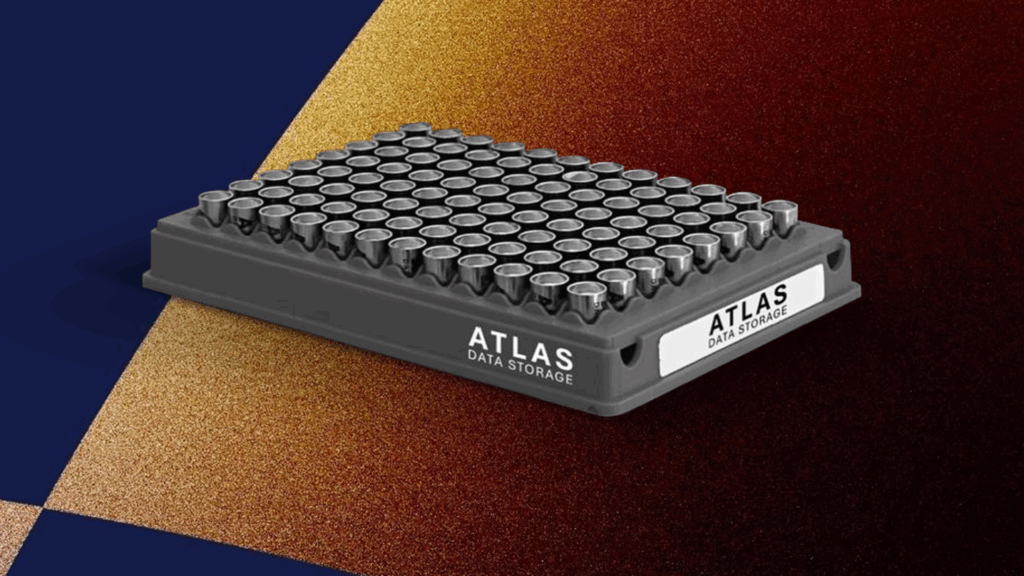
- DNA storage offers unprecedented data density compared to conventional tape and disk media
- Atlas Data Storage relies on custom chips to synthesize DNA for convenient archiving
- Reading of DNA data uses sequencing methods with built-in error correction mechanisms
After nearly a decade of in-house research and commercialization planning, Atlas Data Storage, a spin-off built on Twist Bioscience technology, has outlined a roadmap toward terabyte-scale DNA data storage by 2026.
Atlas Data Storage states that its immediate goal is to demonstrate storage densities high enough to accommodate 13 TB of digital data in a volume described as a single drop of water.
It claims that DNA offers a fundamentally different storage profile than magnetic tape or disk-based media.
Density potential for DNA storage
According to the company, DNA storage provides a 1,000 to 1,500 times improvement in volumetric density compared to standard LTO-10 tape cartridges.
Based on ChatGPT calculations, a standard LTO-10 cartridge has external dimensions of 105.4 x 101.6 x 21.6 mm, resulting in a volume of approximately 231 cubic centimeters.
This corresponds to a native capacity of 40TB and a volumetric density of about 0.173TB per cubic centimeter.
Using these values, a single drop of water, approximately 0.05 cm³, could only store about 8.6 GB, while a volume the size of a 1 cm³ sugar cube could hold approximately 173 GB.
Applying the 1,500x density improvement that Atlas claims, calculations indicate that a single drop of water, around 0.05 cm³, could theoretically store around 13 TB of data, and a volume the size of a 1 cm³ sugar cube could hold more than 260 TB.
These numbers illustrate the density potential of DNA storage and show how it could condense data that would otherwise require thousands of LTO-10 cartridges into very small volumes.
However, the numbers depend on assumptions related to usable volume, error correction, and replication costs.
The Atlas Data Storage system relies on custom chips that synthesize DNA strands that encode digital information, a process described as data writing.
Current prototypes reportedly operate at gigabyte scale, while the next generation is expected to reach terabyte-scale output.
Reading stored data relies on sequencing methods optimized for known DNA formats with built-in error correction, which allows lower costs and faster retrieval than general-purpose sequencing.
Atlas Data Storage presents the combination of synthesis and sequencing as the mechanism that enables practical DNA-based archiving rather than a purely theoretical demonstration.
The company states that DNA stored in sealed capsules at room temperature can remain readable for thousands of years, where copying is done enzymatically rather than mechanically.
This approach avoids periodic media refresh cycles required by tape and reduces long-term carbon output through minimal cooling requirements and lower material turnover.
Although storing 13 TB in a single drop of water matches the theoretical density of DNA, practical implementation will depend on factors such as overhead, redundancy, error rates, and retrieval speed.
Efforts over the last decade have explored DNA’s potential for ultra-dense, long-term digital storage beyond the limits of conventional media.
In 2016, Microsoft took a big step by purchasing ten million strands of long oligonucleotides from Twist Bioscience to experiment with encoding data in DNA.
By 2020, Microsoft, Twist Bioscience and Western Digital had formed an alliance to accelerate development in this area.
Although reports suggest that DNA storage may become available in cartridge form by 2030 and address growing data challenges, practical deployment remains limited at present.
Follow TechRadar on Google News and add us as a preferred source to get our expert news, reviews and opinions in your feeds. Be sure to click the Follow button!
And of course you can too follow TechRadar on TikTok for news, reviews, video unboxings, and get regular updates from us on WhatsApp also.


