
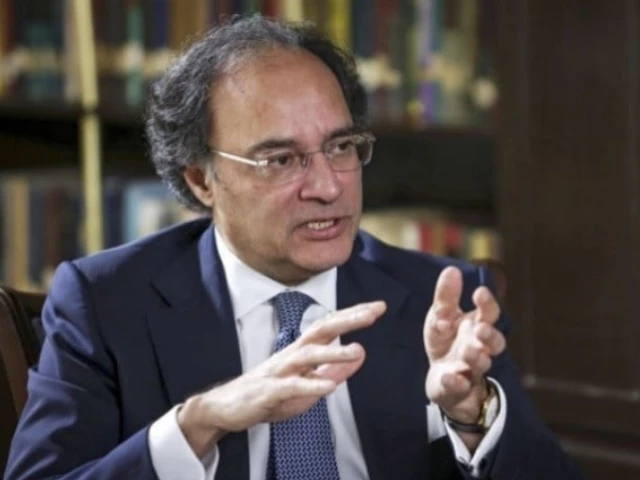
Union Finance Minister Muhammad Aurangzeb. Photo: File
ISLAMABAD:
Finance Minister Muhammad Aurangzeb on Wednesday formally announced energy conservation measures to deal with disruptions in fuel imports as the government considers closing higher educational institutions and fixing fuel prices weekly to deal with the evolving situation.
But the finance minister said the country has sufficient stocks of fuel for this month beyond 10 days of crude oil reserves, stressing there was no immediate cause for concern.
“We are introducing energy-saving measures to curb demand, but there would be no rationing of these products,” the Finance Minister said in a policy statement during a meeting of the Senate Standing Committee on Finance. PPP’s Senator Saleem Mandviwalla chaired the meeting.
We are introducing energy saving measures and would have to self-discipline without creating noise to curb demand, the finance minister said while ruling out the possibility of any rationing of these products.
The finance minister did not reveal these measures, but officials said it has been proposed to shift all higher education institutions to distance learning by closing facilities to save fuel. Another measure will be to set petrol and diesel prices on a weekly basis, ending the current 14-day pricing.
The final set of measures has not yet been approved by the committee, as it would discuss these energy-saving measures again today (Thursday). Prime Minister Shehbaz Sharif is expected to take a decision on Friday in light of the committee’s recommendations, the officials said.
Due to the “evolving situation”, the petrol committee may have to take decisions on an hourly basis and Prime Minister Shehbaz Sharif has empowered the petrol committee to take real-time decisions, Aurangzeb said.
The minister further added that Pakistan has around 28 days of equal stocks of petrol and diesel and 10 days of crude oil. There are also LPG stocks equivalent to 15 days of the country’s requirement and we are monitoring the situation closely, said Aurangzeb, who is also the chairman of the Prime Minister’s committee to monitor petrol prices in the wake of the emerging situation in the region, constituted by the Prime Minister, met for the third time on Wednesday.
However, he said the LNG cargoes have held up from Qatar and the government was closely monitoring the situation.
According to a handout issued by the Treasury Department, gasoline committee members reviewed energy-saving measures as part of broader emergency planning aimed at managing demand effectively while maintaining orderly market conditions.
The committee stressed that even if supply conditions remain stable, prudent energy use and conservation at all levels will help strengthen national preparedness if international uncertainty continues, the Treasury said.
The Committee was informed of ongoing diplomatic and commercial engagement with friendly countries and suppliers in the region to secure additional crude oil and oil supplies where needed. Pakistan has requested Saudi Arabia to supply fuel from the alternative channels to avoid blockade at the Strait of Hormuz.
The committee also noted efforts to diversify procurement opportunities through regional energy hubs, including potential arrangements through ports in the Red Sea and Gulf region, to maintain continuity of refinery operations and ensure supply resilience.
“The committee noted that the international energy environment remains fluid, particularly given the uncertainty surrounding the Strait of Hormuz and its implications for global energy trade,” the Treasury said.
The committee was informed that disruptions to regional shipping routes could affect global LNG logistics. The LPG inflow through cross-border channels is also closely monitored to ensure uninterrupted domestic availability.
The committee also stressed the importance of preventing the hoarding, diversion or smuggling of petroleum products, especially in times of international volatility.
Legislative agenda
After arguments between Muhammad Aurangzeb and PML-N’s Senator Anusha Rahman on the need to stop “abuse of power by the Securities and Exchange Commission of Pakistan, the Standing Committee approved Miss Anusha’s bill with certain changes.
Senator Anusha Rahman highlighted concerns regarding governance and accountability within the SECP, including the retrospective increase in salaries and fees for the commissioners and the composition of the SECP’s policy board.
The committee approved amendments to the SECP Act to reduce the number of private members on the SECP board from six to four and increase the government members from five to seven, despite strong opposition from Finance Minister Muhammad Aurangzeb.
Senator Anusah Rahman said a former SECP commissioner first took Rs 7 million in Islamabad Club membership fee and only paid the money back into the treasury to become eligible for re-appointment. She said such abuse of power was possible only because the SECP political board was complacent.
Miss Anusha also came down heavily on Finance Minister Imdad Ullah Bosal and the Ministerial Act for remaining silent on SECP’s abuse of power. Both secretaries are members of the board.
The Minister of Finance argued that abuse of power by a few individuals should not be a reason to curtail institutional autonomy.


