
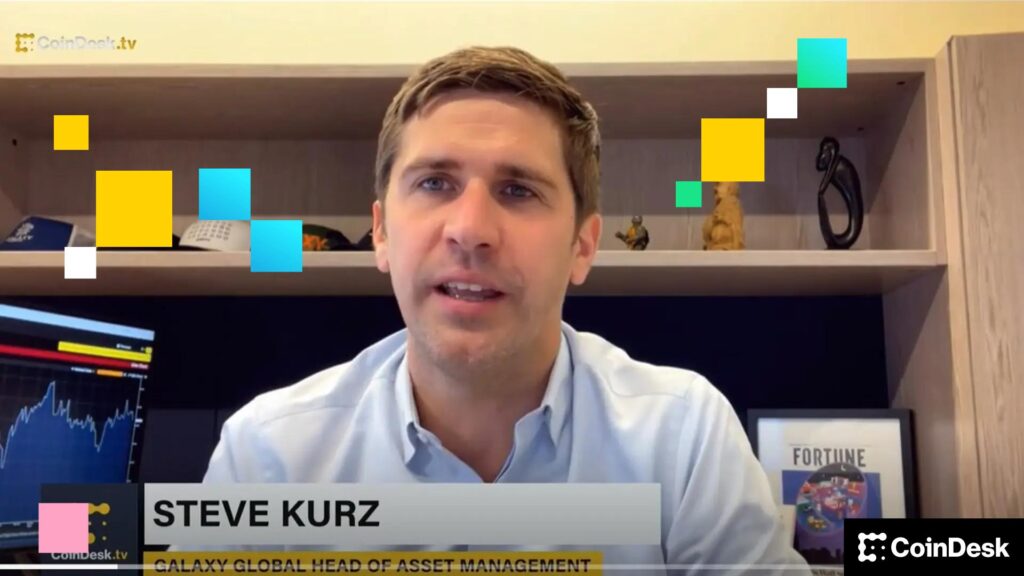
Crypto is no longer just an asset class, it is also an increasingly critical part of financial infrastructure, says Steve Kurz, Galaxy Digital’s ( GLXY ) global head of asset management and co-head of digital assets.
In “The Great Convergence,” the company’s investment outlook for 2026, Kurz lays out a plan that is pragmatic about what can be done now while remaining optimistic about the long-term big picture.
The defining story of this cycle, he argues, is the asset-to-infrastructure transformation.
“The convergence of traditional financial rails with crypto infrastructure represents a significant and sustainable market structure evolution for global financial services,” Kurz told CoinDesk in an interview.
Galaxy Digital, a digitally active financial services and investment firm founded in 2018 by Michael Novogratz, acts as a bridge between traditional finance and the expanding cryptocurrency ecosystem. It offers institutional grade trading, wealth management, investment banking, custody, mining and infrastructure services and increasingly consumer oriented products.
A market caught in overlapping cycles
Kurz characterizes the current environment as one where “many cycles sit on top of each other.”
While the prices of crypto tokens have pulled back significantly, he emphasizes that the levels reached are now below those where many fundamental positive developments have occurred. This disconnect makes it “pretty hard not to scratch your head.”
In his view, the dominant force behind recent price weakness has been the liquidity and leverage cycle.
While the October liquidity event and subsequent deleveraging weighed heavily on markets, it differed from 2022, where liquidations exposed structural weaknesses in a less developed market architecture.
Today’s withdrawal is healthier. The ecosystem now includes more sophisticated instruments and better developed risk management frameworks. The sell-off, he argues, was “a regular wave of deleveraging”, not a systemic collapse at the back end of the system.
Infrastructure is growing rapidly, and prices usually respond only after noticeable increases in activity and adoption, rather than in advance, he said. When onchain activity and engagement picks up again, the story will gather around it.
He allows that “there’s always a possibility of a leg down,” but said most of the dramatic selling has probably already taken place. Sufficient pain has been absorbed that consolidation, range-bound trading or a gradual grind higher are more likely than a V-shaped recovery. His base case is several months of consolidation followed by a firmer move into the second half.
A new regime: crypto on a bigger dashboard
At the center of his thesis: Crypto’s integration into Wall Street’s plumbing. With new connections to traditional finance, crypto is now on a much larger dashboard of global assets, a position that comes with trade-offs.
Capital now flows over a wider set of options, and crypto competes more directly with established assets like gold or emerging themes like quantum technology. The bar for attracting global capital is higher.
According to Kurz, it is proof of maturity. The relationship between crypto and traditional finance is still immature, but is deepening. Public blockchains are increasingly seen as institutional infrastructure. Stablecoins and tokenization are reshaping payments and market structure. The tentacles of crypto infrastructure are spreading across financial services.
This is what he calls a bull market in crypto plumbing. The infrastructure layer – custody, compliance frameworks, integration with banks and fintechs – is clearly on the way forward. And while that may not immediately translate into price increases in the short term, it is fundamentally important to the long-term value of both the technology and the assets built on top of it.
The fusion of asset and technology
The key to the “great convergence” is the fusion of crypto as an asset class with crypto as a technology stack. This integration drives the creation of a larger, more robust onchain economy.
Galaxy remains focused on crypto-native assets and believes that the long-term bridge being built between infrastructure and capital markets is very likely to play out. Kurz is clear: This is not a short-term “buy the dip” trade; it is a multi-year structural change.
Emotion, risks and the underlying process
Kurz notes that the spread between price, sentiment and underlying business activity “has never been greater.” While market prices have struggled, business activity, particularly on the infrastructure side, remains strong. That divergence gives the Galaxy conviction.
He downplays existential fears, such as quantum computers, as immediate threats to crypto’s viability. More generally, he notes that periods of intense negativity often coincide with market bottoms. At the same time, he identifies a more subtle risk: apathy. A loss of relevance in the broader market conversation would be more concerning than the volatility itself.
Bitcoin in his experience, he often acts as a “canary in the coal mine.” Historically, it has been adept at sniffing out macro risk movements before other markets react. It’s possible, he suggests, that BTC sensed broader risk-off conditions and absorbed the pain first. That dynamic can work in both directions.
Having “lived with bitcoin enough,” Kurz believes it can be assessed through a cyclical macro lens. Crypto no longer trades in isolation; it is increasingly intertwined with broader liquidity and risk cycles.
Galaxy’s performance and strategic positioning
Against this background, Galaxy sees strong momentum in its core businesses, especially infrastructure and asset management. At the end of last year, Galaxy had $12 billion in assets on its platform.
On the infrastructure side, Galaxy is doing more than a year ago. It provides technology and payment services to banks and fintech companies, and its ability to integrate services with traditional financial institutions continues to improve.
In terms of asset management, Galaxy is expanding its offerings, including the introduction of a fintech hedge fund designed for wealth and high net worth channels.
The disruption of the financial services market structure represents a “Fintech 2.0” moment and creates investment opportunities in both public and private markets, according to Kurz.
“Galaxy’s Fintech Fund will focus on the public markets winners and losers of the Great Convergence, while Galaxy Ventures will continue to invest in early-stage companies across the globe that are building high-quality, crypto-enabled financial services businesses.”
Institutional allocators, pensions, sovereign wealth funds and other asset owners often view crypto as cyclical. But many of these allocators are now making new capital allocation decisions. Galaxy reports winning business across banks, wealth intermediaries and institutional asset owners, facilitating capital inflows even during a consolidation phase.
Institutional assets under management (AUM) remain a key focus and the firm is experiencing growing engagement from large clients. The gap between subdued prices and stable institutional interest reinforces Galaxy’s long-term thesis.
Owns the Great Convergence
Ultimately, Kurz frames Galaxy’s strategy as “owning the entire story of the Great Convergence,” from crypto rails and onchain infrastructure all the way to public markets and asset management.
The firm positions itself across the stack, capturing both the technological integration of crypto into traditional finance and the financing of crypto-assets.
For 2026, the outlook is measured, constructive. Don’t expect a V-shaped recovery. Expect consolidation, maturation, continued infrastructure expansion. Expect crypto to compete on a wider stage for global capital. And expect the narrative to catch up with the activity once it turns.
In Kurz’s opinion, VVS is being laid for a larger, more sustainable onchain economy. Prices may lag in the short term, but the long-term merger of assets and technology leaves him structurally positive on digital assets and confident in Galaxy’s role at the center of this convergence.
Read more: Deutsche Bank says bitcoin’s selloff signals a loss of conviction, not a broken market


