
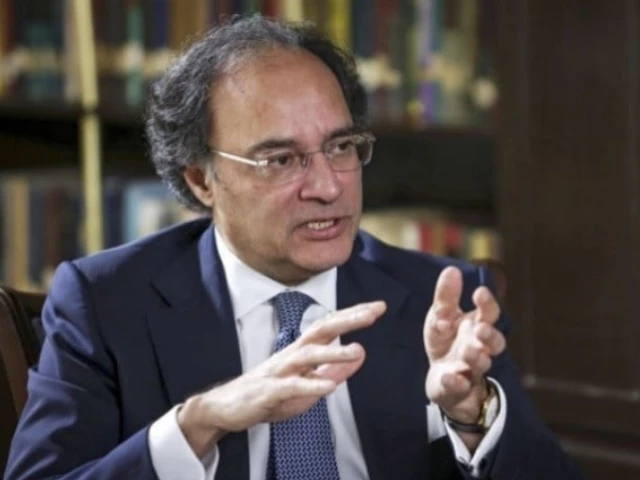
Union Finance Minister Muhammad Aurangzeb. Photo: File
ISLAMABAD:
A special government committee that oversees oil supplies on Thursday discussed introducing a four-day working week with reduced hours and moving educational institutions to virtual learning as part of possible energy-saving measures, amid supply uncertainty linked to disruptions in the Strait of Hormuz.
Officials said the committee was examining the proposal as it remained divided on how far to go in rolling out conservation steps.
Some members warned that measures such as partial closures of offices and institutions could stoke public anxiety and trigger panic buying, while others argued that delaying action could quickly deplete national fuel reserves, leaving little room for maneuver if supply pressures intensify.
The meeting, chaired by Finance Minister Muhammad Aurangzeb, reviewed several proposals aimed at reducing consumption of petrol, diesel and liquefied natural gas (LNG), whose prices have risen following supply bottlenecks and escalating geopolitical tensions.
Despite differences on the pace of action, committee members broadly agreed that the government would not be able to mitigate the impact of rising global energy prices and would have to pass the entire burden on to domestic consumers.
The officials said the majority of the members of the committee were of the view that the government should immediately trigger conservation measures on the lines of COVID-19, but without a lockdown of the markets. Proponents argued that any delay in taking these measures would reduce fuel stocks.
However, the minority cautioned against taking aggressive steps that could upset the public and cause panic buying of these products.
The committee discussed about a dozen conservation measures, some of which did not have the details of how much savings could be achieved by rolling out those steps, the officials said.
The meeting took place on the same day that Prime Minister Shehbaz Sharif appointed veteran bureaucrat Hamed Yaqub Sheikh as the new petroleum secretary. Sheikh has previously served as the Federal Secretary for Finance and his last assignment was the Health Secretary.
Officials said the proposals would now be presented to Prime Minister Shehbaz Sharif on Friday (today), after which a summary could be submitted to the Economic Coordination Committee (ECC) of the Cabinet for approval.
Four day week, online schooling
The officials said the committee was discussing the possibility of switching to four days a week with reduced working hours. There was also a proposal to close all educational institutions and switch to a virtual form of learning, as in the Covid-19 period.
At present, there was no serious proposal to stop public transport, said one of the meeting participants.
Another proposal suggested reducing government fuel quotas to preserve national stocks, currently estimated to cover no more than 25 days.
Sources said the finance minister also suggested adopting a cascading approach instead of implementing all conservation measures abruptly.
Meanwhile, officials said the government was also in discussions with Saudi Arabia, Oman and the United Arab Emirates to secure new contracts or maintain existing supply arrangements through alternative routes.
Officials from Pakistan State Oil, Pak Arab Refinery Company and Pakistan Refinery Limited were also scheduled to hold meetings with their counterparts in Saudi Arabia as part of efforts to replenish stocks.
However, the committee was informed that even if Pakistan secures new agreements, they may not be economically viable. Members were told that an LNG cargo can now cost around $70 million compared to the pre-war price of around $30 million.
The government ensures sufficient fuel stocks
A handout issued by the finance ministry said the committee reviewed several supply and price scenarios to ensure preparedness under various contingencies while maintaining stability in domestic energy supplies.
In this context, “the committee noted that war premium dynamics and intensified competition for energy cargoes, especially in Asian markets, could increase pressure on external accounts if volatility continues,” the ministry stated.
It added that members discussed contingency options to manage demand effectively if disruptions continue while protecting priority sectors and maintaining orderly conditions.
Consistent with broader emergency planning, the committee examined a tiered menu of fuel-saving measures, drawing on institutional protocols implemented during previous national emergencies to support demand management if needed, while carefully calibrating communications to avoid any perception of undue alarm, the Treasury Department said.
It was further decided that the committee will finalize its recommendations by Friday and submit them to the Prime Minister along with a comprehensive implementation plan covering security of supply, enforcement, pricing, governance mechanisms and conservation measures, as applicable.
Members were briefed that national fuel reserves remained at comfortable levels, with adequate coverage available for key products and that there is no immediate cause for concern regarding the availability of petroleum products.
However, the committee noted that the situation remains fluid and uncertain, requiring continued vigilance and prudent planning as global supply chains and shipping routes face increased risk and cost pressures, according to the Treasury Department.
Updates were shared on diplomatic and commercial engagements being pursued with friendly countries and partner suppliers to secure additional crude and refined product volumes through alternative routes and ports, including options outside high-risk corridors.
To ensure orderly market conditions, the committee discussed measures to deter hoarding, illegal storage and diversion, including coordinated enforcement measures by provincial administrations in close collaboration with Ogra and relevant agencies.
The Committee stressed that prevention of outward-facing smuggling and ensuring uninterrupted domestic distribution will continue to be a top operational priority, and that real-time field intelligence and strict enforcement against violations will be maintained.
In his remarks, the finance minister emphasized that the government’s foremost objective is to ensure uninterrupted availability of petroleum products across the country, and that availability will remain the primary driving force for all political and operational decisions.
Aurangzeb emphasized that the government is managing the situation responsibly through a structured governance mechanism with daily monitoring, scenario planning and coordinated decision making.
The Finance Minister noted that where international price movements create unavoidable pressures, the government will respond through established and predictable mechanisms aimed at avoiding distortions and maintaining market stability.
The government orders inspections to curb hoarding
Separately, the federal government directed provincial administrations to conduct physical inspections and monitoring of retail petrol stations through deputy commissioners to prevent hoarding of petroleum products and curb profiteering.
The directive came as the government assured the public that Pakistan currently has sufficient oil reserves to meet national demand.
The Oil and Gas Regulatory Authority (Ogra) said the country’s reserves remain comfortable and within prescribed limits and urged consumers to avoid panic buying as authorities continue to closely monitor the fuel supply chain.
Officials said the surveillance measures were taken after reports suggested that some elements may be trying to hoard petroleum products to take advantage of the ongoing geopolitical situation.
Ogra warned that strict action would be taken against any person or entity involved in illegal storage of petroleum products outside licensed petroleum depots or authorized retail outlets. Any place found where fuel is illegally stored will be sealed.
The regulator also said its inspection team was actively monitoring depots and retail stations across the country to ensure uninterrupted supply and prevent malpractice.
Provincial Chief Secretaries have been directed to direct Deputy Commissioners to carry out inspections within their jurisdictions.
Officials say Pakistan currently has oil reserves sufficient to cover approximately 28 days of national consumption, although two crude cargoes have reportedly been delayed due to the Hormuz outage.
Sources said Saudi Aramco and the UAE’s ADNOC are expected to help deliver oil shipments through alternative routes, while one refinery has already received shipments through the Red Sea and additional vessels are on the way.
The government is also considering several contingency measures to stabilize the market, including moving the oil price review from a 14-day to a weekly mechanism, providing financial cover to oil marketing companies to support imports, and implementing energy-saving measures such as encouraging work from home.
The latest estimates suggest that petrol and diesel prices may rise by Rs 25-50 per liter if the weekly price revisions come into effect from March 8.
Industry stakeholders worried
Despite official assurances, industry stakeholders have expressed concern over supply disruptions.
The Oil Marketing Association of Pakistan (OMAP) warned Ogra that local refiners had deviated from previously agreed delivery commitments and introduced an allocation system that reduced deliveries to oil marketing companies.
According to the association, many companies had planned their supply strategies based on previous commitments and therefore did not arrange import loads.
OMAP said that while refineries reported having sufficient inventories, they supplied significantly reduced volumes, causing the mandatory 21-day inventory coverage maintained by oil marketing companies to steadily decline.
The association warned that if the situation continued, inventory levels could soon reach critical levels and responsibility for any supply shortfall would lie with both refiners and the regulator.
Petroleum traders also sounded the alarm over falling supplies. Leaders of the Pakistan Petroleum Dealers Association said that diesel supplies had fallen sharply, while petrol supplies had also been reduced significantly.
They warned that if the supply situation did not improve, petrol pumps could start shutting down within days.
Traders urged the government to focus inspections on supply depots rather than retail pumps and called for immediate restoration of supplies. They also requested that industry stakeholders be taken into confidence in light of the regional crisis.
A separate letter from the All Pakistan Petrol Pump Owners Association to Prime Minister Shehbaz Sharif warned that oil marketing companies had reportedly introduced a quota system amid the Middle East crisis that limited supplies to petrol stations.
The association said such limits could lead to a shortage of retail outlets if corrective action was not taken quickly.
However, the authorities insist that the country’s fuel supply will remain stable for the time being. Analysts say the situation will largely depend on how long regional tensions persist and whether critical oil shipping routes remain disrupted.


