
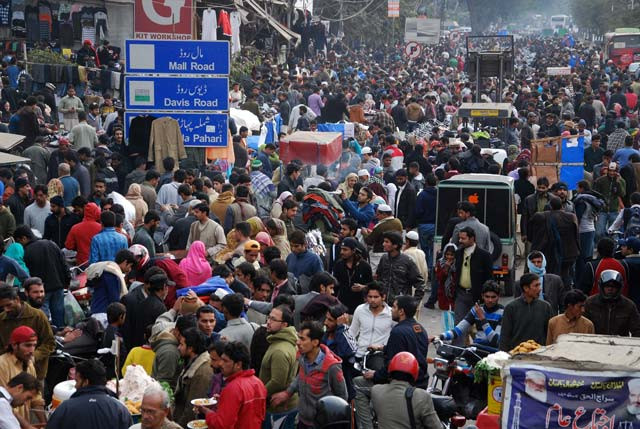
Experts believe that a comprehensive solution is required to address the city’s population crisis
KARACHI:
The Sindh government is working on a new master plan for Karachi, titled the Greater Karachi Regional Plan 2047. Although the main features of this plan have not yet been revealed, experts believe that the increasing population pressure on the city poses a major challenge to urban planning.
According to official statistics, Karachi is the only city in the country whose population has increased 44 times since the creation of Pakistan. At the time of independence, Karachi’s population was 450,000, but it has now risen to over 20 million. According to the 2023 census, Karachi’s population grew by 4 million in just five years, from 14.8 million in 2017 to 18.8 million in 2023.
A recent report by an organization affiliated to the World Bank stated that Pakistan’s overall annual population growth rate is 1.5 percent, while that of Karachi is 6 percent. According to the same report, Karachi’s population will reach 28 million by 2030. Urban planning expert Zahid Farooq believed that sustainable urban planning was contingent on reducing the population pressure on Karachi.
“For this, it is necessary to provide employment opportunities to migrants in their own regions. The main reason behind Karachi’s rapid population growth is the influx of people from KP and other areas in search of jobs because Karachi offers more employment opportunities compared to other cities,” Farooq noted.
Reportedly, no other major city in the country has experienced such a sharp increase in population, mainly due to migration. In fact, the population of Peshawar, the capital of Khyber-Pakhtunkhwa (KP), has decreased by 1.9 million since a large number of people migrated to Karachi in search of livelihood, more than from other regions of the country.
According to the Karachi Strategic Development Plan 2020, the rapid population growth in the city is primarily due to internal migration, where people from different parts of the country move to Karachi for employment. In addition, a large number of Afghans, Bangladeshis and people from other Asian countries also reside in the city.
Farooq added that although several master plans have been developed for Karachi over different periods, none have been implemented due to political reasons. “The Greater Karachi Regional Plan 2047 is a positive step, but such a plan should not be prepared only in a drawing room and instead be made public. The plan should be discussed at all levels, from the Sindh Assembly and City Council down to the Union Councils, while incorporating feedback from experts across various fields,” Farooq pleaded.
Pakistan People’s Party Karachi leader Senator Waqar Mehdi informed that Greater Karachi Regional Plan 2047 was developed under the supervision of international experts to ensure better urban planning and meet the needs of the city for the next 50 years. “Given the rapid growth of Karachi’s population, a comprehensive master plan is essential. The new plan will also take into account previous master plans,” Mehdi asserted. It is worth noting that although several master plans for Karachi have been formulated since the creation of Pakistan, not a single one has ever been implemented. After the country’s formation, the Greater Karachi Plan 1952 was developed but never implemented. Later came the Karachi Development Plan 1974-1985 which also remained unimplemented.
Then in 2007, during the tenure of former President General Pervez Musharraf, the Karachi Strategic Development Plan 2020 was drawn up, but its implementation failed yet again. According to the Karachi Strategic Development Plan 2020, the city is administratively divided between 20 federal, provincial and local institutions, and the Karachi Metropolitan Corporation (KMC) controls only 31 percent of the city.
The plan says that apart from the Sindh government, various federal entities also have administrative control over parts of the city, including six cantonments, Defense Housing Authority, Port Qasim, Karachi Port Trust, Pakistan Railways, Pakistan Steel Mills and Export Processing Zone, among others.


