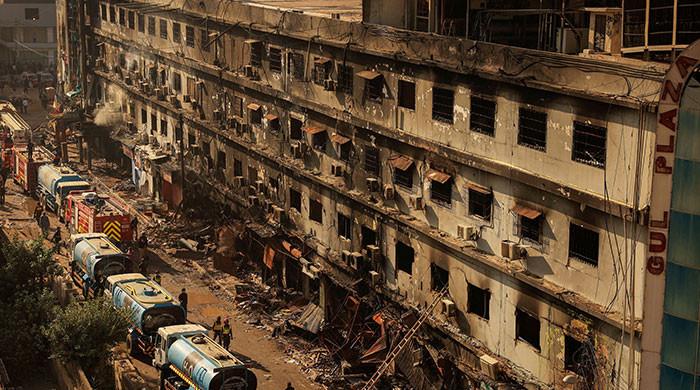
Again I feel compelled to write about a big fire in a big city. It is not the Gul Plaza fire and the city I am referring to is not Karachi.
Although it is the Gul Plaza fire that has made me remember another event that I think is relevant to what has happened to Karachi in the wake of a terrifying tragedy.
The story I want to talk, starting this week, is not about the Baldia factory fire in Karachi in 2012, which was more atrocious than the Gul Plaza fire. Over 250 workers were burned to death in the Great Fire, which was actually a deliberate act, and the date they chose was ominous: September 11 – 9/11, as they put it in the US.
So which big fire in which big city?
Well, the fire became known as the Triangle Shirtwaist Factory fire and the incident took place in March 1911, more than a century ago, in the city of New York. As many as 146 garment workers, most of them immigrant women, died when the factory, located on the eighth floor of a building, caught fire. Many of those who lost their lives had jumped from that height.
Naturally, the entire town was shocked by an event that was unbearably heartbreaking. My intention here is to provide some glimpses of how the city and its people responded to their deadliest industrial disaster. Many thousands had seen the bodies lying on the road in pools of blood. It was something that the city cannot forget, and commemorative events are already being held.
Let me quote some words from a Google account of the funeral procession: “In a profound show of solidarity, an estimated 350,000 to 400,000 people took part in a funeral march in the pouring rain for the unidentified victims”.
Just try to make a mental picture of what that scene would look like.
A commission was established and over 30 new labor laws were issued. But the real answer was evident in the field of arts and culture. The Triangle Shirtwaist Factory brand inspired documentaries and television productions and music and dance and literature. Even until recent years, it has featured in feature films and novels. That tragedy still touches hearts and stirs minds.
As I said at the beginning, I had invoked the New York fire disaster of 1911 earlier in this room. I then compared it to the Baldia fire to emphasize the differences the two tragedies had evoked in their respective cities. In some ways, the Baldia fire had raised more complex questions about governance and the power structure of the state. It therefore required drastic changes and readjustments on many different levels.
But what happened after the Baldia fire? A human tragedy of such magnitude – the miserable death of over 250 workers – was, apparently, quickly forgotten. The affected families and a number of trade unions and social activists certainly took up the case for the innocent victims and the issue was intermittently raised in the media. Yet the collective conscience of the city did not wake up.
The question now is: what will be the consequences of the Gul Plaza disaster? In the immediate context, the event and its bloody details that have continued to unfold have been widely covered by the media. Reports indicate widespread outrage across various sections of society. There is a constant focus on the lapses on the part of provincial and local governments that have led to such a terrible loss of life and property.
At the same time, it feels like a disaster of this nature is always waiting to happen due to the poor state of the entire infrastructure and the blatant violations of relevant legal obligations across all areas of public life. Footprints of corruption are evident on every road.
As it is, Karachi has long been at a breaking point. It is generally recognized as the engine of growth for the entire country. But it cannot long remain so if its public utilities are not repaired and improved. The city’s public institutions are visibly in disrepair.
While the catastrophic fire in Gul Plaza has lessons to be taken seriously by the city’s concerned administrators, it has also provided new opportunities for divisive politics. An attempt is being made to revive old enmities and exploit popular anger for partisan purposes.
All this suggests that the Gul Plaza fire is unlikely to be a catalyst for change in how Karachi is governed. Apparently it will be business as usual. But when I chose to mention the example of the Triangle Shirtwaist Factory fire in New York, I also had the general public and the behavior of the intelligentsia in mind.
Where are the concerned citizens of Karachi and what kind of affiliation do they have with this city? What was their involvement in the 2012 Baldia fire and how do they now relate to the mass death caused by the Gul Plaza fire? In moral and psychological terms, do the citizens of Karachi constitute a smaller community than, for example, New Yorkers?
I don’t know what to do with these and other questions. It can be said that it is meaningless to compare e.g. New York and Karachi in terms of how they have responded to particular events. It is possible to argue that we live in separate worlds.
So let’s settle for the life we live in Karachi. We have seen the Gul Plaza fire dominate the media this week and what is being revealed is very disturbing. At the same time, we are also extraordinarily busy with our social activities, it is the season of festivals and celebrations.
The author is a senior journalist. He can be found at: [email protected]
Disclaimer: The views expressed in this piece are the author’s own and do not necessarily reflect Pakinomist.tv’s editorial policy.
Originally published in The News