
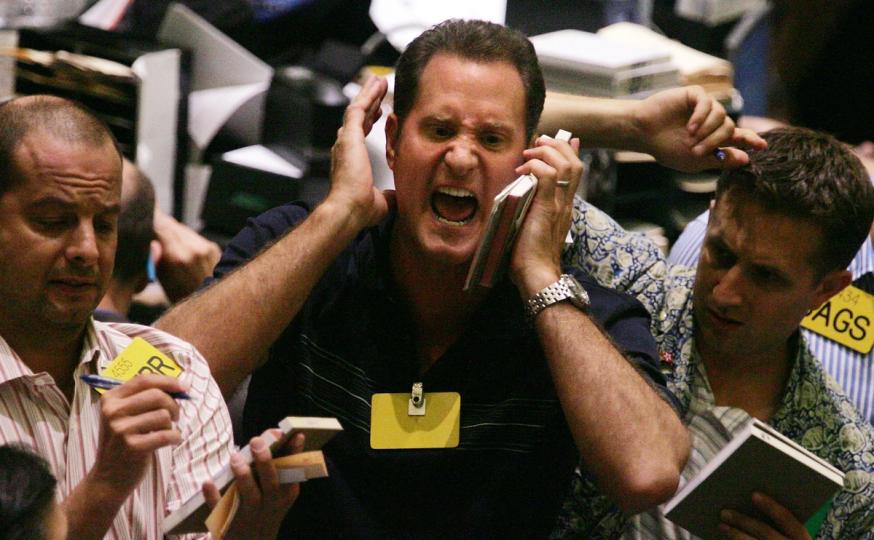
“This is absolutely INSANE.”
While the comment came from a social media post, the painful knee-jerk is likely resonating across the board for anyone even remotely interested in crypto, as bitcoin just dropped to nearly $77,000 on Saturday and has held there ever since.
The price of the biggest digital asset didn’t just stumble; it dived through the $80,000 floor, hitting levels not seen since the April 2025 “tariff strikes”.
By Saturday afternoon, in thin weekend liquidity, at just over $77,000, bitcoin had seen a staggering $800 billion in market capitalization disappear since the peak in October above $126,000, and about $2.5 billion in leveraged long positions liquidated in 24 hours.
The wipeout has even pushed bitcoin out of the global top 10 assets, where it had been for a long time, now trailing institutional heavyweights like Elon Musk’s Tesla and Saudi Aramco.
To say this sale has been painful would be an understatement as social media is in full panic mode and everywhere you look there is blood on the streets. And this is not just isolated to bitcoin; this week has been painful across all asset classes, from tech stocks to precious metals.
If you’re wondering why the “digital gold” narrative has suddenly gone silent, here’s the breakdown of the three-headed monster currently driving the market into a state of “Extreme Fear.”
1. Geopolitics rattles the “security” deal
The immediate spark Saturday was a literal explosion. Reports of a potential major military escalation between the US and Iran sent risk appetite into a deep freeze. In a repeat of a familiar script, traders did not treat bitcoin as a safe haven; they treated it as a source of liquidity.
In times of war, investors typically engage in a “flight to safety” by moving capital into the US dollar. Because bitcoin is a 24/7 market, it often acts as the “first responder” to global panic. On Saturday, it acted as the world’s ATM, selling to cover losses and find safety amid a thin weekend with low liquidity.
Not to mention that since the October 10 crash (which has many pointing fingers at Binance), liquidity has never recovered, making market dynamics even more fragile heading into this weekend.
2. Gold and silver face a ‘hard money’ reset
Bitcoin was not the only victim this week. The wider “store of value” trade came under siege. Gold plunged 9% in a single trading session on Friday to just below $4,900, while Silver suffered a historic 26% crash to $85.30.
In a bizarre twist, the traditional “safe havens” of gold and silver are being sold alongside crypto. Analysts suggest that the massive rise in the US dollar – ignited by the appointment of Kevin Warsh to head the Fed – has made these dollar-denominated metals too expensive for international buyers, leading to massive “de-risking” across all hard assets.
In early Sunday trading, both gold and silver bounced from the difficult Friday by 1% and 3% respectively. Currently, gold is trading near $4,730 and silver around $81.
3. the ‘liquidation trap’
The geopolitical shock hit a market already “beaten” by Washington’s changing political landscape. When the price fell, it triggered a massive mechanical crash in the markets.
According to data from Coinglass, over $850 million in bullish bets (long positions) were wiped out in a matter of hours on Saturday as prices began to crumble, eventually totaling nearly $2.5 billion. These liquidations occur when traders borrow money to bet that the price will rise; when the price hits a certain “trap door”, sellers automatically exchange their holdings to repay the debt. This creates a “domino effect” — foreclosures lead to lower prices, which trigger even more liquidations. Across the board, nearly 200,000 traders had their accounts “blown up” on Saturday.
4. Michael Saylor’s very bad day
To make matters worse, bitcoin’s price briefly fell below Michael Saylor’s strategy (MSTR) average entry point of approximately $76,037, putting his massive bitcoin stack “underwater.” Panic set in that he might be forced to sell his stash, making the sale even more deadly.
However, CoinDesk dismissed this theory, explaining that Saylor will not be forced to sell his bitcoin holdings, as none of his coins are pledged as collateral. What it does mean, however, is that it will hinder his ability to raise cheap capital to buy more bitcoin on the open market.
Although Saylor later came out and signaled that he would “buy the dip, the damage was done. The market realized that if a large company such as Strategy cannot raise more capital to buy bitcoin on the open market, the already fragile market will be left without buyers and vulnerable to liquidations and profit-taking.”
As a result, sentiment has shifted from “moonshot” optimism to defensive hedging as investors rush to buy price insurance in the options market against further slips towards $75,000.
5. Wall Street on edge: US futures turn red
The contagion is already seeping into traditional finance.
While the New York Stock Exchange is closed for the weekend, US Stock Futures, which opened for trading on Sunday evening (US EST), are lower across the board; The Nasdaq is down 1% and the S&P 500 is down 0.6%.
Get ready for a potentially messy Monday!
6. Whales vs. world: a tale of two investors
Perhaps the most telling part of this crash isn’t the price; it is the wallet data.
According to Glassnode data, small investors are running. “Small Fish” (holders with less than 10 BTC) have been selling bitcoin continuously for over a month. They capitulate, spooked by a 35% decline from the $126,000 all-time high.
Meanwhile, “mega-whales” (those with 1,000+ BTC) have been quietly adding to their stacks. This cohort is now back at levels not seen since late 2024, effectively absorbing the coins that panicked retailers are dumping. Although their purchases were not significant enough to move the price up.
7. Bigger Picture: The Inevitable Human Greed
Now let’s zoom out and compare this weekend’s sales and current market dynamics to those that played before.
To be clear, this cycle is not all doom and gloom. The likes of BlackRock and JPMorgan in traditional finance have gone all in on crypto through exchange-traded funds and stablecoins. Regulatory frameworks are being created around the world to make crypto more accessible and usable to the masses, and many legitimate crypto companies are trading publicly and becoming part of many fund managers’ “must-have” stock allocations. None of these were even remotely conceivable during previous cycles.
But the parallels between the last four months and the beginning of the crypto winter in late 2021/early 2022 may be growing, and while the names and methods may have changed, human behavior and the boom-bust nature of the markets have not.
The likes of Three Arrows Capital, Do Kwon and TerraUSD, BlockFi and Sam Bankman-Fried may have been replaced by the Trump family’s alleged bare-bones profiteering, Michael Saylor’s massive purchases and promises of an 11% risk-free rate in a 3% risk-free rate world, and well-followed crypto Twitter personalities teaming up with digital Twitter investment banks teaming up with digital investors. companies.
As in 2021, this new dynamic has probably created a speculative bubble that is likely to have collapsed in 2026. The only question now is how long and deep the downturn will be.
Although no one has fond memories of the crypto winter of 2022 – when the price of bitcoin fell 80% – the timeline was relatively short, about a year from top to bottom. From there, bitcoin quickly doubled in price, rising through 2023 and ultimately hitting a new record high in early 2024.
In theory, if there was another 80% drop from the October 2025 high of $126,000, bitcoin would be around $25,000. That’s a scary number to think about, but it may be necessary to wipe out the worst of this past bull market rift and clear the decks for another sustained run higher.
The end of the 2022 bear market came not long after the collapse of FTX and the arrest of its CEO, Sam Bankman-Fried. Whether wristbands will be necessary for any of this cycle’s bull market personalities remains to be seen.
“It’s only when the tide goes out that you discover who has been swimming naked,” said Warren Buffett. The tide may not be out yet, but it sure feels like it’s heading that way.
Read more: How instant gratification is sucking the air out of the bitcoin market


