
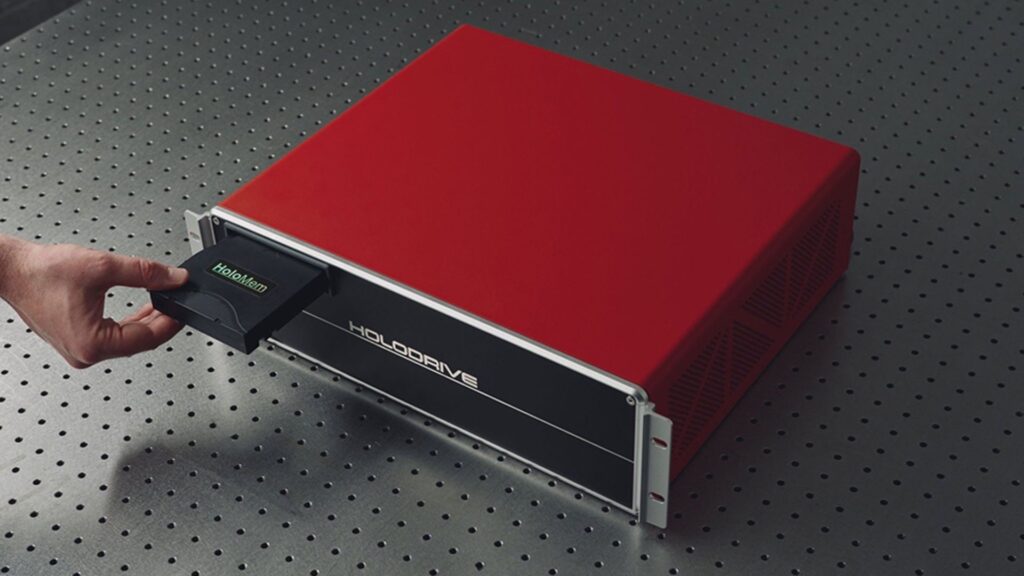
- Holographic tape driven inside a production LTO library without infrastructure changes
- Live application software accessed holographic media using standard tape library workflows
- The dimensions of the cartridge matched the LTO, allowing robotic handling without modification
A UK startup has tested a holographic tape storage system inside a working LTO tape library, showing it can run within existing data center setups.
The testing of the HoloMem involved real software writing data to the system and reading it back through normal tape library operations.
Both traditional LTO drives and holographic drives ran side by side in the same library, which is important because many storage ideas fail outside of controlled test environments.
Testing shifts the focus from concept to implementation options
The system uses polymer tape cartridges that match the size and shape of standard LTO tapes – because of this, the tape library’s robotic arm can move and load them without physical changes.
The holographic drives fit into the library as shelf units, allowing the robot to select between LTO tapes and holographic cartridges based on the request it receives.
From the software side, everything appears as one unified system rather than separate platforms.
Each cartridge is designed to hold up to 200 TB of data in a write once, read many formats, meaning the data can be stored permanently and accessed repeatedly.
The storage method relies on layered holographic recording using relatively inexpensive laser components.
Its capacity figure is a design goal for production hardware rather than a laboratory maximum, and the WORM characteristic aligns with compliance-driven archiving requirements.
Lifetime claims extend beyond 50 years, although implementation focused on functional operation rather than accelerated aging validation.
The value of the trial lies less in raw density and more in demonstrated compatibility, as many alternative archival media platforms require new library designs, new handling systems, or new software layers, slowing procurement and certification.
In this case, the holographic drive was added to an existing tape library without replacing hardware or rewriting software.
HoloMem says this result supports its plans to move towards commercial readiness, with more pilot installations planned while technical work continues through 2026.
“This is a major step forward for the commercial viability of future fit cold data storage, and the results are very exciting,” said Charlie Gale, founder and CEO of HoloMem.
“New technology solutions must be integrated with legacy infrastructure to fulfill their potential, and we are pleased to have proven HoloDrive’s deployability within BDT’s library.”
Mass production of the drive hardware is planned for 2027, placing this system closer to everyday use than silica or ceramic storage technologies that remain difficult to integrate into data centers.
“What HoloMem has achieved is so impressive. By developing a plug-and-play holographic solution compatible with our tape libraries, HoloDrive enables so many use cases for many in the industry,” said Marc Steinhilber, CEO of BDT Media Automation GmbH.
The test doesn’t prove long-term reliability or large-scale cost-effectiveness, but it does show that holographic tape can be added as another layer of storage without disrupting current systems.
Based on what has been demonstrated so far, its credibility depends on whether the production hardware performs as it did in this live implementation.
Via Blocks and files
Follow TechRadar on Google News and add us as a preferred source to get our expert news, reviews and opinions in your feeds. Be sure to click the Follow button!
And of course you can too follow TechRadar on TikTok for news, reviews, video unboxings, and get regular updates from us on WhatsApp also.


