
With the same unhealthy food served to all, patients suffering from nutritionally sensitive conditions
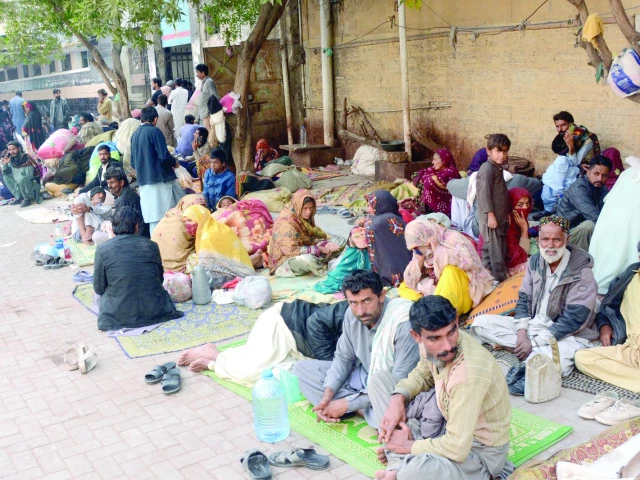
Hosts of out-of-town patients camp in an open space at the Civil Hospital due to lack of free shelter. Photo: Jalal Qureshi/Express
KARACHI:
In many branches of alternative medicine, food is seen as nature’s medicine. Certain foods are proven to support specific health conditions, while others are known to contribute to common lifestyle diseases. But in Karachi’s district hospitals, where patients are served generic meals, food has become a source of harm rather than healing.
While hospital meals globally are being tailored under expert guidance, patients in Sindh’s public hospitals often complain that the food is nutritionally inadequate. Many hospitals provide only one meal a day, and over the past decade, hospital administrations have closed in-house kitchens and outsourced cooking to private contractors. In the past, hospitals hired kitchen staff to prepare meals, but now 90 percent rely on contractors who are unaware of patients’ individual nutritional needs.
Food budgets in public hospitals are tied to the number of beds, and administrators often try to limit patient admissions to reduce spending on food and medicine. The Danish Health Authority issues tenders for meals, including fixed menus, after which the hospitals award contracts to companies that offer the lowest price. Contractors typically prepare food in their own kitchens, although some use hospital kitchens with their staff. No system exists to control the quality of the meal and the food is delivered without guidance from nutritionists.
Although contractors claim to provide mutton twice a week, fish once and vegetables and lentils on other days, patients complain that hospital food feels plain, lacks nutrition and is served in a humiliating manner. Meals are delivered in steel carts, curries in open buckets, and hygiene standards are ignored, prompting many patients to bring food from home. Despite hundreds of millions of rupees being allocated annually for patient meals, complaints are still common.
At Saudabad Hospital, a patient, Muhammad Aslam, confirmed that meals were the same for everyone and were sometimes overly spicy, making it unsuitable for his blood pressure. Another patient, Shafiq Ahmed, added that there was no system to monitor the food quality or ensure it meets the patient’s needs. Similarly, Akhtar Baloch at Lyari General Hospital described receiving only lentils and vegetables for four consecutive days, regardless of his medical conditions.
Lyari General Hospital has over 300 beds, a meal budget of Rs45 million, a partially outsourced kitchen, no dietician and patient occupancy over 50 percent. Liaquatabad Hospital, with 200 beds, allocates Rs27 million for meals and outsources food through the lowest bidder, even without a dietician. New Karachi Hospital, also 200 beds with a Rs10 million meal budget, and Korangi Hospital, with 200 beds and a Rs40 million budget, follow the same model and both report 50 to 60 percent patient occupancy.
In contrast, some larger hospitals maintain more structured food services. The Civil Hospital, with a budget of Rs200 million and over 90 per cent patient admissions, prepares meals in-house under the supervision of a nutritionist and offers mutton, fish, vegetables, lentils, boiled eggs and bread. Jinnah Hospital, with 2,000 beds and a budget of Rs.200 million, runs a scientifically managed kitchen where private dieticians supervise the preparation of meals keeping in mind high and low protein requirements. Although the government dietitian post has remained vacant due to legal issues, private experts are ensuring proper nutrition to the patients with an occupancy rate of around 95 per cent.
Despite significant funding, the majority of Karachi’s public hospitals struggle to provide adequate, hygienic and medically appropriate meals. Patients continue to face uniform, low-quality food, often delivered by contractors unfamiliar with individual dietary needs. While a few large hospitals follow professional guidelines under dietician supervision, the prevailing system in most district hospitals leaves patients unsatisfied, underscoring the urgent need for trained nutritionists, proper kitchens and quality control to ensure hospital meals meet both health and hygiene standards.


