
Field Marshal says future leaders must remain alert to recognize and address such multi-layered cognitive challenges
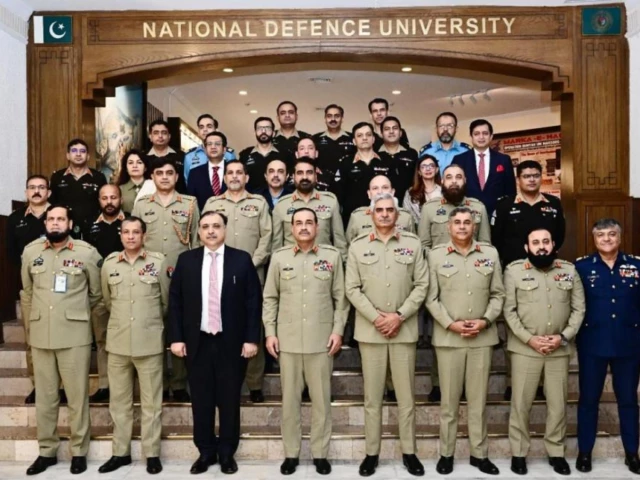
Chief of Defense Staff Field Marshal Asim Munir poses for a group photo with the faculty and staff of the National Defense University during his visit to the institution in Islamabad on Tuesday. Photo: ISPR
Defense chief Field Marshal Asim Munir said the country faces far-reaching and persistent challenges, warning that hostile elements are increasingly adopting indirect and ambiguous tactics – including the use of proxies – to exploit internal fault lines rather than engage in direct confrontation.
Chief of Defense Forces (CDF) Field Marshal Asim Munir made the remarks during his visit to the National Defense University (NDU) where he interacted with civilian and military participants of the ongoing National Security and War Course, according to a statement issued by the Inter-Services Public Relations (ISPR) on Tuesday.
During the interaction, CDF Munir outlined the evolving global, regional and internal security environment and said the country faces “broad and persistent challenges”.
Read: Gunmen kill five policemen in KP ambush
He said these challenges spanned “conventional, subconventional, intelligence, cyber, information, military, economic and other domains”, requiring “comprehensive multi-domain readiness, continuous adaptation and synergy between all elements of national power”.
The field marshal warned that hostile elements are “increasingly employing indirect and ambiguous approaches, including the use of proxies to exploit internal fault lines, rather than open confrontation”, stressing that future leaders must be trained and remain alert to “recognise, anticipate and counter such multi-layered cognitive challenges”.
He also emphasized the importance of decision-making under uncertainty, saying that “clarity and intellectual robustness are critical attributes for functioning in today’s contested and diffuse security environment”.
Similar to the National Defense University’s role, the army chief described it as a premier institution for developing strategic thinkers capable of translating “rigorous training and academic insight into effective policy formulation and operational outcomes”.
Also read: Pakistan, Libya sign multi-billion dollar arms deal
He added that professional military training “remains central to strengthening institutional capacity, advancing indigenous capability and ensuring long-term national resilience”.
Concluding his speech, the Field Marshal appreciated the panels’ “sharp analysis and conclusions” and urged the participants to remain “vigilant, adaptable and steadfast in upholding the values of integrity, discipline and selfless service”.


