
.
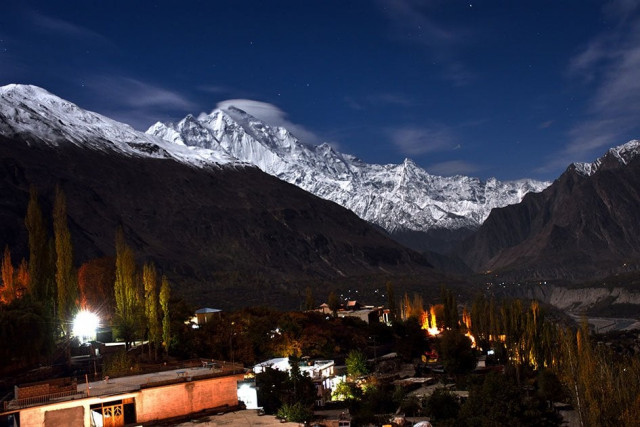
The HUnza valley in the moonlight. PHOTO: EXPRESS
HUNZA:
Every winter for decades, the pool in front of Aleena Gul’s house in Pakistan’s Hunza Valley is transformed into an ice rink, framed by jagged Himalayan peaks and the stone walls of Altit Fort. This year it didn’t.
Gul can see the swimming pool that doubles as a hockey arena from her bedroom. For years, she woke up at dawn, laced up her skates and stepped straight out her front door onto solid ice.
After four years away at university, she returned eager to play again, but has found herself waiting for winter to arrive.
“There is a big difference between 2018 and now,” said Gul, 21, captain of her team and among the first women in Hunza to take up the sport.
Across Pakistan’s northern mountains, winters come later and behave unpredictably. Cold periods are shorter, freeze-thaw cycles are unstable.
In the wider Hindu Kush-Himalayan region, scientists report fewer extreme cold events and shorter snow seasons; what the locals call a “snow drought” when snowfall doesn’t let up.
The change is visible in Hunza. Data collected by WeatherWalay, a climate analysis platform, shows that average winter precipitation has fallen by about 30% since the late 2010s, marking four consecutive years below normal.
Some recent winters have also been 2-3°C milder, so there is less snow to maintain the ice. Unlike European resorts with artificial snow, Hunza’s tournament depends entirely on natural ice. In a valley heavily dependent on tourism, winter sports now depend on weather that no longer follows old rhythms.
For eight seasons, Altit’s pool has hosted the Karakoram Interlude, a community-run tournament that draws teams from across northern Pakistan and extends the tourist season beyond the summer.
In good years, the rink lights up under floodlights, spectators lean over stone railings, teacups in hand, their breath rising in white clouds.
This year, organizers prepared the rink as always, pouring water at night and smoothing the surface by hand to allow temperatures below -20°C to set the layers. “We stayed up until 3 a.m. to help it freeze,” Gul said.
“We’re doing everything we can.” By 2024, “we started seeing a sudden change in weather patterns like snowfall, freezing temperatures and overall temperatures,” said Sadiq Saleem, 31, president of Altit Town Management Society and a founding member of youth organization SCARF, which pioneered ice hockey in the valley.
Thin puddles formed where the leaves scratched the ice. Hairlines spread below the surface. The organizers pressed their palms against the ice, checking for flex and listening for cracks.
“We worked in this arena for a week,” said Naseer Uddin, 34, co-founder of SCARF. “But when the sun came out strong, it destroyed everything.”
The opening ceremony took place under floodlights, but organizers warned that the rink was too fragile to support full teams. Only captains stepped forward to reveal jerseys next to sponsors, wary of the thinning ice.
The traditional opening night friendly was cancelled.
Chasing the cold
There was little time to argue with the weather. Within hours, organizers were moving through Altit’s courts, calling players and knocking on doors.
The tournament was moved almost two hours north to Sost, one of the last cities in Pakistan before the Chinese border, where colder air provided better odds for sufficient ice. They had done that before.
Two winters ago, when the pool at Altit also did not freeze, the ice at Sost, about 2,800 meters (9,186 feet) above sea level – about 300 to 400 meters higher than Altit – held firm.
This year, that solution also faltered. For Gul, it felt like chasing a season that kept receding.
In Sost, the rink was on an exposed stretch of valley floor near the Khunjerab Pass, below steep, wind-sliced ridges that funneled cold air down from even higher elevations. And while the surface was firmer than Altit’s pool, some parts were thin. Players tested it cautiously before committing their weight.
Winter can’t pay the bills
It’s not just the players who feel the strain. Unpredictable winter waves through cafes, guesthouses and transport operators. Smaller guesthouses without heating struggle as pipes freeze, cut off water, thaw and freeze again unpredictably, increasing the risk of bursts and expensive repairs.
Globally, fewer regions can reliably host winter sports as temperatures rise. In Hunza, a district of fewer than 100,000 people, residents face that reality without artificial snow or cooling systems — and without security.
Winter has long been quieter than summer in Hunza, but residents say erratic snowfall, flooding and impassable roads deter visitors who come for snow-capped peaks and frozen lakes, just as the Karakoram Interlude had begun to attract travelers from across Pakistan and beyond.


