
When the crypto market emerged more than a decade ago, its proponents pitched it as “us vs. them”—an insurgent battle against Wall Street and traditional markets.
Over time, the great divide slowly closed with the debut of popular traditional instruments like futures and ETFs linked to cryptocurrencies, and now the two worlds have merged on decentralized platforms.
The market-beating rally in Hyperliquid’s HYPE token, a decentralized exchange, reflects just that, according to Hyunsu Jung, CEO of Nasdaq-listed Hyperion DeFi. It is the first US publicly traded company to build a long-term strategic treasury of HYPE tokens. At the end of last year, it had over 1.4 million HYPE tokens.
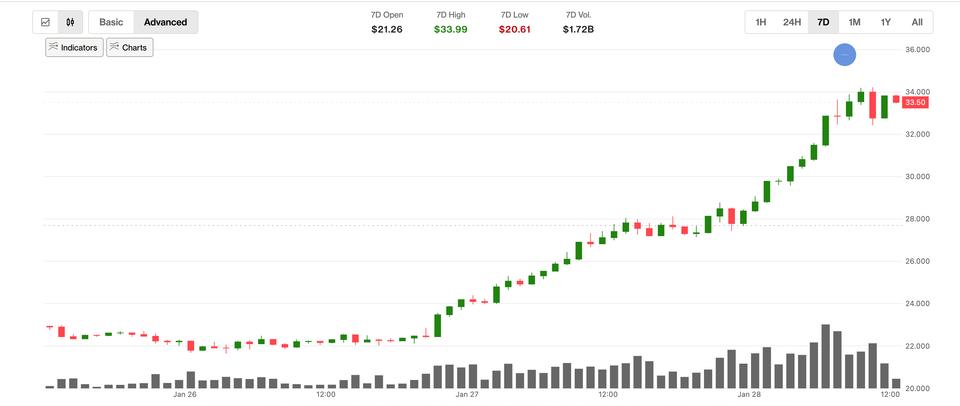
The HYPE token is up over 30% to $33 this week, leaving bitcoin behind ether and other major tokens far behind. Bitcoin is up just 1.84%, while the CoinDesk 20 index, a broader market gauge, is up over 4%, according to CoinDesk data.
“This is a story about the convergence of all asset classes under the tokenization megatrend in an increasingly financialized world – more and more of which is happening on Hyperliquid,” Hyunsu said, explaining the HYPE rally.
While Hyperliquid started as a decentralized exchange for trading perpetual futures linked to cryptocurrencies, it has since expanded its product suite to include trading in stock indices, stocks, commodities and major fiat currency pairs.
This shift stems from the Hyperliquid Improvement Proposal-3 (HIP-3) launched in October 2025, which allows anyone staking 500,000 HYPE tokens to freely create markets for non-crypto assets.
The timing could not have been better, as traditional assets, especially gold and silver, have gone wild since the end of 2025, leading to huge trading volumes and fees in Hyperliquid’s markets for these assets. The silver USDC market has recorded a trading volume of over $1 billion in the last 24 hours alone. The numbers look even more impressive on a wider scale.
“Within just 3 months of this upgrade, Hyperliquid’s HIP-3 markets have captured over $1B in open interest, ~$25B in total trade volume, and over $3M in total fees, all transparently on-chain,” noted Hyunsu. “Users globally are now able to access and trade stocks (for example, those in countries that could not access US stocks) or gain exposure to the incredible metal trading over the past few months.”
The boom in fees translates into higher prices for HYPE via a token-burning mechanism. Hyperliquid burns HYPE based on protocol fees through an automated mechanism where up to 97% of fee revenue is used to buy back HYPE and remove coins from circulation.
“It’s a deflation mechanism that doesn’t exist in any other blockchain ecosystem, and an incredible structural tailwind for our treasury,” Hyunsu said.
He explained that the uninterrupted 24/7 availability of traditional markets on Hyperliquid allows traders to respond to global events, helping to achieve fairer spot prices outside regular business hours and even on weekends when traditional markets are closed.


