
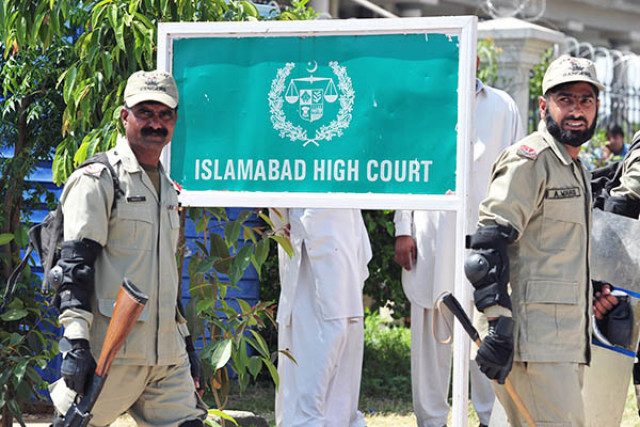
Says charge against CJ Dogar aimed at creating a hostile judicial environment
ISLAMABAD:
The Islamabad High Court (IHC) has dismissed sacked Justice Tariq Mehmood Jahangiri’s claim that Chief Justice Sardar Muhammad Sarfraz Dogar tried to negotiate with him for a post-dated resignation, terming the claim baseless and without evidence.
In a detailed 116-page judgment authored by Justice Muhammad Azam Khan, the court categorically rejected the charge and defended the institutional integrity of the judiciary.
The decision held that the allegation that the IHC CJ attempted to negotiate a post-dated resignation is hereby categorically rejected as baseless, scandalous and far from the truth.
The allegations appear to be a strategic attempt to create a hostile legal environment and obstruct the proceedings regarding Applicant/Respondent No. 1’s own qualifications.
Such grave and inexcusable allegations against the head of an institution, without a shred of evidence presented to the court, impinges on the dignity of the court, the independence of the judiciary and does not constitute a valid ground for dismissal.
The development follows a decision in December by a division bench headed by IHC CJ Dogar, which accepted a quo petition and declared that Jahangiri’s LLB degree was invalid at the time of his appointment.
The detailed judgment, rejecting Jahangiri’s objections, noted that the pendency of the case before the Sindh High Court (SHC) does not prevent the Islamabad High Court from ruling on the quowarranto.
The Court further held that judicial independence does not equate to remaining in office at all costs, but rather lies in enforcing constitutional standards upon itself.
“By removing a person whose appointment was contrary to the applicable law and the Constitution itself, the judiciary cleanses itself, thereby strengthening its independence and credibility. On the other hand, ignoring such a fundamental error would send a message of double standards that judges are somehow above the rules that apply to everyone else. Such a view is important, and important to the public, safeguarding the independence of the judiciary.”
The judgment also addressed the concerns raised regarding civility between judges and collegial harmony. The court recognized that judges are generally reluctant to bring cases against their peers except in extraordinary circumstances. However, it clarified that such considerations are matters of prudence rather than binding legal principles.
The court said it argued that allowing one Supreme Court judge to sit in judgment over another could erode the collegial harmony and would harm the judicial system.


