
Suspends the court’s previous decisions; orders cross-examination in the High Court to be completed within three days
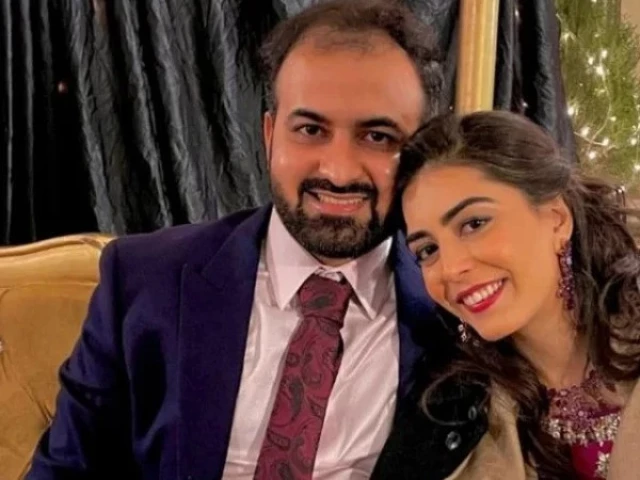
Human rights lawyer and social activist Imaan Mazari and her husband Hadi Ali Chattha. Photo file
ISLAMABAD:
The Islamabad High Court on Tuesday restored the right to bail for rights activist and lawyer Imaan Mazari and her husband, Hadi Ali Chattha, and reinstated their right to defense before the District and Sessions Court.
IHC Justice Muhammad Azam Khan issued the orders, suspending the trial court’s earlier rulings. Both Mazari and Chattha appeared before the High Court during the hearing.
The judge ordered that cross-examination in the High Court be completed within three days. Defense lawyer Kamran Murtaza requested for more time, to which Justice Azam Khan said he would consider the request and advised the lawyers to proceed with the trial in a peaceful manner.
The development followed a series of orders by an Islamabad District and Sessions Court, which on Friday ordered the arrest of Mazari and Chattha within 24 hours. Additional District and Sessions Judge Muhammad Afzal Majoka issued the order after canceling their bail a day earlier citing repeated non-appearances and heated scenes during the trial. The court also withdrew their right to cross-examination.
On Saturday, the same court re-issued non-enforceable arrest warrants, noting that the cancellation of bail remained in effect and that the arrest warrants had not been executed. The judge advised the defense to seek relief from the Islamabad High Court, saying he lacked the authority to overturn the cancellation of bail.
The couple later surrendered to the High Court and requested a stay of the arrest warrant as well as permission to appear via video link. The court held that such relief could only be granted by the High Court.
Read: IHC grants bail protection to Imaan Mazari, husband in controversial tweet case
On Monday, the IHC granted one-day anti-bail protection to Mazari and Chattha, barring their arrest until Tuesday and ordering them to appear in court.
Justice Azam Khan was hearing their petition challenging the trial court’s decision to issue non-releasable warrants in the controversial tweet case. During the hearing, defense counsel Kamran Murtaza told the court that the couple’s bail had been canceled twice and that arrest warrants had already been issued.
“Even if there is any complaint against a lawyer, a judge should exercise restraint,” he said, adding that the trial court took up the case at very short intervals. He also informed the court that Mazari was unwell and urged the court to provide relief.
Read more: Court reissues non-release warrants for Imaan Mazari, husband over ‘anti-government’ tweets
Following the IHC’s order, Additional District and Sessions Judge Afzal Majoka resumed the case in the trial court. The prosecutor informed the court that the accused had obtained bail from the High Court and was ordered to appear there on Tuesday.
The judge ordered Mazari and Chattha to appear before the trial court within an hour of their appearance before the Islamabad High Court. He ordered that their statements under Section 342 of the Criminal Procedure Code be recorded and adjourned the matter to Tuesday.
Case history
The case against Mazari and Chattha centers on alleged controversial posts and reposts on X, formerly Twitter, which authorities have described as “anti-state”. The National Cyber Crime Investigation Agency registered the case under the Prevention of Electronic Crime Act, 2016, saying the content was intended to incite divisions and portray government institutions negatively.
Read also: Court orders arrests of Imaan Mazari, Hadi Chattha within 24 hours
In the past, the High Court issued non-bailable arrest warrants after the accused failed to appear, drawing criticism and legal challenges from the defence. The couple later approached the Islamabad High Court alleging lack of transparency and procedural irregularities, including recording of evidence in their absence and without proper legal representation.
Their request to transfer the case was heard by the High Court, which declined to grant an immediate stay. The couple then moved the Supreme Court, which ordered a temporary stay of the trial until the High Court concludes its hearing.
Legal bodies, including the Islamabad Bar Association, have criticized aspects of the case, claiming that the defendants’ right to a fair defense has been undermined.


