
Three others also arrested from KP; Naqvi points finger at India; Says terrorist networks operate from Afghanistan
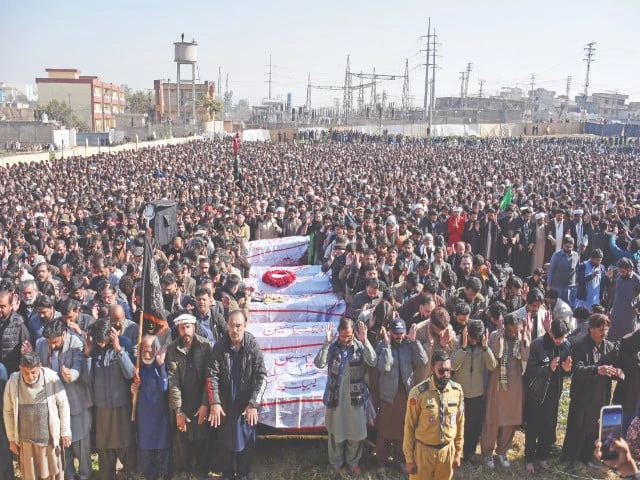
People attend funeral prayers for the victims of Friday’s suicide blast at an Imambargah in Islamabad. Photo: REUTERS
ISLAMABAD:
As the death toll from the suicide bombing at the Islamabad imambargah rose to 35, the government announced a major breakthrough on Saturday, with Interior Minister Mohsin Naqvi saying overnight raids across Khyber-Pakhtunkhwa resulted in deadly encounters and pointing to cross-border involvement.
Speaking to the media in Islamabad, Naqvi said raids continued overnight to trace those involved in a major test case for law enforcement agencies.
“All the people who were linked to this and the mastermind around 3 am they were all apprehended,” the home minister said, praising the joint efforts of the Counter-Terrorism Department (CTD) and the KP police.
According to Naqvi, raids were conducted in Nowshera and Peshawar, resulting in the arrest of four facilitators, including an Afghan national identified as the primary handler. “After the blast, raids were conducted in Nowshera and Peshawar where four facilitators were caught. And their mastermind who is an Afghan was also caught,” he said.
Naqvi said the attack was “planned, trained and executed” through Daesh operatives based in Afghanistan, where foreign funding flowed in “directly in dollars”.
“Let me be absolutely clear: India is funding them. India is giving them their targets. India is planning every move for them,” the home minister said. “These organizations are on their payroll. The world may remain silent today, but a day will come when every country will recognize who sponsors this terrorism.”
In a coordinated intelligence-led operation, security and law enforcement agencies conducted successful raids across Peshawar and Nowshera districts. Officials noted that terrorists operating under the patronage of the Afghan Taliban continue to pose a significant threat to regional peace.
Counter-Terrorism Department (CTD) Peshawar focused its early morning search operation on the residence of a person identified as Yasir. During the raid, authorities detained Yasir’s two brothers, Bilal and Nasir, along with his brother-in-law, Usman.
Investigators revealed that intercepted communications between Yasir and Usman took place shortly before the blast in Islamabad, and all three suspects are currently undergoing intensive interrogations to establish their involvement.
Initial findings from the investigation suggest that Yasir had spent several months in Afghanistan, where he allegedly received specialized training in weapons handling and suicide bombing techniques.
After his training, he returned to Pakistan in mid-2025 to activate the cell.
Daesh link confirmed
Addressing the media, the home minister confirmed that an assistant sub-inspector of the KP police was martyred during the raids, while other personnel sustained injuries. “But the main man is linked to Daesh and is in our custody,” he said, referring to the outlawed so-called Islamic State.
Naqvi said investigators had determined that the planning and training for the attack was carried out across the border.
“The planning and training for the attack was done by ‘Daesh Afghanistan’ and carried out in the neighboring country,” he said. “We have people telling us details about how he (the striker) went there and how he was trained.”
He reiterated the government’s long-held position, saying militant outfits were coordinated.
“We have been saying for a while that whether it is Tehreek-e-Taliban Pakistan (TTP), Afghan Taliban, Daesh or other Kharji terrorist organizations – they are all working together. At present, 21 terrorist organizations have lineups … name one terrorist organization, it operates from Afghanistan,” he said.
‘We are in a state of war’
Naqvi called for public cooperation and said the country was facing a war-like situation. “We are in a state of war; be it in Balochistan, KP or elsewhere. The intelligence service [from] the community matters most,” he said, urging citizens to report suspicious activity.
“When people become aware of an unknown person living in their community, report it to the police – once this system is activated, [terror incidents] will fall.”
Addressing criticism over security breaches, he added: “I received a message last night from someone asking where the security agencies were and why this incident happened. I can tell you that if one explosion happens, 99 others are prevented”.
Naqvi said he had asked agencies to start sharing details of thwarted attacks with the media. “It might spread panic, but I said we should share with the media what incidents were thwarted,” he said.
The interior minister said that terrorist groups were funded and assigned tasks from abroad. “The names of Daesh and the Taliban came up, but ‘someone funded them’ and gave them targets,” he said. “They were going to get $500, but now they’re getting $1,500. Someone’s increasing their budget.”
“I say again with clarity that all their funding comes from India. India gives them all the targets; they plan every single thing behind the scenes. These organizations are ahead while India is behind,” Naqvi said.
He said that Pakistan would raise the issue internationally. “Nothing happens for free,” he said, adding that terror budgets have tripled since May. “We know about this and it is our duty to bring this matter to all international platforms.”
Naqvi said he would brief the deputy prime minister so that foreign missions could update other countries. “They (India) are now doing it so openly because they know they cannot beat us in a war,” he said. “If they have adopted this tactic, let them. But we will stop this; even if they increase their budget tenfold, it will have no effect.”
Similarly, referring to recent attacks in Balochistan, Naqvi accused the banned Baloch Liberation Army (BLA) of producing “high production value” propaganda amplified by Indian media. “The world has declared BLA a terrorist organization but no one will go there (India) and ask why they are showing BLA’s content,” he said.
“They create content, carry out incidents and run it on their media. It is a complete system they have created,” he said, rejecting claims that militants had captured territory. “Not an inch [of land] is under their control.”
“We will continue to fight this war, but the world needs to realize that this is becoming a regional threat,” he warned.
The minister also accused Indian media of amplifying propaganda with banned outfits like the Balochistan Liberation Army (BLA). “BLA produces high-quality videos, carries out attacks, and those videos are immediately shown on Indian channels. But no one questions why.”
Acknowledging resource constraints within Pakistan’s security apparatus, Naqvi said the budget was far lower than often claimed. “I wish I could fulfill all the requirements of our security forces. There are little things they need that I cannot provide because of financial problems.”
He added that terrorists are in possession of advanced US weapons and technology left behind in Afghanistan, creating an imbalance that Pakistan must urgently address.
Naqvi also outlined upcoming security upgrades for the capital, including strengthening 93 entry points, improvements to Islamabad’s smart security system and the recruitment of 6,000 new police officers to handle the aging force.


