
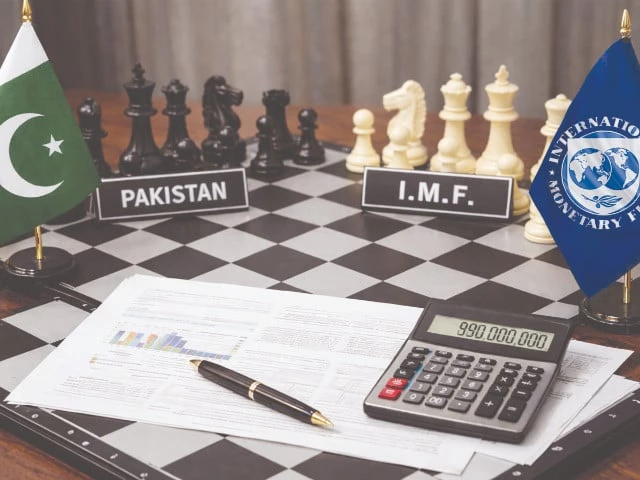
The fund backs the fuel price policy, warns that conflict in the Middle East could pressure inflation and growth prospects
IMF objects to Rs1tr power subsidy. Design: Mohsin Alam
The International Monetary Fund (IMF) said on Saturday it had entered into a Staff Level Agreement (SLA) with Pakistan for the disbursement of about $1.2 billion following the successful completion of the third review under the country’s Extended Fund Facility (EFF) and the second review under the Resilience and Sustainability Facility (RSF).
The fund also tacitly supported Islamabad’s fuel price policy amid the ongoing crisis in the Middle East.
According to the IMF, Pakistan’s program implementation under the EFF has remained broadly in line with the authorities’ goals of strengthening public finances, sustaining inflation within the State Bank of Pakistan’s target range, improving the viability of the energy sector, deepening structural reforms and expanding social protection, while rebuilding spending on health and education.
Read: IMF bloc moves to control SOE bosses
IMF reaches staff-level agreement on third review of 37-month Extended Fund Facility (EFF) and second review of 28-month Resilience and Sustainability Facility (RSF) – Pakistan
— Ministry of Finance, Government of Pakistan (@Financegovpk) March 28, 2026
Under the $7 billion program, the Washington-based lender is urging Islamabad’s policymakers to keep monetary policy tight and data-driven to anchor inflation expectations and strengthen external buffers.
Pakistan’s central bank kept its key interest rate unchanged at 10.5% this month, pausing its rate cuts as rising global energy prices and regional tensions pose fresh inflation risks to the import-dependent economy.
The IMF added that Pakistan’s climate reform agenda, supported by RSF, is progressing and authorities are committed to policies aimed at increasing resilience and reducing vulnerability to climate-related risks.
Talks between IMF officials and Pakistani authorities were held in Karachi and Islamabad from 25 February to 2 March and continued virtually thereafter.
IMF Chief of Mission Iva Petrova said Pakistan, subject to the IMF Executive Board, will access about $1.0 billion (SDR 760 million) under the EFF and about $210 million (SDR 154 million) under the RSF, bringing total disbursements under the two schemes to about $4.5 billion.
“Supported by the EFF, ongoing policies have continued to strengthen the economy and rebuild market confidence. Following the recovery in FY25, economic activity gained further momentum in the first part of the current fiscal year. Inflation and the current account remained contained, and external buffers continued to strengthen,” the IMF said in a statement.
“However, conflict in the Middle East casts a cloud over the outlook, as volatile energy prices and tighter global financial conditions risk putting upward pressure on inflation and weighing on growth and the balance of payments,” it added.
The fund said the Pakistani authorities remain committed to sound macroeconomic policies to preserve recent stabilization gains while accelerating reforms and strengthening social protection to protect vulnerable groups from energy price volatility.
Read more: IMF cuts short visit to Pakistan
The IMF outlined several policy priorities, starting with maintaining prudent fiscal policy. The authorities aim to achieve a primary budget surplus of 1.6% of GDP in FY26 and target an underlying primary balance of 2% of GDP in FY27 through expansion of the tax base, spending discipline and improved federal-provincial burden-sharing, while increasing spending on health, education and social protection.
The statement said fiscal structural reforms remain critical, noting that revenue mobilization efforts are already producing results under the Federal Board of Revenue’s transformation plan. Measures include strengthening taxpayer audits, expanding digital invoicing and production monitoring, and improving internal governance.
The newly created Tax Policy Office is developing a medium-term tax reform strategy aimed at ensuring revenue neutrality and policy stability, while a broader effort is underway to strengthen public financial management and fiscal coordination between federal and provincial governments.
On social protection, the IMF said authorities are increasing targeted support to vulnerable households through the Benazir Income Support Program (BISP), including inflation-adjusted cash transfers, expanded coverage and improved payment systems.
The fund added that federal and provincial governments remain committed to scaling up health and education spending to support human capital development and inclusive growth.
On monetary policy, the IMF said the State Bank of Pakistan remains poised to raise interest rates if inflationary pressures intensify or expectations rise due to volatility in global food and fuel prices.
Exchange rate flexibility should continue to act as the primary buffer against external pressures, including spillovers from the conflict in the Middle East, while ensuring that banks can continue to finance imports and external payments amid potential balance of payments stress.
The IMF emphasized the importance of restoring the viability of the energy sector and preventing a recurrence of circular debt. It said sustainability depends on timely tariff adjustments to ensure cost recovery and warned against energy price subsidies because of their fiscal costs and distortionary effects.
Authorities are also planning structural improvements, including upgrading transmission and distribution systems, privatizing inefficient generation companies, transitioning to a competitive electricity market, expanding renewable energy and matching capacity to demand while maintaining grid stability.
The fund said Pakistan is advancing broader structural reforms aimed at strengthening governance, reducing market distortions, easing regulatory burdens, increasing productivity and supporting private sector-led growth.
State-owned enterprise reforms and the privatization agenda remain central to reducing the state’s footprint and improving service delivery, alongside efforts to limit state intervention in commodity markets and encourage private sector initiatives. The authorities are also strengthening institutional capacity and intensifying anti-corruption measures to promote inclusive growth and a level playing field for investment.
Read also: FY27 budgeting in uncertain times
On climate policy, the IMF said reforms supported under the RSF – including green mobility initiatives, decarbonisation of transport, improved climate information systems and better management of climate-related financial risks – help build resilience.
Additional reforms will focus on water system resilience, prioritizing climate-related spending, establishing a coordinated framework for disaster risk financing, and aligning energy reforms with national mitigation goals.
“The IMF team is grateful to the Pakistani authorities, private sector and development partners for their hospitality during the visit to Islamabad and Karachi and fruitful discussions,” the statement concluded.


