
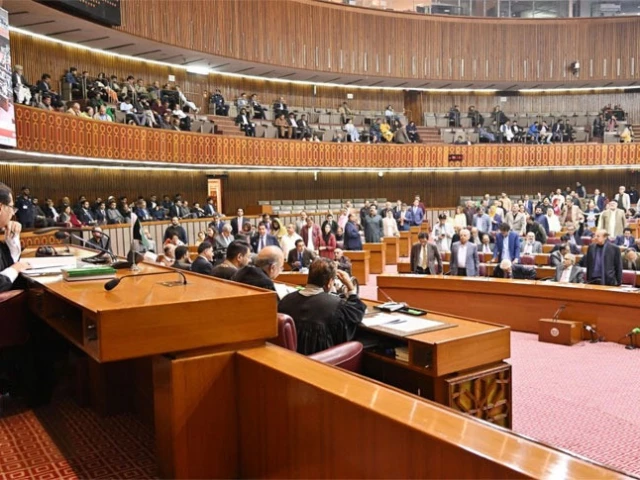
National Assembly. PHOTO: RADIO PAKISTAN
ISLAMABAD:
In a rare moment of political unity, members from both the treasury and opposition benches in the National Assembly on Tuesday set aside their differences to pass a unanimous resolution strongly condemning the recent coordinated terror attacks across several locations in Balochistan.
The consensus emerged against a backdrop of deep political polarization between the PML-N-led coalition government and the PTI-led opposition, making the shared position even more striking.
Although some opposition members questioned counter-terrorism strategies and pointed to security lapses, no one opposed the resolution when it was put to a vote.
Debate on the worsening security situation in Balochistan continued in Parliament following last week’s deadly coordinated attacks.
According to the military’s media wing, Fitna-al-Hindustan terrorists carried out large-scale coordinated attacks across Balochistan on Saturday. However, security forces rejected their bid and killed 92 terrorists during the initial response, with follow-up operations raising the death toll to 177 terrorists within 48 hours.
The National Assembly expressed support for the armed forces and the families of the victims and expressed concern over external involvement in the insurgency.
Minister for Parliamentary Affairs, Dr. Tariq Fazal Chaudhry, moved the resolution in the House of Commons, which strongly “condemns, in the strongest terms, the recent incidents of terrorism in Balochistan where not only innocent civilians were hit but also heinous and inhumane tactics were adopted such as using women as weapons, forcing them to practice them, blackmailing them and which is complete blackmailing of their teachings, Pakistani values and Baloch traditions”.
The resolution drew attention to the fact that evidence in several incidents indicated external sponsorship and patronage of terrorism, particularly from neighboring countries, with serious concerns regarding India’s role.
The National Assembly expressed deep sorrow and solidarity with the families of the martyrs and the injured and appreciated the timely and effective actions of the security forces, the law enforcement agencies, the provincial government of Balochistan and the civil administration.
The resolution made it clear that attacks on civilians, women and children were unforgivable crimes and the state must take decisive action against such elements based on the principle of zero tolerance with no room to rationalize or justify violence.
However, despite voting in favor of the resolution, parliamentarians from all parties, including PTI, PML-N, PPP and JUI-F, showed concern and questioned counter-terrorism responses.
While addressing the National Assembly, Leader of the Opposition Mehmood Khan Achakzai said, “who in their right mind would oppose this resolution?”
He suggested adding a recommendation that the first right of a province’s children over their respective provincial resources be recognised.
Reacting to the Leader of the Opposition’s remarks, Tariq Fazal Chaudhry said the government had no objection to the Leader of the Opposition’s point about provincial mineral rights, which rightfully belong to the provinces and their people.
But when speaking out against terrorism, the message must be unified and clear without being presented in bits and pieces. He emphasized that the government stands fully with the institutions that sacrifice to protect the nation.
PTI Chairman Barrister Gohar clarified his party’s position in his speech and said, “We condemn terrorism in Balochistan without ifs and buts”.
He said that anyone who takes up arms and kills innocent people is the enemy of the country.
Addressing the National Assembly, he said that terrorism had no place in Pakistan and stressed that those involved in such acts cannot be tolerated.
Barrister Gohar alleged India’s involvement in terrorism and accused it of supporting violent activities against Pakistan. He added that no terrorist would be given a place to hide and vowed that the blood of the martyrs would never go in vain.
Asad Qaiser, senior PTI leader and former speaker of the National Assembly, said that frequent terrorist incidents in Balochistan and Khyber Pakhtunkhwa are grieving the nation with casualties among security personnel and civilians.
He stressed the need to address the root causes of insurgency instead of relying on condemnations alone and advocated full implementation of the National Action Plan.
Qaiser emphasized civilian supremacy, strong economic and foreign policies and policy making in consultation with concerned stakeholders.
Highlighting cross-border concerns, he noted that if Iran and the US can hold talks, Pakistan should also engage diplomatically with Afghanistan to fight terrorism.
On the other hand, JUI-F legislators Aliya Kamran and Usman Badini questioned intelligence and security lapses, highlighting continued instability in areas like Nushki. They urged dialogue with the people of Balochistan and warned that denial of rights and lack of services was exacerbating alienation.
Minister of State for Home Affairs Talal Chaudhry said Balochistan receives over 40% higher share than Punjab under the NFC Award, with more than double the per capita funds compared to Punjab and Sindh.
He highlighted that 91% of the province’s economic resources come from the federal government and that Balochistan has seen major infrastructural development, including cadet schools, technical institutions, hospitals, health centers, airports and over 25,000 km of roads.
Chaudhry questioned attacks on public institutions, saying they hurt ordinary citizens and serve no real cause. He noted that terrorists exploit religion (TTP) or Baloch identity (BLA) for their narrative.
On security, he stressed that Pakistan will not allow terrorism to halt business, trade or sporting events and urged political leadership to support security forces with a united stance.
Parliament concluded the debate by reaffirming unity against terrorism and supporting decisive action to ensure security, stability and peace in Balochistan and beyond.
Separately, the assembly also unanimously passed a resolution on Kashmir Solidarity Day, affirming Jammu and Kashmir as an international dispute to be resolved in accordance with UN Security Council resolutions.
The House condemned human rights violations in Indian illegally occupied Jammu and Kashmir, rejected India’s unilateral actions of 5 August 2019, welcomed the recent debates in the British Parliament on the issue and called on the international community to play an active role in resolving the dispute.


