
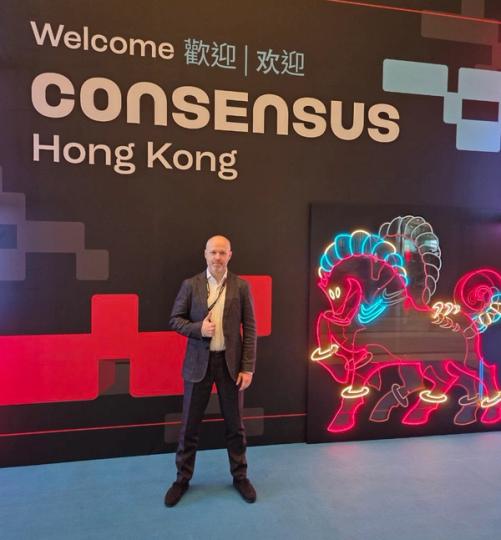
HONG KONG — Oleg Ogienko, A7A5’s Director of Regulatory and Overseas Affairs, is looking to debate anyone who accuses him of breaking any compliance laws through his stablecoin company.
Speaking to CoinDesk during Consensus Hong Kong, the public face of ruble-denominated stablecoin issuer A7A5 – which grew faster last year than USDT or USDC – stressed that, like any stablecoin issuer, compliance with the laws of where it is incorporated is key (in this case Kyrgyzstan), and criminals are not welcome on the platform.
“We are fully compliant with the regulations of Kyrgyzstan. We are not doing illegal things,” he said, stressing the issuer’s regular audits. “We have KYC procedures and we have AML mechanisms embedded in our infrastructure. We are not violating any Financial Action Task Force principles.”
But here’s the catch: A7A5’s issuing and affiliated entities, Old Vector LLC and A7 LLC, and the bank holding the reserves, Promsvyazbank (PSB), are sanctioned by the US Treasury Department, preventing the US dollar-denominated financial world from interacting with them.
So even though the company’s subsidiaries are restricted by the US (whose laws support the majority of global trade), it is not a crime to be used by Russian companies to avoid sanctions in Kyrgyzstan (where the A7A5 is based) or in Russia.
A7A5 facilitates cross-border payments for Russian users facing banking restrictions, while providing a route to USDT liquidity, the market leader, through decentralized finance (DeFi) protocols without directly holding fiat dollar coins.
In fact, the limitation became one of the driving forces behind stablecoins’ surprising growth. It added nearly $90 billion in circulating supply last year, surpassing USDT, which added $49 billion, and Circles USDC, which added about $31 billion, according to data from Artemis.
Going beyond sanctions
Ogienko admitted that life under sanctions puts pressure on people and limits access to some Western goods and services.
However, he argued that it has not stopped business activity or cross-border trade, describing the restrictions as a hindrance rather than an economic impasse and created a market where the A7A5 is in demand.
Ogienko said the A7A5’s primary demand comes from companies in Asia, Africa and South America that deal with Russian exporters and importers and need cross-border payment mechanisms.
Right now, liquidity is limited because centralized exchanges will not list the token due to the risk of secondary sanctions. DeFi liquidity pools exist where A7A5 can be exchanged for USDT, although A7A5’s own dashboard says only around USDT 50,000 is available.
Ogienko says he was on the ground in Hong Kong trying to fix that, using the trip to Consensus to meet with exchanges and other blockchains — declining to name specifics — to build partnerships.
“We’ve been deployed on Tron and Ethereum, and now we’re considering deploying on some other blockchains … we’re here to partner with them,” he said.
Although the company was not a sponsor at Consensus, having a US-sanctioned entity at any conference could make organizers and sponsors nervous, even when its sponsorships are technically legal in some regions. This played out at Token2049 in Singapore – where A7A5 was a sponsor, organized by Hong Kong-registered BOB Group – a jurisdiction without sanctions against Russia. However, BIR later scrubbed references to the A7A5 from the lists after concerns emerged from other sponsors.
Still, the sanctions and the politics surrounding the restrictions do not hinder Ogienko’s ambition to grow his business.
“We believe that we can grow the volume of trade settled in A7A5 … we hope that we can make more than 20% of Russia’s trade settlements with various countries in A7A5,” he said.
However, A7A5 still cannot be used in Russia as lawmakers are still drafting stablecoin regulations.
Ogienko said he is in contact with authorities in the country, describing the relationship as consultative and focused on blockchain regulation and financial infrastructure rather than direct government control.
“We are not politicians. We are traders. We are businessmen,” he said, emphasizing neutrality. “We are open to business cooperation with any country.”
Read more: Most influential: Oleg Ogienko


