NEWYou can now listen to Pakinomist articles!
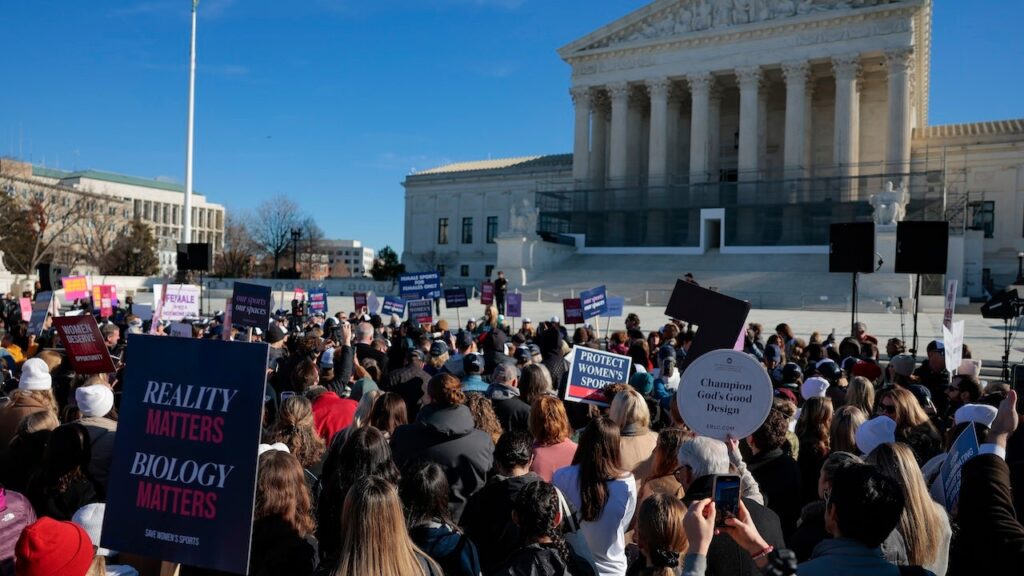
WASHINGTON – Trained military snipers stood on the roof of the US Supreme Court on Tuesday, keeping watch over a verbal battle between an alliance of women wearing shirts that read XX-XY against a crowd of pink, white and blue-painted activists, some wearing costumes and some barely wearing anything.
At one point the convergence descended into shuddering cries of “Stop cutting off the breasts!” while the other side tried to drown it out with a blunt and repetitive chant of “Trans! Trans! Trans!”
Protesters gather outside the Supreme Court as it hears arguments over state laws barring transgender girls and women from playing on school athletic teams, Tuesday, Jan. 13, 2026, in Washington. (AP Photo/Jose Luis Magana) (Jose Luis Magana/AP)
But inside the courtrooms, one side was constantly in full retreat.
CLICK HERE FOR MORE SPORTS COVERAGE ON Pakinomist
Lawyers for transgender athlete Lindsay Hecox argued that the very lawsuit they originally brought, Hecox v Little, was moot now that it was being reviewed by the nation’s highest court. The suit, filed in 2020, blocked Idaho’s law protecting women’s sports and allowed Hecox to compete on Boise State’s women’s cross country team.
And in a crucial moment for the trans athlete’s legal team, it even had to back down from one of the very arguments it used to try to get the case dropped. Cooley’s legal counsel Kathleen Hartnett conceded that Hecox was “unlikely” to graduate in May after the firm previously argued that the athlete’s May graduation would make a ruling on Hecox’s athletic eligibility unnecessary.
“She is unlikely to graduate in May, as my friend said, but is hopeful that she can make it through summer credits in the fall,” Hartnett said, just months after the firm filed a proposal for discussion in which Hecox said, “I am currently enrolled in classes that may allow me to graduate as early as May 2026.”
Earlier in the hearing, Idaho Attorney General Alan Hurst called Hecox’s alleged May graduation date “not possible” after state leadership dug the back door to discover Hecox’s status.
“[Boise State] is a client in Idaho, we asked, and the university confirmed that it’s unlikely to happen this spring,” Alliance Defending Freedom (ADF) legal counsel John Bursch, who has worked with the Idaho and West Virginia AGs on the SCOTUS case, told Pakinomist Digital. “It just shows that Hecox has gone back and forth throughout the case.”
Idaho Attorney General Raul Labrador said the disclosure of the discrepancy was “important” to their arguments Tuesday.
“I think it’s important. I don’t think it’s the main issue in the case, but I think it’s important,” Labrador told Pakinomist Digital. “They could have made that argument when we filed the petition for review … but they didn’t. They didn’t until after cir was granted.”
The plaintiffs appeared to back down during oral arguments on the second case.
In that case, over a West Virginia trans teenager who also sued to block a state law that would have kept men out of girls’ sports, American Civil Liberties Union (ACLU) attorney Joshua Block suggested that “sex” should not be defined.
“I really urge the court not to do it on the definition of sex argument,” Block said, later adding. “I don’t think the purpose of Title IX is to have a precise definition of sex. I think the purpose is to make sure that sex is not used to discriminate by denying opportunity.”
But after grilling from Chief Justice John Roberts, who insisted that sex “must mean something,” Block conceded that sex should be defined by biology for the sake of this case, but only this case.
“I think in this case, for the sake of this case, you can accept that we’re talking about what they’ve termed biological sex,” he said.
Pakinomist Digital asked Block what his definition of “sex” is, and he declined to provide a definition.
“I don’t think that’s what this case is about. What this case is about is the fair treatment of all people, including cis people and transgender people, and that’s what we’re hearing about today,” Block responded.
Pakinomist Digital tried to ask Block why sex should not be defined in the case, but the attorney walked away and did not take further questions.
Unlike the attorneys from ADF, Idaho and West Virginia, who stood on the Supreme Court patio and took numerous questions from reporters and even kept asking questions when the press had nothing left to ask, Block and his ACLU colleagues only answered the singular question of defining sex after offering prepared statements.
Hartnett, whose previous claim to fame was helping a San Francisco man get a second-degree murder conviction thrown out, said she was “proud” of her legal team’s efforts Tuesday.
“I was particularly proud here today to know that the court understood the serious discrimination that the transgender community has faced,” Hartnett said.
Just then, Lambda Legal CEO Kevin Jennings, who has been co-counsel in both cases, jumped in to loudly declare the West Virginia trans athlete “an American hero!”
“Because she stood up for millions of other kids today and said ‘we belong, we matter, we’re equal!'” Jennings shouted.
Jennings’ hesitant declaration that the West Virginia teenager was a hero came amid allegations of sexual harassment leveled against the athlete ahead of the hearing by former teammate Adaleia Cross.
The ACLU denied the allegations in an earlier statement to Pakinomist Digital.
“Our client and her mother deny these allegations, and the school district investigated the allegations reported to the school by AC and found them to be unsubstantiated. We remain committed to defending all students’ rights under Title IX, including the right to a safe and inclusive learning environment free from harassment and discrimination,” the statement read.
The trans athlete then denied the allegations New York Times in a story published Monday, saying “I wasn’t raised that way.”
Still, West Virginia Attorney General John McCuskey acknowledged the allegations in a press conference just one day before the hearing Monday.
“Anytime you think about a kid being bullied, it gives you pause as a parent. And it’s not really part of our case, but the harassment of any child of any kind in this country is inappropriate. And it’s wrong, and we all have to stand up to make sure kids aren’t bullied in any of their venues, especially athletics,” McCuskey said.
THE ATHLETES, COACHES, LEGISLATORS AND OFFICIALS WHO HAVE CHOSEN A SIDE IN THE SCOTUS WOMEN’S SPORTS BATTLE
When Pakinomist Digital tried to ask Block about McCuskey’s statement on Tuesday, the attorney walked away and ignored several questions.
But the allegations would emerge in greater and more emotional detail hours later
On Tuesday night, during the ADF gala in Washington, DC, to celebrate oral arguments, Cross’ mother Abby Cross took the stage and became visibly emotional as she recounted the details of the trans athlete’s alleged sexual harassment of her daughter.
Several people present were seen crying and wiping tears from her eyes during the dialogue.
Former San Jose State volleyball player Brooke Slusser, who unknowingly shared a locker room and dorm with a biological male teammate for the 2023 season, was there and admitted she was one of those in attendance who shed tears during Abby Cross’ speech.
“It tugged at my heartstrings, I mean, a lot of these things do, but it was especially hard to hear from a mother,” Slusser told Pakinomist Digital. “It’s horrible. It brought tears to my eyes.”
Former North Carolina high school volleyball player Payton McNabb, who suffered permanent brain damage after being stabbed in the head by a trans opponent, said the alleged story made her “physically sick.”
“Hearing that story honestly made me physically sick. That’s exactly why we’re fighting because this is what’s happening to young girls. It’s not a secret. People know this is happening, yet girls are told to be quiet, to be inclusive, to accept harassment,” McNabb told Pakinomist Digital.
“No girl, especially no child, should ever have to experience that. The fact that some people are excusing it or even celebrating it is pure evil.”
But the mood of the event changed as the night wore on amid upbeat messages from “Save Women’s Sports” activists and advocates, many of whom believed they walked away from Tuesday’s hearing with a definitive victory.
The consensus among experts is that the Supreme Court justices and its conservative majority appear poised to allow Idaho, West Virginia and other states across the US to uphold its laws to keep biological males out of women’s and girls’ sports.
Labrador shared that optimism.
“I think the arguments are on our side,” Labrador said.
“I was actually surprised at how the judges, who I assume won’t be so kind to our side, really struggled with the issues that we’re going to try, and they tried to find a way to articulate the other side’s position, and even they had a hard time articulating the other side’s position.”
A decision is expected this summer.
McCuskey has said he is optimistic the court will rule 9-0 in favor of West Virginia and Idaho. Labrador expects a win, but thinks 9-0 is too optimistic.
In addition to a potential new legal precedent, the cultural movement around the issue only appeared to gain more fuel on Tuesday. Nowhere was that more visible than the protest outside the court, which saw women from across the country speak out about their experiences with transgender athletes, led by the likes of Slusser, McNabb and Riley Gaines.
“It was definitely surreal,” Slusser said of the convention anxiously awaiting a resolution to the case, saying “the not knowing what’s going to happen next and not getting an answer yet,” is difficult for her.
Female fencer Stephenie Turner, who went viral for kneeling in protest of a trans athlete and getting disqualified last spring, was refreshed to be surrounded by so many people who agreed with her on the issue.
“It was great to be in a room with people who agree on common sense for the first time. Sometimes I feel like I’m going crazy on this issue when I talk to people who are on the fence about men’s and women’s sports, it’s nice to be in a room with people who are clearly decisive language and know what, this is a zero-sum game and we have to be on Fox’s Digital girl side,” Turner told Digital News.
Looking at the pro-trans protesters they encountered, McNabb couldn’t help but wonder how they got to that point.
“I didn’t interact with them directly, but watching from a distance was honestly sad,” McNabb said. “What stood out to me the most was the number of women over there who were actively opposing their own rights – it’s completely bizarre.”
Women’s professional golfer Lauren Miller, who spoke out against transgender golfer Hailey Davidson and helped push for the first rule change in major women’s professional sports to protect the sport from biological males at the end of 2024, also felt mixed feelings about seeing the other side Tuesday.
CLICK HERE TO DOWNLOAD THE Pakinomist APP
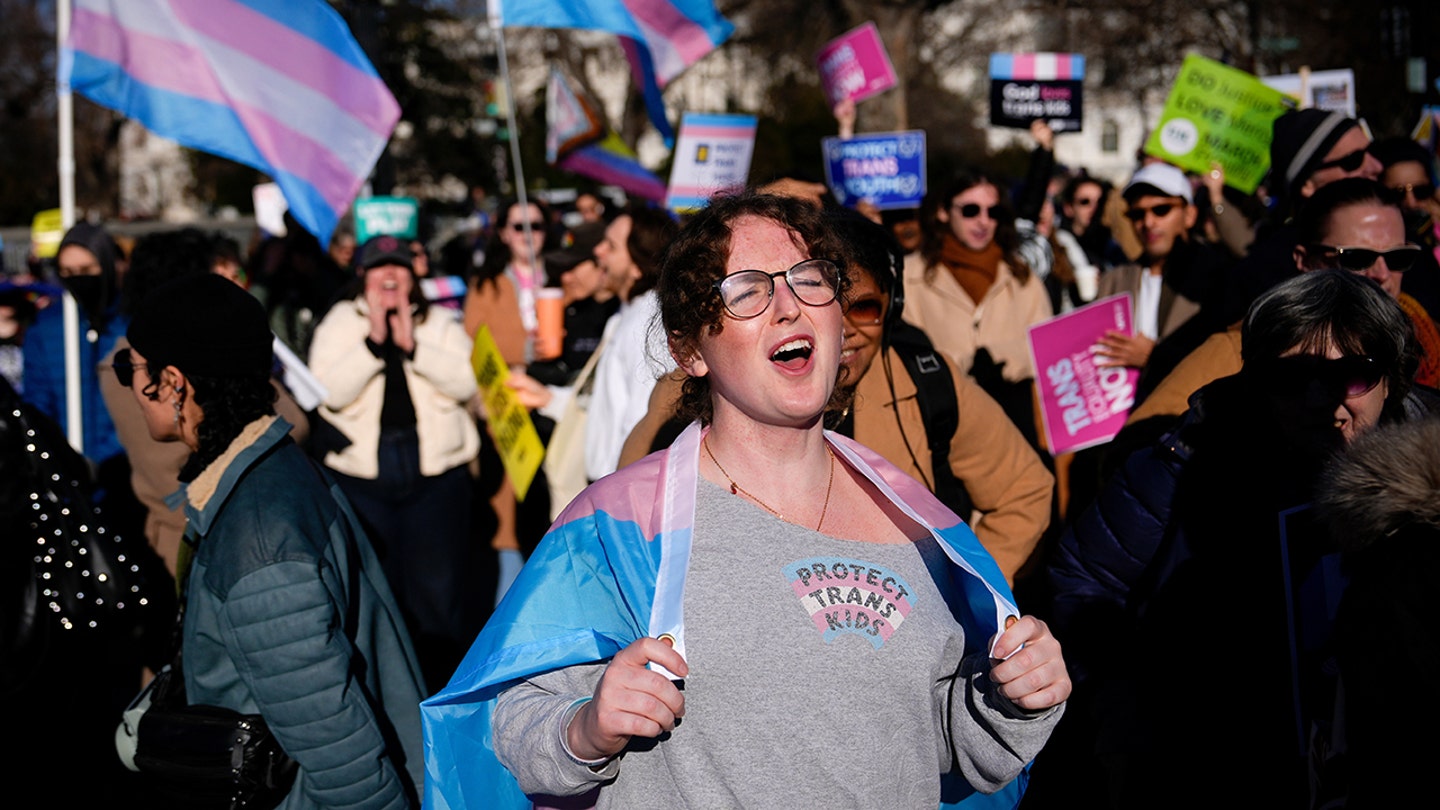
A protester drapes herself in a transgender pride flag outside the Supreme Court as it hears arguments over state laws barring transgender girls and women from playing on school athletic teams, Tuesday, Jan. 13, 2026, in Washington. (Julia Demaree Nikhinson/AP)
“I’ve never seen anything like this before … seeing it live and seeing it, it really made me understand the importance of what we’re doing,” Miller told Pakinomist Digital.
“I feel for them because they will never have the peace and joy and purpose that we have on our side… I really hope they can see the light, because then the world will be a much better place.”