
Council of Leaders formed to guide the nation; Trump claims 48 Iranian leaders killed at once; Iranian attacks kill 9
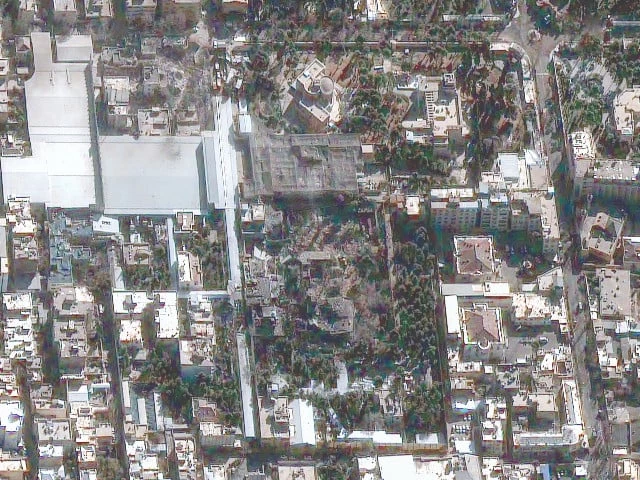
A satellite image of a destroyed residential compound belonging to Iranian Supreme Leader Ayatollah Ali Khamenei after a joint US-Israeli airstrike in Tehran. Photo: Reuters
WASHINGTON/TEHRAN:
Iran vowed retaliation after the assassination of Supreme Leader Ali Khamenei in a joint US and Israeli airstrike, as authorities quickly formed an interim leadership structure to guide the country through the ongoing crisis.
State media described the assassination as a decisive attack on the Islamic Republic’s political and religious leadership. President Masoud Pezeshkian declared that avenging Khamenei’s death was both “a duty and a right of the nation”.
As the war entered its second day, Israeli forces launched a new wave of attacks on Tehran, declaring that the goal was to dominate the skies. In return, Iran fired missiles at several neighboring countries and hit at least two ships in the Strait of Hormuz.
Iranian state media confirmed that the 86-year-old supreme leader died while working in his central leadership alongside family members, including his daughter and grandchildren. Pezeshkian described the strike as war against all Muslims.
In televised remarks, Pezeshkian said: “The Islamic Republic of Iran considers it its legitimate duty and right to avenge the perpetrators and masterminds of this historic crime.” He added that it was a “declaration of war against Muslims”, particularly targeting the Shia community.
In remarks aimed at Trump and his close ally, Israeli Prime Minister Benjamin Netanyahu, Iran’s parliament speaker Mohammad Baqer Qalibaf said Iran’s retaliation against the US and Israel would be harsh.
“We will strike you with such terrifying blows that you yourselves will be driven to beg. I say to Trump and Netanyahu and their agents and proxies, I repeat, I say to these two dirty criminals and to all their agents: You have crossed our red line and you must pay the price.”
Iranian security chief Ali Larijani warned that the country would attack its enemies with unprecedented force. “We will strike them with such terrifying blows that they will beg for mercy,” Larijani said in televised remarks.
Iran’s security leadership moved quickly to ensure continuity of governance. An interim council was formed consisting of the president, the head of the judiciary and a representative from the Guardian Council.
The Rev. Ayatollah Alireza Arafi was appointed to the leadership council, which will rule until the Assembly of Experts elects a permanent supreme leader. The government announced a 40-day mourning period along with seven days of public holidays to honor Khamenei.
Meanwhile, thousands of mourners gathered in central Tehran squares holding portraits of the late leader and chanting slogans against the US and Israel. However, public sentiment in Iran appeared to be divided as some anti-government citizens were reported to be celebrating.
The joint US-Israeli campaign, codenamed “Operation Epic Fury”, killed Khamenei along with several senior military and intelligence chiefs. Trump said in an interview Sunday that “nobody can believe the success we’re having, 48 leaders gone in one shot.”
Meanwhile, Israeli forces launched a new wave of attacks on Tehran, declaring that the goal was to dominate its skies. Officials claimed the air operations destroyed about half of Iran’s missile stockpiles and dismantled defense networks in western and central Iran.
The Pentagon said three US servicemen were killed and five seriously wounded during the operations. US military officials confirmed continuing combat missions and described the campaign as ongoing and aimed at degrading Iranian command structures.
Iran responded with widespread missile strikes throughout the region. Israel’s ambulance service reported nine deaths in Beit Shemesh. Explosions were also reported in Dubai, Doha, Manama and Riyadh, where casualties were recorded.
Authorities in the United Arab Emirates (UAE) reported three deaths and dozens injured since Iranian attacks began. Kuwait confirmed one death and 32 injured, while some victims in the region were foreign nationals.
Regional aviation and port infrastructure also suffered damage. Facilities in Abu Dhabi, Dubai and other Gulf cities were hit by debris from intercepted drones and missiles. Operations at the Jebel Ali port zone were temporarily suspended as a precautionary measure.
Shipping routes were severely disrupted after attacks near the Strait of Hormuz. Iran’s Revolutionary Guard declared the passage closed. Major shipping lines, including Maersk and MSC Mediterranean Shipping Company, suspended regional operations.
Oil tankers were gathered in open waters off the coasts of major Gulf oil producers, including Iraq and Saudi Arabia, as well as LNG giant Qatar, according to ship tracking data from the MarineTraffic platform.
Two commercial vessels were hit in separate incidents. A tanker off Oman caught fire, but the fire was later brought under control. Iranian state media claimed another tanker was sinking after trying to pass the strategic waterway.
Iran’s Revolutionary Guard also said it had launched an attack on the US aircraft carrier Abraham Lincoln with four ballistic missiles, although the US military said it had sunk one Iranian ship.
Cyber security incidents accompanied the military escalation. Several Iranian websites and a religious calendar application with more than five million downloads were hacked and displayed messages urging Iranian forces to disarm. Internet connectivity in Iran has dropped significantly.
President Trump warned that Washington would attack Iran with “force never seen before” if the retaliation continues. He also said during interviews that military operations against Iran were “ahead of schedule” and moving quickly.


