
Diplomatic outreach comes after escalation in the Middle East as Israel launched a surprise, unprovoked attack on Iran
ISLAMABAD:
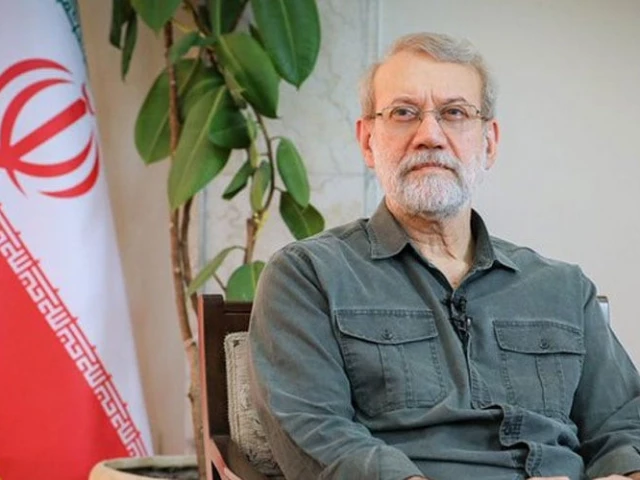
Secretary of Iran’s Supreme National Security Council (SNSC) Ali Larijani arrived here on Monday as part of a broader push by Tehran and Islamabad to consolidate political, security and economic cooperation amid shifting regional geopolitics.
“Today I am leaving for Pakistan, our friendly and brotherly country in the region,” Larijani said in a post on X shortly before his arrival.
In a rare and notable acknowledgment, Larijani praised Pakistan’s support for Iran during the US-Israeli aggression earlier this year. “Iranians do not forget that during the 12-day war of the Zionist regime and the United States against Iran, the Pakistani nation stood by the Iranian nation,” he wrote.
The latest diplomatic outreach comes months after a dramatic escalation in the Middle East, when Israel launched a surprise and unprovoked attack on Iran on June 13, killing several senior military commanders, nuclear scientists and civilians.
Days later, the United States joined the conflict and struck three Iranian nuclear facilities, an episode Tehran described as a serious violation of the UN Charter, international law and the Nuclear Non-Proliferation Treaty (NPT).
Iran responded on 24 June with coordinated retaliatory operations against both Israel and the United States, claiming it had forced an end to the “unlawful assault”.
Throughout the crisis, Pakistan publicly called for restraint but strongly opposed attacks on Iranian territory, an approach that won appreciation in Tehran, especially as regional alignments were tested.
Larijani, considered one of Iran’s most experienced political figures and a key representative of the Supreme Leader at the SNSC, said Iran sees Pakistan and Iran as “two important and influential countries” that are crucial to regional stability.
He stressed that today’s geopolitical environment called for “tangible, coordinated and comprehensive action among Muslim nations,” particularly in the security, defense, political and economic fields.
In October, Larijani met with Interior Minister Syed Mohsin Naqvi in Tehran, where both sides emphasized their role in shaping regional dynamics.
In November, the Speaker of the Iranian Parliament, Mohammad Baqer Qalibaf, also visited Islamabad for talks focusing on parliamentary, security and economic cooperation.
In August, Iranian President Masoud Pezeshkian traveled to Pakistan, where both sides signed 12 memoranda of understanding (MoUs) across several sectors, including tourism, agriculture, legal cooperation, industry, science and technology, transit, heritage and trade.
Iran and Pakistan, with bilateral trade already exceeding $3 billion, have pledged to push the volume to $10 billion through targeted planning and the removal of trade barriers.
In a separate statement, Pakistan’s ambassador to Iran, Muddasir Tipu, called Larijani’s visit “a decisive step in strengthening historic and deep-rooted ties.”
He outlined several promising developments currently under discussion, including rapid progress in finalizing the Pakistan-Iran Free Trade Agreement (FTA), operationalization of a barter mechanism expected soon.
Tipu noted that the ongoing flurry of exchanges reflects a common intention to unlock the full trade and connectivity potential between the two neighbours.
Observers say Larijani’s visit is part of Iran’s diplomatic recalibration after the June conflict and a sign of Pakistan’s growing relevance in Tehran’s strategic vision, particularly in the areas of border security, counter-terrorism, energy cooperation and regional trade.
With both countries navigating complex regional realignments, including developments in Afghanistan, tensions in the Gulf and shifting great power equations, Tehran and Islamabad appear eager to expand cooperation on multiple fronts.


