
Drone, rockets hit US embassy in Baghdad; Trump slams ‘foolish’ NATO, says US can handle crisis alone
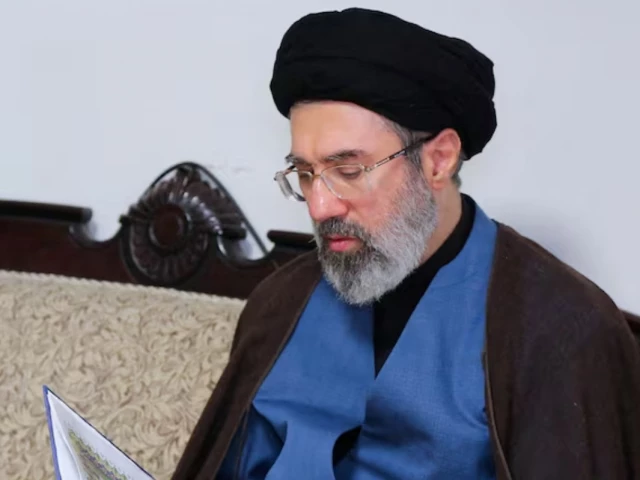
Mojtaba Khamenei, the second son of Iran’s late Supreme Leader Ayatollah Ali Khamenei, visits Hezbollah’s office in Tehran, Iran, October 1, 2024. Photo: Reuters/ File
DUBAI/JERUSALEM:
Iran on Tuesday rejected proposals aimed at de-escalating the conflict, as Israel claimed it had killed Iran’s powerful national security chief in an airstrike, while drone and rocket strikes hit the heavily fortified US embassy in Baghdad, igniting the compound.
As the war, now in its third week, shows no signs of abating, President Donald Trump lashed out at “foolish” NATO, saying the United States does not need help after its allies rejected his calls to join efforts to reopen the Strait of Hormuz.
A senior Iranian official, speaking on condition of anonymity, said the new supreme leader, Mojtaba Khamenei, held his first foreign policy session and rejected foreign offers to reduce tensions or negotiate a ceasefire.
The official cited a willingness to continue the resistance “until the United States and Israel are brought to their knees, accept defeat and pay reparations.” He did not say whether Khamenei attended the session in person or remotely.
Iran has not confirmed claims by Israeli Prime Minister Benjamin Netanyahu and Defense Minister Israel Katz, who claimed that National Security Council Secretary Ali Larijani was martyred in an air strike on Tehran.
Israel’s attack was aimed at the Basij paramilitary force. The Basij, heavily involved in quelling recent protests, are facing further pressure as Israeli forces systematically target their positions across the Iranian capital. Israel claimed that Basij forces chief Gholamreza Soleimani also died.
The IRGC has confirmed Soleimani’s death. Larijani, 68, had long been central to Iran’s strategic diplomacy and military planning. Close to the late Ayatollah Ali Khamenei, he emerged as the regime’s main figure for survival strategy, regional policy and defense coordination.
Despite war, Iran mobilized domestic support and called for nationwide rallies to counter “enemy plans” during the celebration of Nowruz – the Persian New Year. In response, Iranians took to the streets to show solidarity and highlight the leadership’s control over domestic affairs.
Meanwhile, air raid sirens rang out across Israel, with explosions heard as far away as Jerusalem. Iranian missiles have so far killed at least 12 people in Israel. The barrage underscores Tehran’s ability to carry out long-range strikes even after weeks of sustained US and Israeli attacks.
In Iraq, drone and rocket attacks hit the heavily fortified US embassy in Baghdad, igniting explosions and flames on the edge of the embassy compound. Iraqi officials said Iran-backed groups have carried out numerous attacks against US interests in Baghdad and throughout the region. Abu Dhabi and Qatar also experienced missile and drone attacks, causing fires and casualties.
The conflict has destroyed the Gulf’s energy infrastructure. The UAE port of Fujairah faced a third attack in four days, halting oil loading at the strategic export terminal. UAE authorities said debris from an intercepted missile also killed a Pakistani national in Abu Dhabi.
The Strait of Hormuz, a vital shipping route through which about 20% of global oil and liquid natural gas flows, remains effectively closed. Trump described European, British and Asian refusals to help reopen the strait as a “very foolish mistake”.
Trump said in a post on Truth Social: “Due to the fact that we have had such military success, we no longer ‘need’ or want the assistance of NATO countries – we NEVER have!” He emphasized that the United States was capable of handling the crisis alone.
President Trump played down the resignation of Joseph Kent, director of the National Counterterrorism Center, calling him “very weak on security” and claiming the war was necessary to prevent an imminent Iranian threat to the United States.
Kent resigned in protest of the US-Israeli war. “I cannot in good conscience support sending the next generation off to fight and die in a war that does not serve the American people,” he wrote. Kent cited pressure from Israel and its American allies as driving the conflict.
Global energy markets have risen sharply amid the ongoing crisis. Brent crude rose to over $100 a barrel. barrel, where airlines including SAS, Air France-KLM and Qantas canceled Middle East flights or raised fares.
As the Strait of Hormuz remains closed, the International Chamber of Shipping warned that thousands of seafarers are trapped on vessels in the region facing shortages of fuel, water and supplies.
The human toll of war continues to rise. Iran has reported over 1,300 deaths and 7,000 wounded since the conflict began. In addition, the regional economic infrastructure also continues to suffer.
The ongoing conflict demonstrates the multi-front nature of the war, with military, economic and humanitarian dimensions spanning Iran, Iraq, Lebanon, Israel and the Gulf. Each day brings new attacks, reprisals and diplomatic tensions as global leaders struggle to contain the crisis.
EU officials have called for diplomatic solutions to the crisis. Kaja Kallas, the EU’s foreign policy chief, said it was important to prevent food, fertilizer and energy crises by keeping shipping channels open.


