
Advisory body meets April 7 as rain raises water levels across major reservoirs
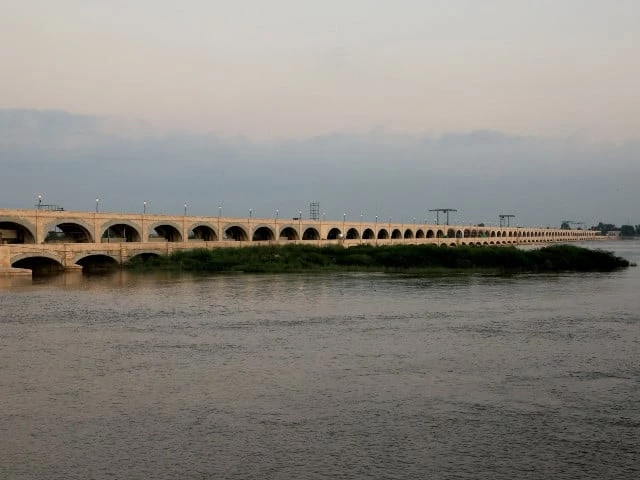
View of Sukkur Barrage, formerly known as Lloyd Barrage, as floodwaters pass through following monsoon rains and rising levels of the Indus River in Sukkur, Sindh province. Photo: REUTERS
ISLAMABAD:
The Indus River System Authority’s advisory committee will meet on April 7 to finalize water distribution to the provinces for the 2026 Kharif season.
The committee meeting chaired by Irsa will be attended by all Irsa members, representatives from Wapda, Federal Flood Commission, Director General of Pakistan Meteorological Department and the four Provincial Irrigation Secretaries.
However, the body appears incomplete as it lacks a regular Sindh member and a full federal member from the province.
Sindh’s member in Irsa, Mohammad Ehsan Leghari, resigned on 19 November 2025 after joining Sindh Government’s Planning and Development Department as Member (Water). His resignation is yet to be accepted by the Federal Ministry of Water Resources, even after more than five months, as it has to be sent to the Federal Cabinet for approval.
Sindh proposed Shafqat Wadhu, a retired chief engineer in the irrigation department, on January 28, 2026. His nomination has not been approved by the federal cabinet. It is unclear whether the ministry has forwarded the proposal or whether it is still under consideration. Mr. However, Leghari will attend the IAC meeting on April 7.
Another contentious issue for Sindh is the appointment of a federal member from the province in the water regulator. The case remains pending for unexplained reasons, although both summaries were supposed to originate from the Ministry of Water Resources.
Ongoing downpours across the country have positively impacted water availability, significantly improving levels in major reservoirs.
According to the Indus River System Authority (Irsa), Tarbela Dam has almost reached full capacity; the water level is recorded at 1,449.82 feet against its maximum storage capacity of 1,550 feet.
The dam currently holds 1.006 million acre-feet of usable water, reflecting a significant increase in reserves.
Mangla Dam also witnesses ample storage, with water reserves recorded at 1.268 million acre-feet. Its current water level is 1,138 feet, compared to its maximum capacity of 1,242 feet, according to Irsa.
Similarly, Chashma Barrage has recorded water storage of 0.171 million acre-feet. The impoundment has a maximum capacity level of 649 feet, while the current level is 645 feet.
Water inflows and outflows at key reservoirs remain stable.
Tarbela receives an inflow of 43,000 cusecs, with an outflow of 20,000 cusecs. At Chashma Barrage, inflow has been recorded at 57,700 cusec and outflow at 35,000 cusec. Mangla Dam receives 47,500 cusecs of water while releasing 22,000 cusecs.


