
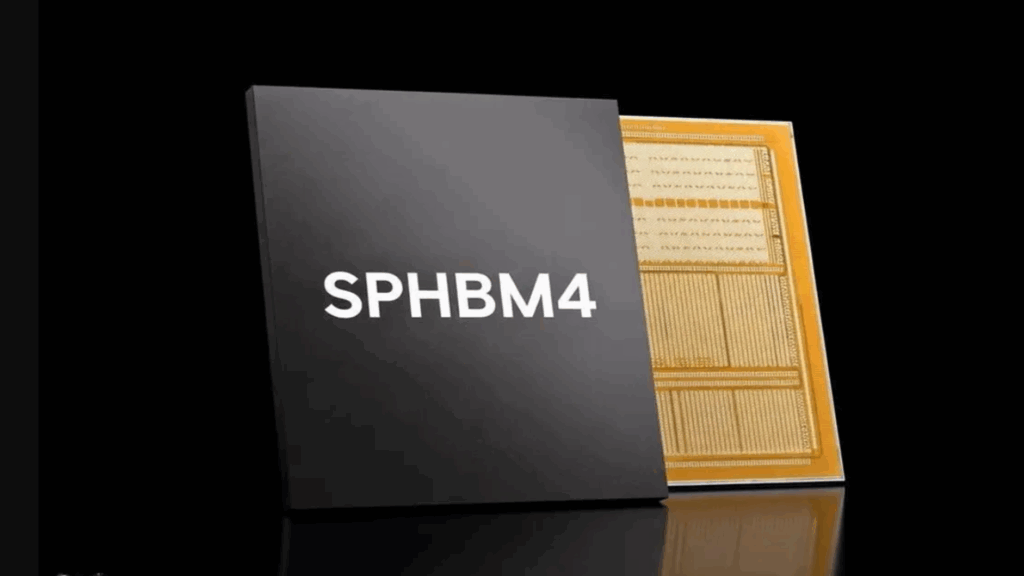
- SPHBM4 dramatically reduces the number of pins while maintaining hyperscale class bandwidth performance
- Organic substrates reduce packaging costs and relieve routing constraints in HBM designs
- Serialization shifts complexity to signaling and base logic silicon layers
High-bandwidth memory has evolved around extremely wide parallel interfaces, and that design choice has defined both performance and cost constraints.
HBM3 uses 1024 pins, a number that already pushes the limits of dense silicon spacers and advanced packaging.
The JEDEC Solid State Technology Association is developing an alternative known as Standard Package High Bandwidth Memory 4 (SPHBM4), which reduces the physical interface width while preserving overall throughput.
HBM4 interface duplicates HBM3
The standard HBM4 specification doubles the HBM3 interface width to 2,048 pins, with digital signals passing through each switch to increase overall throughput.
This scaling approach improves bandwidth, but it also increases routing complexity, substrate requirements, and manufacturing cost, which concerns system designers.
The planned SPHBM4 device uses 512 pins and relies on 4:1 serialization while operating at a higher signaling frequency.
In terms of bandwidth, one SPHBM4 pin is expected to carry the equivalent workload of four HBM4 pins.
This approach moves complexity away from pin count and toward signal technology and basic logic design.
Reducing the number of pins allows greater spacing between contacts, which directly affects packaging options.
JEDEC states that this relaxed bump pitch enables connection to organic substrates rather than silicon interposers.
Silicon substrates support very high interconnect densities with pitches above 10 micrometers, while organic substrates typically operate closer to 20 micrometers and cost less to manufacture.
The interposer connecting the memory stack, its base logic die and an accelerator would therefore move from a silicon-based design to an organic substrate design.
HBM4 and SPHBM4 devices are expected to offer the same memory capacity per stack, at least at the specification level.
However, organic substrate mounting allows longer channel lengths between the accelerator and memory stacks.
This configuration can allow multiple SPHBM4 stacks per package, which can increase overall memory capacity compared to conventional HBM4 layouts.
Achieving this result requires a redesigned base logic matrix, as SPHBM4 memory stacks involve a four-to-one pin count reduction compared to HBM4.
HBM is not general purpose memory and is not intended for consumer systems.
Its use cases remain concentrated in AI accelerators, high-performance computing, and GPUs in data centers powered by hyperscalers.
These buyers operate at scales where memory bandwidth directly impacts revenue efficiency, justifying continued investment in expensive memory technologies.
SPHBM4 does not change this usage model, as it preserves the bandwidth and capacity of the HBM class while optimizing system-level cost structures that are mainly relevant for hyperscaling deployments.
Despite references to lower costs, the SPHBM4 does not indicate a path into consumer RAM markets.
Even with organic substrates, SPHBM4 remains stacked memory with a specialized base logic matrix and tight coupling to accelerators.
These characteristics are inconsistent with DIMM-based consumer memory architectures, price expectations, or motherboard designs.
Any cost reduction applies within the HBM ecosystem itself rather than across the wider memory market.
However, for SPHBM4 to become a viable standard, it requires support from major suppliers.
“JEDEC members are actively shaping the standards that will define next-generation modules for use in AI data centers…” said Mian Quddus, Chairman of the JEDEC Board of Directors.
Major vendors including Micron, Samsung and SK Hynix are JEDEC members and are already developing HBM4E technologies.
“Our #NuLink D2D/D2M #interconnect solution has demonstrated the ability to achieve 4TB/s bandwidth in standard packaging, which is up to 2x the bandwidth required by the…HBM4 standard, so we look forward to leveraging the work JEDEC has done with SPHBM4…” said Eliyan, a base logic semiconductor company.
Via Blocks and files
Follow TechRadar on Google News and add us as a preferred source to get our expert news, reviews and opinions in your feeds. Be sure to click the Follow button!
And of course you can too follow TechRadar on TikTok for news, reviews, video unboxings, and get regular updates from us on WhatsApp also.


