
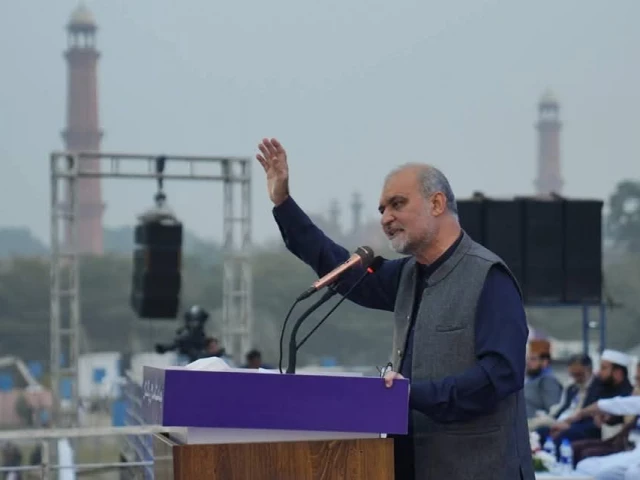
JI chief Hafiz Naeemur Rehman addresses the inaugural meeting of the party’s three-day congregation beginning at the historic Minar-e-Pakistan in Lahore. Photo: X
LAHORE:
Jamaat-e-Islami (JI) chief Hafiz Naeemur Rehman on Sunday announced a nationwide campaign of protest rallies and sit-ins as part of the party’s “Badal do Nizam” (change the system) movement.
He unveiled the next phase during the concluding session of JI’s three-day JI’s Ijtima-e-Aam at Minar-e-Pakistan, which was attended by hundreds of thousands.
Addressing the massive gathering, Hafiz Naeem said the movement sought to “remove a handful of people from positions of power” and overhaul a “fake legal system”. He accused certain elements of trying to change the constitution to protect corruption and declared that they would be held accountable to 250 million Pakistanis.
The JI chief said the party would launch a drive for “supremacy and protection of the constitution”.
He announced that JI would organize protest rallies and sit-ins in 25 major cities over the next three months, adding that after mobilizing the public, the party would “liberate Pakistan from the grip of a few”.
The JI emir also ruled out electoral alliances with any political party. He called for lifting the ban on the TLP, which he noted had won hundreds of thousands of votes, and demanded the release of PTI’s founding chairman and former prime minister Imran Khan.
He announced that Jamaat-e-Islami aims to recruit five million new members and establish 50,000 community committees nationwide.
Hafiz Naeem identified the lack of discipline in political parties as one of the country’s most pressing issues, saying key decisions are often driven by wealth, influence and dynastic interests.
He made it clear that Jamaat-e-Islami will not field any candidates until the election schedule is announced and reiterated that all decisions within the party will be taken strictly in accordance with its organizational principles.
He said that all workers and youth members of Jamaat-e-Islami were representatives of the movement and candidate selection would be completely system driven.
Furthermore, he urged party workers to integrate the teachings of the Qur’an into their daily lives, maintain honesty in financial matters, avoid conflicts over trivial matters, and strengthen the party’s grassroots presence.
He said the root cause of Pakistan’s political and economic crises lies in the concentration of power in few hands and the disproportionate influence of the bureaucracy.
He emphasized that JI envisages a governance model where real authority rests with elected officials.
On foreign policy, the JI emir urged Pakistan to adopt an independent stance, asserting that dependence on the US has harmed national interests. He said regional peace was being undermined by “external interference”.
He added that Kashmir and Palestine remained non-negotiable red lines for JI, rejecting the two-state solution for Palestine and only announcing support for a fully independent Palestinian state.


