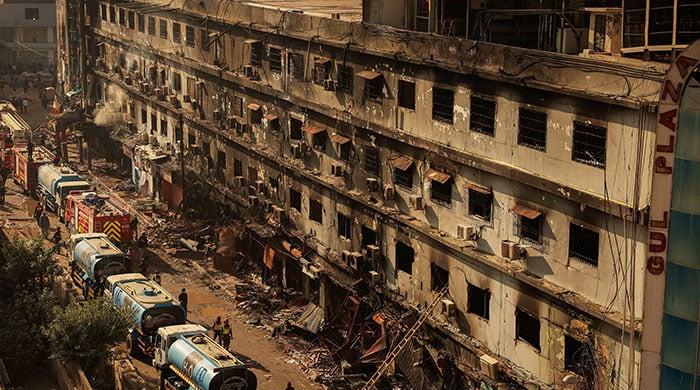
- Fire incidents reveal serious gaps in safety preparedness.
- More than 20 fire incidents reported in February so far.
- The deadliest incident of the Gul Plaza fire occurred on 17
The memory of the deadly Gul Plaza fire still haunts Karachi, a stark reminder of how devastating fires can be in the city. But fire incidents still continue unabated, revealing serious gaps in safety and preparedness.
This January alone, Karachi reported an alarming 225 fire incidents, leaving destruction, injuries and loss of life in their wake, The news reported Saturday.
The trend has continued into February, with more than 20 fire incidents reported in just the first five days, showing the city remains at constant risk.
Authorities warn that unless stricter security measures and increased public awareness are implemented, Karachi’s residents will continue to face daily threats from both major and minor fire incidents – a danger that cannot be ignored.
On Thursday alone, fire incidents were reported at six different places in different parts of the city. Although no human casualties were reported in these incidents, two animals – a cow and a buffalo – suffered burns.
The deadliest incident occurred on January 17, when an inferno at Gul Plaza killed 79 people, including women and children, and left at least 22 others injured, according to official figures.
Since then, no major fire disaster of similar magnitude has been reported. But small fires continue to break out on a daily basis, with as many as five to six incidents sometimes reported in a single day.
Four more people, including a child and an elderly man, also lost their lives in separate fire incidents last month. In addition to the loss of life, countless others are struggling with property damage and economic ruin, painting a grim picture of the ongoing danger that fires pose to Karachi’s residents.
People often focus only on the Gul Plaza fire, the lives lost in it and the devastation it caused. But while such large-scale tragedies are rare, smaller fire incidents continue to occur on a daily basis across the city. It’s not just statistics. People lose their lives and suffer economic losses every day.
Among other notable incidents, a man died in Landhi on January 1 after being burnt by a fire lit to keep warm in the cold weather. On January 26, a fire broke out in Malir’s Khokhrapar area in a private school operating inside a house, resulting in the death of a minor and injuries to another. Other students were rescued in time.
Another fatal fire took place in Gulistan-e-Jauhar on 28 January. A separate fire incident in Orangi Town also claimed a life. Several others suffered injuries in incidents reported in Hawkesbay and in Korangi and near the Met Office area.
Data shows District Central reported 30, the highest number of fires, in January. Saddar reported 18 incidents while another 18 took place within the jurisdiction of Sohrab Goth-Gulistan-e-Mustafa fire station.
Nazimabad reported 13 incidents, SITE area 11, and Lyari and Korangi nine each. Landhi reported three incidents, while Orangi Town and Shah Faisal Colony reported eight each. Manzoor Colony reported 14 incidents and areas covered by New Karachi fire station reported 13.
On Thursday, fires were reported at several places, including a plastic warehouse near Nauman Kanta on Sher Shah Akbar Road, where the fire rekindled repeatedly due to Thermocol. Firefighters used heavy machinery under the supervision of Assistant Commissioner Nida Saman to demolish walls and complete cooling operations.
Other incidents included a fire on the roof of a private bank near Sultan Hospital in Korangi No. 4, a fire in chemical-filled drums at a perfume factory in Mehran Town, a cattle shed fire in Malir’s Khurramabad area, a fire in a gym in Federal B area and a fire in a K-Electric tower in New Karachi Industrial Area. All the fires were brought under control without any casualties.
Authorities have expressed concern over the increasing frequency of fire incidents and stressed the urgent need for stricter safety measures, regular inspections and greater public awareness to prevent more tragedies.