
Defense Minister cites capacity payments in long-term agreements with independent power producers
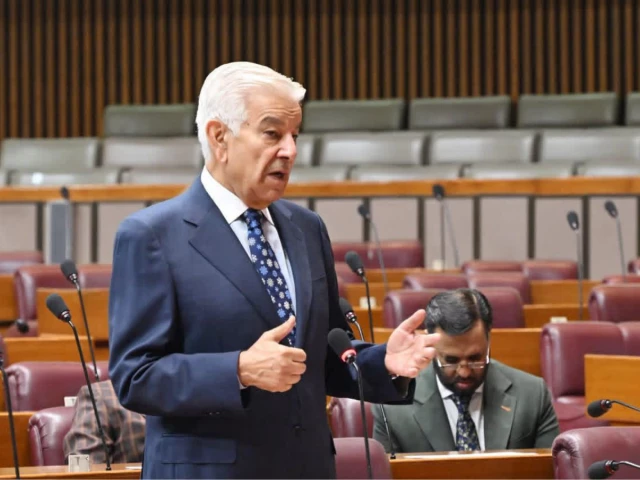
Defense Minister Khawaja Asif addresses the National Assembly. PHOTO: FACEBOOK/ PAKISTAN NATIONAL ASSEMBLY
ISLAMABAD:
Defense Minister Khawaja Asif on Tuesday defended the government’s revised solar policy, saying authorities were constrained by long-standing agreements with independent power producers (IPPs) and must balance the interests of solar users and conventional electricity consumers.
Speaking at a meeting of Pakistan’s National Assembly, chaired by Speaker Sardar Ayaz Sadiq, Asif said that while switching to solar power was desirable, capacity payment obligations limited policy flexibility.
“So this is the way forward – go solar. What can we do? Capacity payments have to be made; our hands are tied,” he said.
The debate followed an “attention notice” moved by Syed Naveed Qamar of the Pakistan Peoples Party (PPP), which raised concerns over the imposition of tax on solar panels.
Foreign Minister Shazra Mansab Ali Khan Kharal said the tax had been reduced from 18% to 10% and would only apply to new consumers. She said the policy was based on several considerations.
Read more: Five policemen injured in IED attack on patrol in KP’s Lakki Marwat
The National Electric Power Regulatory Authority revised terms for net-metered solar consumers in February to manage increasing solar deployment and protect the financially strained grid.
The amendments abolished the exchange of electricity units under net metering and proposed to reduce the buy-back rate for excess solar power from Rs25.9 per unit. unit at Rs11 per unit. The duration of the contract was also reduced from seven to five years. The changes came into effect on February 9 and will not apply to existing consumers until their current contracts expire.
Opposition lawmakers criticized the move, saying it discouraged the adoption of renewable energy. Qamar questioned why green energy was penalized when electricity remained expensive and largely generated by polluting fuels.
Responding to criticism, Asif said earlier agreements with IPPs — signed two to three decades ago under successive governments, including those of the PPP — continued to bind the current administration. “Discussions were held with IPPs some time ago but little progress was made,” he said.
Under these agreements, the government must pay power producers in US dollars based on installed capacity, regardless of actual power purchases. Over time, revised contracts increased costs per unit and capacity payments, contributing to a circular debt of over Rs 2.3 trillion.
Read also: Heavy rain in KP swells rivers, triggers power outages, disrupts daily life
Fuel price increase
Lawmakers also raised concerns about rising fuel prices. PPP lawmaker Sharmila Farooqi criticized the latest hikes, saying Pakistan had raised oil prices ahead of regional peers and that official briefings had been unsatisfactory.
She said gasoline still carries heavy taxation and called on the government to reduce margins for oil companies and develop a comprehensive pricing policy. “People ask us how they will manage their livelihood. Even we hesitate while arranging petrol,” she added.
Responding to the ongoing energy crisis, the government on Thursday further hiked petrol prices by Rs137 per liter to a record high of Rs458.4. It was the second major increase in fuel prices in less than a month. But on Friday evening, Prime Minister Shehbaz announced a reduction of Rs80 per liter in oil tax on petrol.
Criticizing the finance minister, NA member Noor Alam Khan said, “By raising prices, you have benefited the oil companies,” he said, adding that the rise in diesel costs has made all goods more expensive. “Now even wheat harvest has become prohibitive.”
Noor Alam also questioned why petrol prices rose despite Saudi Arabia supplying oil and Iran providing passage. “If Saudi Arabia was supplying oil and Iran was providing passage, why were gasoline prices still rising?”
MNA Alia Kamran submitted an awareness message highlighting the lack of tax revenue, reported a shortfall of Rs 430 billion. last year and accused the government of trying to reduce the deficit by raising oil prices.
The federal government missed the International Monetary Fund (IMF) dictated fiscal target by a wide margin of Rs610 billion. It is the third quarter in a row that the FBR has missed its tax target. The government is offsetting the tax deficit with the increase in oil tax rates and by drastically reducing development spending.
Foreign Minister Bilal Azhar Kayani said that Pakistan aims to secure a primary balance. “We have introduced digital invoicing for cement, tobacco and sugar and will increase enforcement collection. Last year we achieved the primary balance and this year we will also achieve our target.”
He added that during the ongoing war, the government removed burdens wherever possible by setting diesel tax to zero and reducing petrol tax by Rs80. “Some work has already been done to widen the tax net.”
PPP MNA Mirza Akhtar Baig also criticized the sudden hike in petrol prices and asked how much profit companies got after the price was hiked by Rs55 overnight. “Global prices may rise and increases may be necessary, but they should not be so high that life becomes impossible for ordinary citizens,” he said.
He also questioned the finance minister about austerity and criticized the federal government’s unjustified spending.
Responding to the opposition, Finance Minister Muhammad Aurangzeb defended the government’s fiscal measures in NA and urged lawmakers to rely on accurate information. “We have to look at the facts,” he said, adding that “some things said in Parliament do not exist.”
He said that when global oil prices rose, “a blanket subsidy was provided to petroleum products,” adding that “Rs129 billion in subsidies have been provided so far,” while “Rs100 billion has been cut from the public sector development program” and “a third-party audit is being conducted.”
Aurangzeb said targeted subsidies are now being rolled out. “Targeted subsidies are being given … the process has started and the first installments have started reaching the beneficiaries,” he said, noting that the provinces already have electronic data to identify beneficiaries.
He said the government is closely monitoring global developments. “In several countries queues have formed for oil,” he said, adding that fuel prices in the UAE have risen sharply, with petrol rising by around 30% and diesel by as much as 70%.
The minister said domestic oil and gas prices are also under review, while maintaining that reserves remain stable. “So far there has been no impact on foreign reserves,” he said, confirming that a repayment of $1.4 billion in Eurobonds is due this week.
Aurangzeb said that 26 institutions have been handed over to the Privatization Commission, though some are not suitable for privatization. He also acknowledged governance issues, saying corruption had been identified in subsidy programs at institutions such as supply stores.
He said lessons learned from the Covid-19 pandemic are being used to deal with the energy crisis, adding that a task force has been set up to shift towards cleaner energy over the next eight to 10 years. “We will move towards clean and green energy,” he said, expressing hope that “peace will prevail” and Pakistan’s efforts for regional stability will succeed.
The Gulfstream jet
MNA Atif Khan raised an issue with the recently acquired Gulfstream jet by the Punjab government and demanded that until petrol prices are reduced, Punjab Chief Minister Maryam Nawaz should not travel by jet. “Only then will we know if they are serious.”
The aircraft in question, a Gulfstream G500 with registration number N144S, arrived in Lahore from North America in December 2025 and began local flight operations on February 6, 2026. The jet purchased by Punjab is a 19-seater VIP aircraft worth a staggering Rs 11.7 billion. table.
Responding to widespread criticism, Abid Sher Ali, a Pakistan Muslim League-Nawaz (PML-N) senator, said the plane belonged to the Punjab government and its replacement was justified as the previous jet was more than 25 years old.
Defense Minister Khawaja Asif said all four provincial chief ministers are using aircraft and only Maryam Nawaz is being targeted. “This kind of political stance is inappropriate,” he said, adding that the prime minister continues to use an older aircraft.
MNA Juniad Akbar replied that all four chief ministers have planes, but that the other three use older planes.
Opposition member Zain Qureshi added that KP Chief Minister does not have a plane and asked why Punjab Chief Minister bought a Gulf Air plane worth Rs 11 billion. “Why did she sabotage herself with this decision?” he said.
Balochistan and Tirah
Meanwhile, opposition leader Mahmood Khan Achakzai called for political dialogue and unity, warned of unrest in Balochistan and called for greater space for civilian leadership.
“We have to agree on some key points. We have to tell the military to give us some space. Countries cannot function without their armed forces,” he said. He added that if Prime Minister Shehbaz was present, he would go and personally talk to him. “This country can only progress through collective wisdom,” he added.
Read more: Reporting of gas pump data is inadequate
Separately, legislator Engineer Hamid Hussain highlighted the displacement of residents from Tirah Valley in Khyber-Pakhtunkhwa and said that more than 26,000 families had been registered in Bara amid the ongoing operations and were facing severe hardships.
Since the beginning of the year, there have been ongoing large-scale displacements from the Tirah Valley. More than 26,000 families have been registered in Bara as part of what officials describe as a major humanitarian and administrative operation in the border region.
National Assembly Speaker Ayaz Sadiq directed authorities to provide details of affected individuals and said the matter would be taken up with provincial officials, including the KP Inspector General of Police.
The session of the National Assembly was adjourned until 17 Wednesday.


