
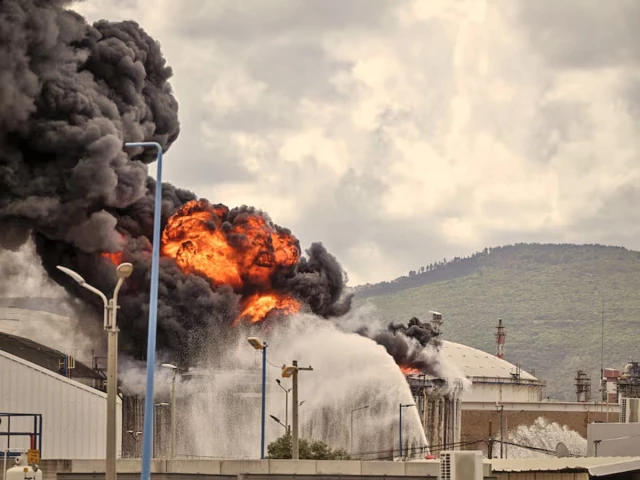
US strengthens troop presence in region Both sides exchange new waves of attacks The Haifa refinery was struck again in the middle of
WASHINGTON/TEHRAN:
US President Donald Trump sharply raised the stakes, warning that Washington could unleash widespread destruction of Iran’s critical infrastructure if an agreement to end hostilities is not reached “soon”.
The growing and increasingly volatile conflict showed no sign of abating on Monday as fresh strikes, increasing military deployments and stark warnings of escalation underscored the risk of a wider regional and economic crisis.
Trump’s threats included targeting oil facilities, power plants and even desalination systems that supply drinking water. They came as Washington continued to project confidence in diplomatic progress, even as Tehran publicly dismissed US proposals as “unrealistic, illogical and excessive”.
At the center of the tensions is the Strait of Hormuz, a vital global energy artery through which about a fifth of the world’s oil passes. Iran has effectively blocked the narrow waterway, sparking fears of prolonged supply disruptions and sparking a sharp rise in global oil prices.
Brent crude rose to around $115 a barrel. barrel, marking a rise of nearly 60% since the war began on February 28, as markets braced for further escalation. The International Monetary Fund and G7 finance leaders have warned of serious spillover risks to global economic stability.
“The United States is in serious discussions with a NEW AND MORE REASONABLE REGIME to end our military operations in Iran,” Trump wrote in a social media post, adding that “great progress” has been made in the talks.
“However, if for some reason an agreement is not reached shortly, which it likely will be, and if the Strait of Hormuz is not immediately ‘Open for Business’, we will end our lovely ‘stay’ in Iran by blowing up and completely wiping out all of their electrical generating facilities, oil wells and Kharg Island (and possibly all of the desalination plants on purpose!) which he has yet to say on purpose!”
On the battlefield, both sides intensified their attacks. Iran launched new waves of missiles aimed at Israel, hitting infrastructure across the Gulf. In Kuwait, an Iranian attack hit a power and desalination plant, killing one worker and wounding 10 soldiers.
Saudi Arabia intercepted several missiles aimed at its oil-rich Eastern Province, while the United Arab Emirates air force shot down a projectile over Dubai. Turkey also reported intercepting a ballistic missile that briefly penetrated its airspace, highlighting the growing geographic reach of the conflict.
Inside Israel, a fire broke out at an oil refinery in Haifa for the second time during the war, while residential areas in cities including Shefaram and Haifa suffered damage from Iranian missile strikes. Sirens also sounded near sensitive strategic locations, reflecting sustained pressure on Israeli defenses.
Israel, backed by the United States, launched a new wave of attacks on Iran, targeting what it described as military infrastructure. Explosions were reported across Tehran, and a petrochemical plant in Tabriz was damaged in an airstrike.
The US has significantly increased its military presence in the region. Thousands of troops from the 82nd Airborne Division have begun arriving, adding to deployments of Marines, naval forces and special operations units already in place.
Officials said the troop buildup is intended to expand Washington’s military options, including the option — still under consideration — of deploying ground forces inside Iran for missions such as securing oil routes, extracting nuclear material or seizing strategic assets such as Kharg Island, which handles the majority of Iran’s oil exports.
Despite the military escalation, the White House insists that diplomacy remains active. Officials say talks are progressing through intermediaries, although analysts note a persistent gap between public rhetoric and private signals from both sides.
Trump has even floated the idea of calling on Arab states to help finance the war effort, while setting an informal deadline for Iran to reopen the Strait of Hormuz. Failure to comply, he warned, could trigger devastating US strikes.
However, Iran has reacted with defiance. Senior officials warned that any US incursion on the ground would be met with force, with one senior official saying Iranian troops were ready to “set them on fire” if US forces entered the country.
Tehran has also hinted at further escalation options, including mining in the Persian Gulf and potentially withdrawing from the Nuclear Non-Proliferation Treaty (NPT), a move that would heighten fears of nuclear proliferation.
The human cost of the conflict continues to rise. Iranian authorities say more than 1,900 people have been killed, while at least 19 have died in Israel. Dozens more have been killed across the Gulf and other affected areas, with many casualties reported to be civilians. More than 300 US soldiers have been wounded and 13 killed since the start of the operations.
The conflict has also triggered geopolitical ripples far beyond the immediate region. Spain has barred US military aircraft involved in the war from using its airspace, reflecting growing unease among some allies over the scale and legality of the campaign.
As military activity intensifies and diplomatic efforts struggle to gain traction, the war appears to be entering a more dangerous phase, where the risk of direct confrontation widens and the consequences for the global economy become harder to contain.


