
Almost 400,000 students appear as complaints about overcrowding, power cuts, cheating surface
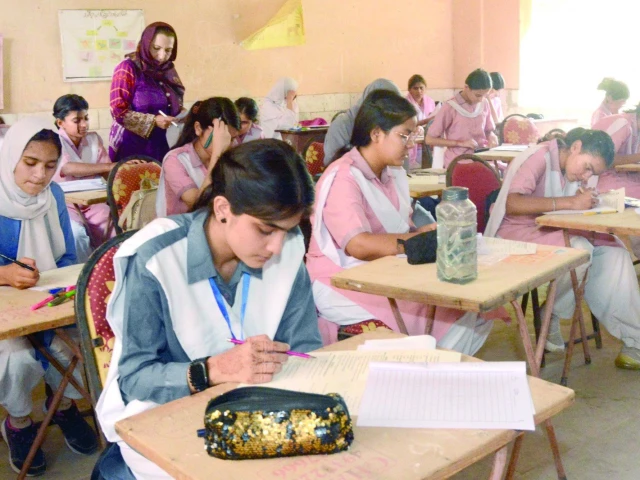
Girls Higher Secondary School Jacob Lines Examination Center in Karachi. PHOTO: JALAL QUERESHI/FILE
KARACHI:
Annual examinations for classes IX and X under the Board of Secondary Education Karachi (BSEK) have begun across the metropolis, with over 385,000 candidates appearing at 521 examination centers established in 18 cities.
The exams were conducted in two shifts under tight security arrangements while 51 vigilance teams were deployed to curb cheating. According to BSEK, paper distribution was monitored through a control room and special measures were taken to ensure transparency, including monitoring via video calls and WhatsApp groups. Section 144 was also imposed around examination centres.
In the morning shift, Class X students appeared for Computer Science, while General Science was held in the afternoon. Each paper was of three hours duration.
However, complaints of mismanagement and lack of facilities surfaced at several centres. Problems were reported, including lack of furniture, non-functional fans and power cuts, forcing candidates to sit in difficult conditions. In some centers, students were reportedly forced to sit on mats due to inadequate seating arrangements.
At a government boys’ school in Malir, students complained of extreme heat due to non-functional fans, while power cuts were also reported in several areas despite requests for uninterrupted power supply.
There were also reports of irregularities from various centres. At Government Boys Secondary School No. 1 PECHS, several cases of alleged cheating were reported while during a search operation, a student was found with a dagger along with cheating material, raising serious concerns over security arrangements at examination centres.
On the occasion, BSEK chairman Ghulam Hussain Soho while visiting a center at Pilot Girls Higher Secondary School Nazimabad claimed that the examinations were conducted peacefully and the arrangements were satisfactory. He said surveillance was ensured through the control room and the watch teams were actively working across centres.
However, he acknowledged problems like limited availability of centers in government schools and lack of furniture, while maintaining that basic facilities including electricity and water were available at all centers.
However, Director of Secondary Education Mirza Arshad Baig disagreed with the board’s stand and stated that examination centers are finalized after field verification by board teams. He said that in several cases, students were accommodated beyond capacity, with some centers designed for 200 students being allocated up to 400 candidates, causing administrative difficulties.
The All Sindh Private Schools and Colleges Association also expressed serious concerns over last-minute center allocations, software glitches and problems in the examination registration system, terming them as a source of mental stress for students. The association further said that overcrowding at smaller centers could facilitate fraud and reflect poor planning on the part of the authorities.
Meanwhile, students and teachers demanded better arrangements citing poor infrastructure and lack of basic facilities at several centres.
Despite official claims of smooth conduct, the first day of matriculation was marred by allegations of mismanagement, infrastructure deficiencies and security breaches, raising questions about the preparedness of the exam system.


