
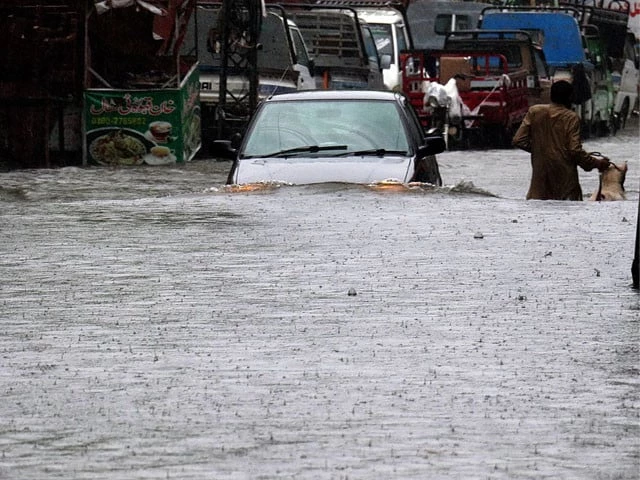
Heavy monsoon rains have pushed river levels over Punjab to dangerous heights, flooding villages, destroyed crops and cut off Earth’s access in several districts. Local authorities have established flooding camps, while rescue teams continue evacuations as the meteorological department warns of further rainfall and flash floods in the coming days.
According to Punjab Disaster Management Authority (PDMA), the province is currently experiencing the seventh magic form for monsoon rain, which is expected to continue until August 23.
Officials warned that cloudbursts remain possible in Rawalpindi, Murree, Galliyat, Jhelum, Chakwal and Attock, while heavy rainfall is expected across major city centers, including Lahore, Sialkot, Faisalabad and Multan.
Read more: PM exposing ministers to supervise
In Kasur, the Sutlej River has risen sharply, immersive dozens of villages and large agricultural land. PDMA -Employees reported on water discharge at the Ganda Singh Wala headwork reached 75,000 CUSSCS. Authorities warned that further water releases from India’s Harike headwork could intensify flooding, which is further jeopardizing societies downstream.
The wave has destroyed standing crops, damaged hundreds of hectares of agricultural land and displaced scores of families. Rescue 1122 teams have deployed boats to move stranded residents, while flooding camps provide food, medical treatment and livestock feed.
In Bahawalnagar, violations of protective dams have enabled flooding water to spread in villages, which asks the district administration to impose section 144 to limit the civil movement along Riverbanks.
Similar conditions were reported in Chiniot, where the Chenab River has reached low flood levels and in the Kundian, where the Indus River flows on medium flood stage.
In Narowal’s Zafarwal Tehsil, Dek Nullah swollen with more than 22,000 CuseC’s water flooding villages nearby and damaged homes. Auxiliary camps were created in several places and evacuation warnings were sent into low -lying communities.
Officials also said that India’s release of additional water in Sutlej has increased risks in Chishtian, where sugar cane and cotton fields have already been affected. Farmers warned that further flooding could cause catastrophic financial losses.
ALSO READ: Journalist Khawar Hussain found shot in Sanghar
The Pakistan Meteorological Department released a red alarm warning of heavy rain that was able to generate flash floods in streams and nullahs over Khyber Pakhtunkhwa, Kashmir, Gilgit-Baltistan, Pothohar region, Dera Ghazi Khan and northeast Balochistan. The city’s flood is still a major problem for low -lying areas of Lahore, Rawal Pindi, Islamabad, Peshawar and parts of the southeast Sindh.
Authorities also warned of landslide and mud lids in hilly regions, including Murree, Galliyat, Kashmir and Gilgit-Baltistan. Strong wind and lightning can damage weak structures such as thatched home, power bars and picture boards by the roads, officials said.
At a meeting with chairman of provincial disaster management committee chief Khawaja Salman Rafique conducted officials continuous surveillance of river flows and confirmed that section 144 will remain in place around vulnerable river banks.
Authorities appealed to the public to follow evacuation orders, avoid unnecessary travel and remain aware of rapidly changing weather conditions.
The Punjab Tourism Department also issued an advisory limiting entry to rivers, streams and other areas at high risk. Emergency control rooms have been created on tourist and heirlooms, while rescuers have been placed on a high alarm. Travelers were encouraged to control weather updates before they began and call for emergency numbers in case of danger.
Precipitation data
Over the past 24 hours, heavy rain was recorded in several parts of Punjab. Islamabad received up to 76 millimeters at Golra and 75 millimeters at Saidpur, while Rawalpindi registered 53 millimeters at Chaklala. Jhelum, Sialkot, Mangla and Mandi Bahauddin also reported on considerable rain. Heavy showers were also measured in Tharparkar, Barkhan and parts of Kashmir.
Meteorologists said that moist streams from both the Arabian Sea and Bengalbugt combined with a Western wave burn the ongoing system. Rain and thunderstorms are expected to continue through the beginning of next week, with the heaviest falls expected in northern Punjab, Pothohar, Upper Khyber Pakhtunkhwa and northeast Balochistan.
Punjab Tourism Department issues advisory
The recent magic form has not only been hit hard, but the damage has also been expanded to popular tourist destinations. Roads and bridges in several valleys have collapsed and disturbed travel, while hotels and guesthouses in certain areas also have significant losses.
In response, the Punjab Tourism Department has issued an advisory province to ensure public security at all tourist places. According to the counseling, all field offices have been asked to remain in close coordination with district administrations and emergency surgery centers for a timely reaction to any crisis.
Emergency Control Rooms are established in historical and tourist places; Focal persons are appointed to maintain immediate contact with rescue agencies, and the staff are instructed to remain vigilant, trained in first aid and emergency preparedness.
پی ڈی ایم oud
Ital
یاح ک پہاڑی علاق کےext ضروی فر ے گریز کی ہایات۔ pic.twitter.com/ywekmpnxty– PDMA PUNJAB OFFICIAL (@PDMAPUNJABO) August 17, 2025
Punjab Tourism Secretary, Raja Jahangir Anwar, said public access to Riverside, streams and vulnerable areas will be limited to preventing unfortunate events. He added that relief numbers appear at all tourist places, and encouraged travelers to stay up to date with the latest weather forecasts before going on any journey.
“In the event of heavy rain or flood -like conditions, people should avoid unnecessary journeys and immediately contact the accompanying guides in the event of emergencies,” he advised.
It is worth noting that earlier, National Disaster Management Authority (NDMA), on the directives of Prime Minister Shehbaz Sharif, had also issued an advisory limiting tourism in mountainous and disaster-exposed regions.
NDMA warned that, if necessary, section 144 could be imposed to limit the public movement in areas at high risk, while the authorities have been aimed at enforcing tourist restrictions during the ongoing monsoon season.


