
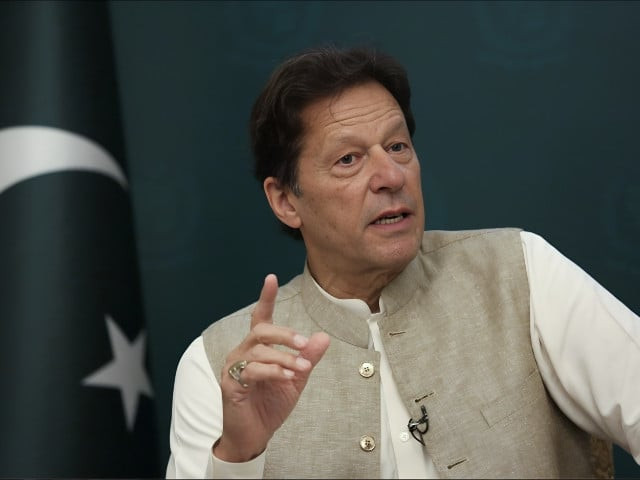
Pakistan Tehreek-i-Insaf founder Imran Khan. Photo: Reuters/file
ISLAMABAD:
A single medical revelation has changed the political temperature. Before jailed former prime minister Imran Khan revealed that he had lost 15 percent of the sight in his right eye, many within the PTI had quietly resigned themselves to a prolonged incarceration.
The legal space seemed limited, the political climate unforgiving and the prospect of immediate relief remote. Even among the most committed supporters there was a grim tenacity, a sense that this would be a long and grinding wait.
Then came the seven-page report detailing the PTI founder’s prison conditions. Clinical in tone, yet politically combustible in implication, it changed the mood almost overnight. The legal and political battle suddenly entered the realm of health and humanitarian concern.
The partial loss of sight struck a chord that extended beyond party lines.
The discourse changed. No longer limited to courtroom technicalities or election appeals, the conversation moved into questions of moral responsibility and medical urgency.
Within hours, PTI’s rank and file appeared to be revived. Social media was abuzz with concern, with several former cricketers publicly seeking relief for Khan. What once seemed improbable—the possibility of relief—began to look less like wishful thinking.
Khan’s legal team has petitioned the Islamabad High Court (IHC) seeking suspension of his sentences in the Toshakhana II case, citing serious health problems, including partial loss of vision in his right eye. Courts have ordered independent medical assessments.
Inevitably, speculation followed. Was this just a medical revelation or the opening act of a larger political choreography?
Some observers argue that recent developments are too adaptive to be coincidental. The Supreme Court’s unexpected decision to allow one of Khan’s lawyers to meet him in prison raised eyebrows.
Equally intriguing was the restrained tone Khan adopted in the report itself, conspicuously avoiding direct blame on the establishment. PTI leaders outside echoed this caution. Even the usually combative Khyber Pakhtunkhwa chief minister urged PTI supporters to exercise restraint, while government ministers offered assurances of full medical assistance.
For seasoned political observers, the parallels are hard to ignore. They recall how former prime minister Nawaz Sharif, once convicted and serving a sentence, eventually secured relief on medical grounds.
Is history, in an altered form, ready to repeat itself?
“It is a constant in Pakistani politics that when there is a confrontation between the civilian government and the authorities, any prevailing government will have to take a softer approach,” noted Ahmed Bilal Mehbood, the head of a think tank that closely follows political developments in Pakistan.
“But if you confront, you end up being taken out of action. We have seen this happen repeatedly in the past,” he added, referring to Khan’s current predicament.
Some observers believe that the PTI is already trying to recalibrate its tone. They point to the absence of statements from Khan’s X-handle. The last particularly combative post directed at the establishment came on December 21st. Some interpret the silence as a move to appease those in power.
“Even if some things are happening behind the scenes, the course of action should be for Imran Khan to tone down his politics. Only then progress can be made on these issues,” Bilal said.
“So if you want to return to Pakistani politics, you have to take the safest approach rather than confrontation,” he maintained.
PTI supporters nevertheless argue that the inactivity on Khan’s X-handle is not evidence of any collusion, but rather a result of restrictions on visitors meeting him.
However, Bilal maintained that if Khan wants to return to mainstream politics, he would have to change his approach.
“When former prime minister Nawaz Sharif was in exile in 2002, he did not upset the authorities, waited patiently, bided his time and then came back to contest elections,” he said.
Speaking to the Express Pakinomist, senior journalist Mazhar Abbas expressed doubt that Khan had entered into a secret deal with the authorities.
“I doubt he will be allowed to go abroad. Even if he agrees to go for medical reasons, people might not accept it because his whole political platform is built on staying on the ground,” Abbas said.
According to Abbas, Khan has opposed the type of politics pursued by Asif Ali Zardari and Nawaz Sharif and prefers to fight while remaining in the country.
Analysts believe any move by Khan to strike a deal carries a political risk as his supporters may struggle to accept it.
Abbas agrees with that assessment. “So even if he decides to go for health concerns or other reasons, the public may not accept it.”
He is also skeptical that the authorities will allow Khan to leave. “It does not seem likely that permission would be granted. If so, there would probably have to be a written undertaking that he would not make political statements from abroad, as was required of Nawaz Sharif earlier when he was released.”


