
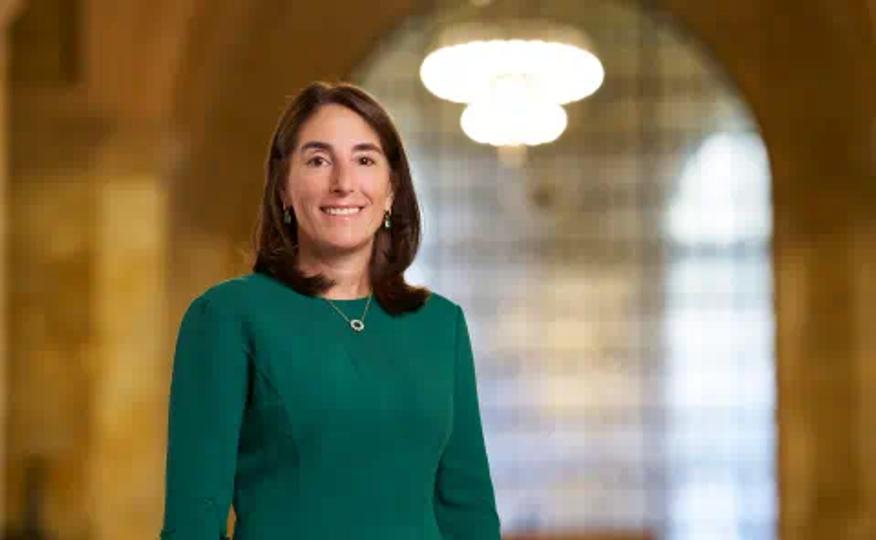
It’s no secret that Cleveland Fed President Beth Hammack has staked out a spot as perhaps the most hawkish member of the U.S. central bank since her appointment in 2024 after a career at Goldman Sachs.
Next year, however, she will be in a more prominent position to advance these views. The Fed’s Federal Open Market Committee (FOMC) sets interest rate policy. Among its twelve voting members are four of the Fed’s eleven district presidents, who serve one-year terms. In 2026, the head of the Cleveland Fed – Hammack – will join this voting group.
“My starting point is that we can stay here [with rates] for a period of time until we get clearer evidence that either inflation is falling back to target or that the employment side is weakening more significantly,” Hammack told the WSJ over the weekend.
“I take that with a grain of salt,” Hammack said of last week’s November consumer price report, which showed a shock drop in the headline inflation rate to 2.7% from 3.1%, with a corresponding drop in the core interest rate.
Hammack blamed last fall’s government shutdown on data distortions, and her own calculation puts the rate more like the 2.9% or 3.0% that economists had previously predicted.
All other things being equal, easier central bank monetary policy is assumed to be good for risk assets such as stocks, commodities and bitcoin . While that’s certainly been the case this year for stocks and commodities like gold and silver — all of which are at or near record highs — bitcoin has struggled, beginning a decline from its own high not long after the Fed’s first rate cut in September.
A big break with Waller
Among the finalists to become President Trump’s pick for the next Fed chair is current Fed Governor Chris Waller.
Waller said three days ago that he views the current level of 3.5%-3.75% of the Fed Funds rate range as 50 to 100 basis points above the neutral level – meaning Fed policy remains quite restrictive.
However, Hammack told the WSJ that the fed funds range today is “a little bit below” the neutral rate, meaning she believes current policy is at least somewhat stimulative.
That’s an enormously wide delta between two of 2026’s most important political decision-makers. Regardless of where the awards go in 2026, there are bound to be disagreements on what is typically a unanimous or near-unanimous vote. Whoever ends up as Fed chairman may find it problematic to line up the seven votes needed at each meeting to set policy.


