
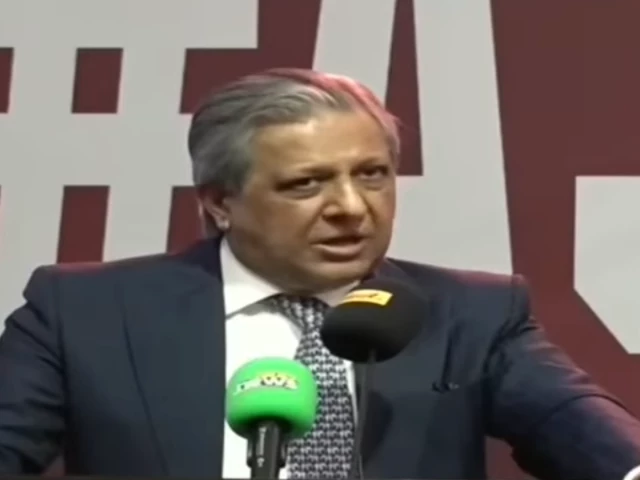
Law Minister Azam Nazeer Tarar is addressing the Asma Jahangir Conference in Lahore on Saturday. SCREEN GRAB
Law Minister Azam Nazeer Tarar on Saturday announced the formation of a new committee to look into the long-standing issue of missing persons, saying the government was treating the matter with seriousness and sensitivity.
Addressing the Asma Jahangir Conference in Lahore, Tarar said that as the problem had reached alarming proportions, the number of missing persons was nearly 10,000.
He said after a commission was formed, committees were set up and Parliament played its part, the number had gradually declined and was now reported to be around 2,600. Tarar added that although the number had decreased, ideally it should be zero.
But the HRD minister noted that the issue was not unique to Pakistan and existed in many other countries as well.
Referring to steps taken by the previous federal government, Tarar said a relief package had been introduced as a stopgap arrangement. He clarified that the relief package did not mean that cases would be closed.
“It was to alleviate the suffering of the families and it not only includes financial support but also provides a mechanism to resolve all related legal complications.”
Read: Cases of missing persons referred to the Commission
The minister said that another committee was now being set up to look into the matter further, adding that there was serious concern at the prime ministerial level over the issue. He said that Prime Minister Shehbaz Sharif believed that every person should be treated strictly in accordance with the law and such practices could not be accepted in any form.
Explaining the reasons why people were listed as missing, Tarar said that in many cases people who died in terrorist attacks or encounters also ended up being included in the missing persons list. Therefore, he said, it could not be ruled out that some people had voluntarily disappeared and joined banned organizations, which also contributed to the numbers.
He said the government was working on the issue with all seriousness and announced progress on the establishment of an independent commission for minorities. “There is good news from the Ministry of Human Rights. It was a long-awaited wish and demand that there should be an independent commission for minorities. Thank God, the legislation has been completed and the process has now started.”
The Law Minister said the matter would come before Parliament and independent appointments would be made to the commission, expressing hope that credible names would be nominated.
In the same address, Tarar defended the decision to refer some cases to military courts, saying the law required people who attacked military installations to be tried in that forum.
“The anti-terrorism law, under which other people have been convicted or sentenced, allows for harsher and more severe punishments. The reason some people were referred to military courts was because the law required those who entered army defense facilities and searched them to be tried in that forum,” he said.
Tarar added that even in military courts, the government’s effort was to ensure maximum protection within the guarantees provided under the law, which was why the punishments did not appear to be overly severe.
He also welcomed the award of A status to the National Human Rights Commission. He said that in the past insufficient work had been done to formalize the minimum age for child marriage, but the country was now close to passing the law.
“Punjab is almost, almost very close to legislating it, and then only Khyber-Pakhtunkhwa will be left, which we are also in discussions with.”
Also read: Government forms panel to help families of missing persons
Talking about blasphemy cases, he said that the use of social media in such cases was a problem for everyone. He said the government had taken the issue seriously, tightened surveillance and, keeping in mind checks and balances, formulated a policy to ensure that no one was wrongfully persecuted.
Comparing the situation with previous years, Tarar said 2025 had brought some relief as the number of cases had dropped by 20%.
“This time, the total number reported in Pakistan, in a population of 240 million, was only 34 cases compared to 180 to 200 cases annually in previous years.”
He emphasized freedom of expression and said differences of opinion were a right in a civilized society.
He said people should give positive criticism within reasonable limits and show the government a mirror of truth, adding that the government would listen with an open heart and try to rectify matters wherever possible.


