
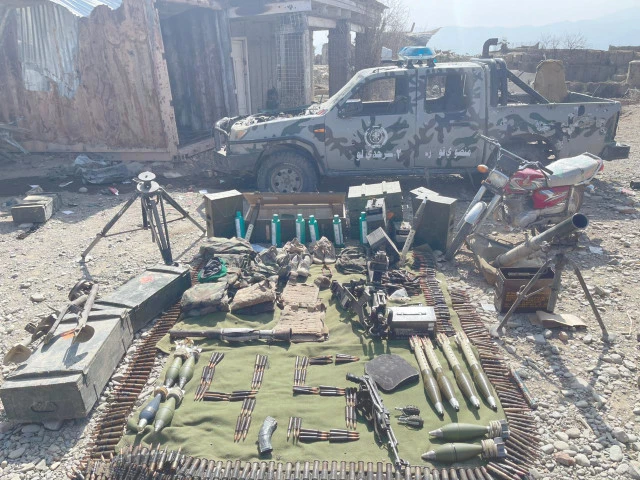
Heavy weapons and ammunition seized from retreating Taliban forces are displayed amid the ongoing operation Ghazab Lil Haq.
ISLAMABAD:
Security officials said Thursday that Pakistan’s ongoing Operation Ghazab Lil-Haq against terrorist networks in Afghanistan will continue until credible assurances are given that terrorism will no longer be supported from across the border.
Relations between Pakistan and the Afghan Taliban have been at their lowest level since the group seized power four years ago. On February 22, Pakistan carried out overnight attacks on terrorist camps and hideouts in Afghanistan’s Nangarhar and Paktika provinces. The Afghan Taliban subsequently launched unprovoked attacks along the border last week. Subsequently, Islamabad launched Operation Ghazab Lil-Haq on 26 February.
While speaking to reporters from Khyber-Pakhtunkhwa in Rawalpindi, the security officials maintained that Pakistan had no problem with Afghanistan or its people, but noted that the Afghan Taliban regime had become a “proxy master” facilitating several terrorist groups, posing a threat to regional peace and stability.
They said the Afghan Taliban leadership had to choose between maintaining relations with Pakistan or continuing support for terrorist groups.
They described Operation Ghazab-Lil-Haq as a continuation of Pakistan’s wider war on terrorism, adding that it would continue until there were credible assurances and practical steps from the Afghan Taliban regime to end patronage of terrorists.
The security officials described the terrorists as Khawarij and said they promoted a “distorted interpretation of religion”. They emphasized that terrorism, suicide attacks and violence against women had no connection with Islamic teachings and were contrary to religious and social traditions.
It added that religious scholars of various schools had declared the fight against the Khawarij and their followers as the highest form of jihad.
Pakistan has been targeting hideouts, facilitation networks and launch pads for Fitna al-Khawarij and Fitna al-Hindustan based on intelligence reports.
Fitna al Khawarij is a term used by the state for terrorists belonging to the banned Tehreek-e-Taliban Pakistan, while Fitna al Hindustan is a term designated by the state for terrorist organizations in Balochistan.
The officials rejected claims that civilian areas were targeted in Afghanistan, calling them contrary to facts that ignored the loss of innocent Pakistani lives in terror attacks.
They further said that groups facing persecution under the Afghan Taliban regime had welcomed the operation, adding that Afghan official social media accounts and Indian-backed media were spreading fabricated narratives.
Officials also noted that more than 200 intelligence-based operations were conducted daily across Pakistan to counter terrorist threats. They stressed that national unity and full implementation of the National Action Plan were essential to eliminate terrorism.
Responding to concerns about regional developments, including tensions involving Iran, officials said claims that Pakistan’s security was under threat were unfounded.
They reiterated that Pakistan believed in maintaining constructive relations with all countries but remained fully prepared to defend its sovereignty and territorial integrity.


