
Authorities continue to monitor the situation to ensure the safety of aviation and coastal regions along its expected path
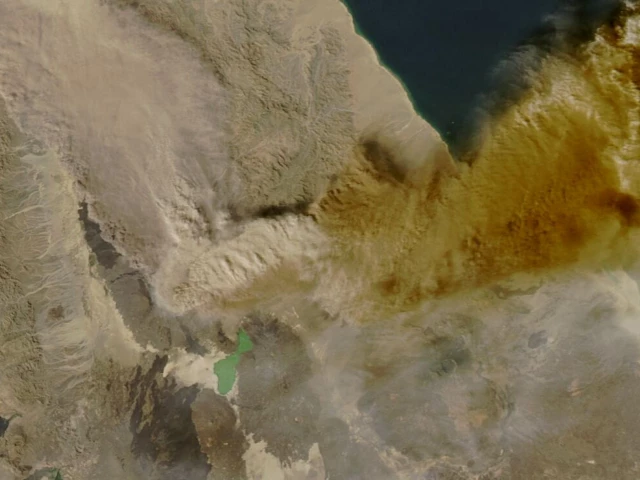
A satellite image shows ash rising from the eruption of the Hayli Gubbi volcano in Ethiopia as it drifts over the Red Sea. PHOTO: NASA/Handout via REUTERS
Pakistan’s meteorological department has clarified that no threats beyond aviation hazards have been identified following an ash plume from a rare volcanic eruption in northeastern Ethiopia, which has drifted towards southern Pakistan after passing through Yemen and Oman.
According to the Toulouse Volcanic Ash Advisory Center (VAAC), the cloud originates from the Hayli Gubbi volcano, which erupted on Sunday for the first time in almost 12,000 years. The eruption sent huge plumes of smoke high into the atmosphere and plunged large areas of the region into darkness.
In response, PMD has issued an air traffic control warning. Domestic flights that typically operate around 35,000 feet and international flights that fly between 40,000 and 45,000 feet may encounter engine hazards from the ash cloud. The authorities are actively monitoring its movements.
VAAC reported that the ash plume reached extreme heights, affecting the airspace over southern Saudi Arabia, Yemen, Oman and Pakistan’s coastal areas. But the PMD stated that Karachi is unlikely to experience any direct impact. “Projections suggest that the ash will mostly drift over the deep Arabian Sea, Oman and Mumbai’s flight region at around 50,000 feet,” a spokesman said.
Earlier in the day, the cloud was spotted 60 nautical miles south of Gwadar, prompting an active warning issued to relevant authorities. PMD spokesperson Anjum Nazeer Zaighum confirmed that the ash would remain far out as it moves over the Arabian Sea.
BREAKING: Significant outbreak reported in Afar, Ethiopia 🌋
Urgent reports this morning indicate a significant volcanic explosion in the Afar region, either at Ali Bagu (Amaytole) or possibly Erta Ale itself. Early information suggests that the outbreak may be located between… pic.twitter.com/ChwmyT9vDZ
— Volcaholic 🌋 (@volcaholic1) 23 November 2025
Eyewitnesses in Ethiopia’s Afar region described the eruption as extraordinarily powerful. This was told by a local resident Addis Standard that the explosion happened eight kilometers from the volcano’s main mountain. Television reported a “massive eruption”, noting that the force and sound of the explosion was stronger than any previous events that residents remembered. Reports indicated that the sound and effects could be felt as far as Djibouti, Tigray and towns in the Wollo area.
The flight tracking platform FlightRadar showed the projected path of the ash cloud at 03:31 heading towards the Arabian Peninsula and the Arabian Sea. Pakistan is directly in the path of the cloud, with expected arrival in approximately 18 hours. Interactive VAAC mapping indicates that the ash may pass over southern Sindh before drifting northeast into India.
The Hayli Gubbi volcano, located in Ethiopia’s Afar region about 800 kilometers northeast of Addis Ababa near the Eritrean border, erupted for several hours. The volcano rises about 500 meters and is located in the geologically active Rift Valley, where two tectonic plates meet.
The Smithsonian Institution’s Global Volcanism Program confirmed that Hayli Gubbi had no recorded eruptions during the Holocene epoch, which began about 12,000 years ago. Volcanologist Simon Carn, a professor at Michigan Technological University, confirmed the finding, stating that the volcano “has no record of Holocene eruptions.”
Authorities continue to monitor the ash cloud closely to ensure the safety of aviation and coastal areas along its expected path.


