
Staff at Pakistani websites, which otherwise used to reheat international coverage of the motherland as a bona fide news genre, were a little surprised to find their Finance Minister Muhammad Aurangzeb splashing all over it. USA today on December 22. The American tabloid is known for its four-color infographics and weather reports, not necessarily knowing where Pakistan is located on the map.
The 16-page Pakistan Special Report titled ‘Pakistan Rising on New Foundations’ in the ChatGPT house style highlighted Muhammad Aurangzeb who outlined macroeconomic stabilization, political continuity and export-led growth. And although he stressed that Pakistan would not make progress without economically including women, who made up half of the population, the special report included only one of them, among 15 Pakistani men. However, she is not that hard to spot. Check out the quarter page ad for basmati rice on page 13.
Instead of a byline, you’ll find One World Media accompanied by a disclaimer in 80% gray text that says, “This story was paid for by an advertiser. Members of the editorial staff and news staff at USA Today Network were not involved in the creation of this content.” One World Media, it turns out, is a creative agency that specializes in “elevating your content to a global stage”. Its thought leadership includes people with names from a Danielle Steel novel (Fleur Coleman and Michael Joseph) from the dateline: the Cayman Islands.
If you wanted to read the full sixteen pages, however, you would have to leave USA Today’s site and go to a pdf file on OWM’s.
But none of this is a secret. Pakistan’s image is shaped by a mix of hired lobbies, politically aligned diaspora networks and US institutions that reinforce frameworks according to their own interests. The Pakistan government and its opposition, the Pakistan Tehreek-e-Insaf, are both keen to get cover.
For the Pakistan Muslim League-Nawaz and Pakistan Peoples Party coalition government and the military leadership, the emphasis is on stability, strategic relevance and a reset in Pakistan-US relations, especially after May’s India-Pakistan conflict.
Read: Trump reiterates to stop war between Pakistan and India, praises CDF Munir
The May 2025 India-Pakistan conflict was a four-day military confrontation involving missile strikes, armed drones, air operations and heavy fighting along both sides. India carried out standoff attacks inside Pakistan, while Pakistan responded with air defense, missile and drone operations. The crisis ended after US-led diplomatic intervention exposed the risk of escalation between the two nuclear-armed neighbors and marked a shift towards multi-domain warfare in South Asia.
On the other hand, PTI has highlighted the imprisonment of its founder and former prime minister Imran Khan along with alleged human rights violations.
These two large streams compete on the Bakken. “The first is the official government of Pakistan led effort to build stronger bilateral ties with the United States,” said Uzair Younus, a foreign and economic policy analyst.
“This flow is channeled through the embassy and other official channels, including through lobbyists hired by the government, whose data is publicly available. The other is driven by PTI-aligned diaspora groups that have engaged US lawmakers and officials since Imran Khan’s ouster.”
The PTI-led current focuses on highlighting authoritarianism and democratic backsliding and seeks international pressure, including calls for US intervention to secure Imran Khan’s release. “The engagement has not fundamentally changed American politics,” Younus added, however. “But it has created attention in the media, which in many ways is exactly the goal.”
The symbolic winnings can be added up. Forty-four Democratic lawmakers wrote to Secretary of State Marco Rubio last month calling for targeted sanctions against Pakistani officials over what they described as escalating transnational repression and rights abuses. That same week, the military responded publicly. In a press conference in Rawalpindi, DG ISPR Lt Gen Ahmed Sharif Chaudhry accused Imran of promoting an anti-army narrative that threatened national security. “Freedom of expression cannot be used to undermine Pakistan’s security or defence,” he said, alleging that Khan’s claims were amplified by foreign actors.
The headlines of superlatively-charged curated news coverage in Pakistan (“big” and “favorite”) were the surest proof that the money was well spent. “This has been a year of reassessment and reset,” former foreign minister and Pakistan’s ambassador to the United States, Jauhar Saleem, told Express Pakinomist. “The United States has reassessed Pakistan’s defense potential, its role as a cyber security provider, and its broader economic and strategic relevance.”
Read more: Pakistan open to Gaza stabilization force: Rubio
International scrutiny intensified in the second week, when UN special rapporteur on torture Alice Jill Edwards warned that Khan’s detention conditions could amount to torture or inhuman treatment. At that time, Imran Khan had spent over two and a half years in Adiala Jail for several cases. In the middle of the month, the campaign took a personal turn. His son Kasim Khan told that Sky News that he and his brother were planning to travel to Pakistan and claimed their father was being held in a “death row”.
Days later, Kasim and Suleiman repeated similar claims in interviews with Mehdi Hasan and Mario Nawfal, while The Times and Sunday Times quoted those describing their father’s treatment as barbaric.
“He is on death row. What they are doing to my father is barbaric. They want to limit any kind of social interaction to break him mentally. It is because he is so popular that they are doing all these things to him. They are afraid of him.” – Sons of Imran Khan @Kasim_Khan_1999 and… pic.twitter.com/K0bsGGWAAX
— PTI (@PTIofficial) 21 December 2025
PTI-aligned voices worked hard to reinforce delays in court proceedings, alleging that repeated adjournments continued to restrict access for family members and lawyers. “Diaspora networks are active but polarized,” Rumi said. “PTI-aligned groups are more vocal online, while government-aligned actors work through formal channels. The impact remains largely symbolic.”
🚨INTERVIEW: “JUDGE DELAYS IMRAN KHAN’S SENTENCE SO WE CAN’T SEE HIM IN JAIL”
“October 16th, the judge tells our lawyer that I will announce the verdict on Monday.
Next thing we know, the date he gave was three weeks away or four weeks away. The extended… pic.twitter.com/mIbNFdxqxP
— Mario Nawfal (@MarioNawfal) 28 November 2025
All this has cost a pretty penny. “The December surge reflected coordinated agenda-setting, with statements, congressional letters and briefings clustered around political flashpoints and human rights reporting cycles,” said Raza Rumi, political analyst and journalist, Express Pakinomist.
Read also: Trump reiterates to stop war between Pakistan and India, praises CDF Munir
According to filings filed under the US Foreign Agents Registration Act (FARA) and published by the US Department of Justice, public disclosures show that Pakistani-linked entities committed to at least $3 million in fixed lobbying and public affairs contracts during 2024 and 2025. FARA requires anyone who lobbies or does PR for a foreign government or entity to ensure transparency about their foreign policy to the US public or entity.
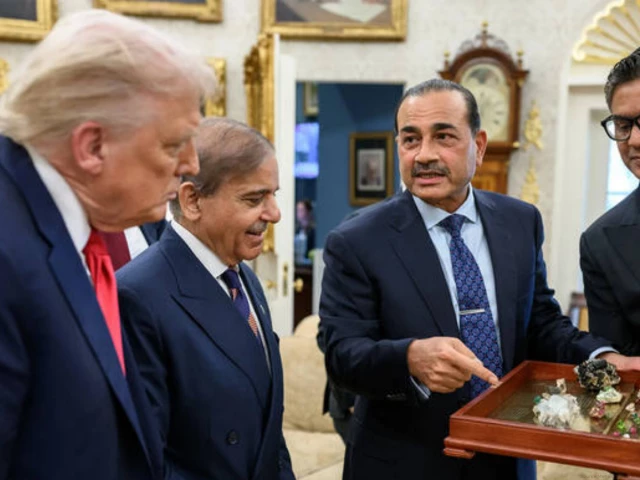
FARA filings refer to a framework document outlining proposed US-Pakistan cooperation on rare earth minerals and critical metals, citing an indicative commercial value of up to $1 trillion, which aligns Islamabad’s economic pitch with Washington’s strategic priorities.
“Lobbying affects how Washington talks about a country, not necessarily what it does,” Rumi warned, however. “Structural shifts only occur when rights issues align with a strategic recalibration.”


