- E-mining platform to increase transparency, efficiency in the mineral sector.
- Pakistan invites China to invest in copper, gold, rare earth minerals.
- Mineral development must include benefit to KP, Balochistan: minister.
ISLAMABAD: Federal Minister for Planning Ahsan Iqbal has said that Pakistan-China partnership has entered a new era which is not limited to infrastructure alone but is focused on production, exports, employment and sustainable development, The news reported Thursday.
Addressing the China-Pakistan Mineral Cooperation Forum on Wednesday, he said that on the occasion of the 75th anniversary of diplomatic relations between Pakistan and China, this partnership has become a shining example of continuity, trust and strategic depth.
The China-Pakistan Economic Corridor (CPEC) has completely changed the development scenario of Pakistan through energy, roads, Gwadar Port and national connectivity.
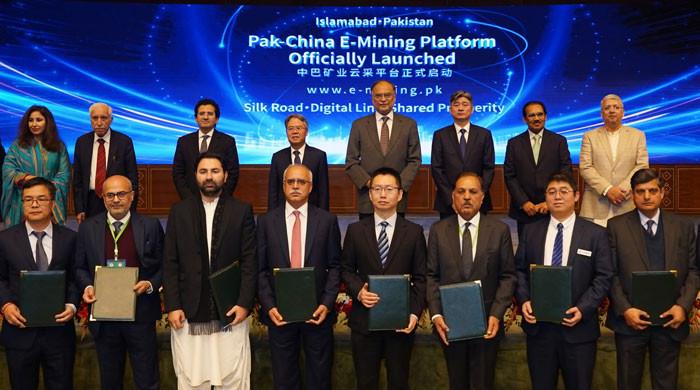
Pakistan and China launched the “Pak-China E-Mining Platform”, a digital initiative aimed at improving information sharing, project connectivity and cooperation between Pakistani authorities and Chinese companies.
The platform also aims to unlock more than $10 billion in investment in Pakistan’s mineral sector
Ahsan Iqbal said that CPEC 2.0 is fully compatible with Pakistan’s national economic transformation framework, “Uraan Pakistan”, which aims to create a trillion-dollar economy by 2035.
He said during the recent visit to China, a memorandum of understanding was signed to link Uraan Pakistan’s five roads with President Xi Jinping’s five growth corridors, which will create synergy in planning, investment and implementation.
The minister said that the mineral sector is the key to achieving the export target of Uraan Pakistan. Pakistan’s mineral resources are worth about $6 trillion, but mineral exports are currently only $2 billion a year.
He said that through better governance, modern technology and international partnerships, mineral exports can be increased to $6-8 billion per year and millions of employment opportunities can be created.
He said it is the need of the hour to expand mineral cooperation with China beyond extraction to value addition, processing, smelting and refining.
Projects such as Saindak, Dodar and Thar are successful examples of this collaboration, while recent investment deals reflect the growing confidence in the sector.
He emphasized that mineral development should be sustainable, environmentally friendly and based on regional inclusion so that resource rich regions like Balochistan and Khyber Pakhtunkhwa can reap real benefits in terms of employment, education and health facilities.
He clarified that the protection of Chinese citizens and investments is the top priority of the Government of Pakistan and effective measures are being taken for this purpose under the Special Investment Facilitation Council (SIFC).
He said that Pakistan invites China to invest in copper, gold, rare earth minerals and other important minerals so that mineral wealth can be transformed into industrial strength, export competitiveness and shared prosperity.
The minister made a direct bid for China to open its huge import market, saying even a small trade quota could lift the country out of repeated IMF bailouts. He said China’s annual imports are around $2 trillion and a modest share for Pakistan can transform Pakistan’s economy.
He said Pakistan’s exports to China could rise from about $3 billion today to $50 billion by 2035, easing foreign exchange pressures and supporting long-term growth […] Pakistan could avoid repeated IMF bailouts. Uraan Pakistan provides a clear roadmap for building a trillion-dollar economy by 2035 and is based on the Five Ways (5Es): Exports, e-Pakistan and Knowledge Economy, Environment and Climate Change, Energy and Infrastructure, and Equality, Empowerment and Ethics.
He said this synergy was taken to a new strategic level during the recent high-level visit of the Prime Minister of Pakistan to China.
“I was honored to sign a Memorandum of Understanding (MoU) through which the five Es of Uraan Pakistan were formally linked to the Five Growth Corridors of Development proposed by President Xi Jinping. This MoU provides a systematic framework to align Pakistan’s national reform and export agenda with China’s development vision under the Belt and Road Initiative, so that planning, investment are fully aligned.
“The visit was not merely symbolic but highly meaningful. Hundreds of business units from both countries participated in the large-scale B2B conference held during the visit, which resulted in the signing of several MoUs and trade agreements in various sectors including minerals, energy, manufacturing, agriculture, IT and logistics.”
The Pak-China E-Mining Platform is expected to improve transparency, efficiency and cooperation in the development of Pakistan’s mineral sector. The e-mining platform was launched during the Pak-China Mineral Cooperation Forum organized by the China Chamber of Commerce in Pakistan.
More than 70 Chinese companies, over 100 Pakistani companies and about 800 participants participated in the forum, which reflected great interest from both sides to deepen cooperation in the mineral sector. Delivering the keynote address, Chinese Ambassador to Pakistan Jiang Zaidong reaffirmed China’s strong interest in investing in Pakistan’s mining sector and supporting capacity building and technological advancement.
He emphasized the importance of sustainability and international construction standards in mining projects and noted that these efforts had been recognized by Pakistan’s Ministry of Energy.
He said responsible mining could improve resource utilization and promote harmonious relations with local communities, adding that the Saindak project alone had trained over 5,200 local workers. An important milestone at the forum was the launch of the Pak-China E-Mining Platform.