
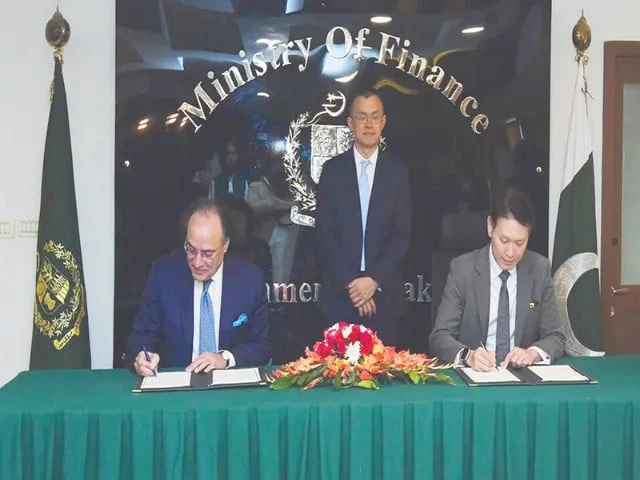
Finance Minister Muhammad Aurangzeb signs a memorandum of understanding as Binance founder Changpeng Zhao looks on in Islamabad. Photo: Courtesy: X/@Financegovpk
KARACHI:
Pakistan has signed a memorandum of understanding with crypto exchange Binance to explore the “tokenization” of up to $2 billion in government bonds, treasury bills and commodity reserves to boost liquidity and attract investors, the finance ministry said on Friday.
Separately, Pakistan also gave initial approval to Binance and HTX, a digital asset platform, to register with regulators to set up local subsidiaries and begin preparations for full exchange license applications, the virtual assets authority said.
The ministry said the agreement paved the way for exploring a potential collaboration aimed at enabling tokenization and blockchain-based distribution of Pakistan’s real-world assets.
These can include government bonds, treasury bills, commodity reserves such as oil, gas, metals or other raw materials owned by the government.
Tokenization is the process of creating a digital version of an asset. The move comes as other countries such as the United Arab Emirates, Japan and parts of the European Union expand formal licensing rules for crypto exchanges amid a broader global regulatory tightening.
The ministry also said the initiative could involve assets of up to $2 billion, subject to approvals, with the aim of improving liquidity, transparency and international market access.
Finance Minister Muhammad Aurangzeb said the MoU signaled Pakistan’s reform course and “a long-term partnership.” Binance founder Changpeng Zhao said the deal was “a good signal for the global blockchain industry and for Pakistan”, saying it marked the beginning of a step towards full implementation of the tokenization initiative.
The Pakistan Virtual Assets Regulatory Authority said it had issued early approvals to Binance and HTX after reviewing their governance and compliance checks. The approvals allow them to register on the Anti-Money Laundering system, create local entities and prepare full applications.
Chairman Bilal bin Saqib said the approvals start Pakistan’s phased licensing process and signaled that the compliance force will decide which exchanges move forward.
Pakistan ranks as the world’s third largest crypto market by retail activity, Saqib said at Binance Blockchain Week Dubai 2025 earlier this week.
A central bank pilot for digital currency and a virtual assets law are also planned for 2025. Pakistan’s crypto council has signed a letter of intent with US-based World Liberty Financial to explore stablecoin use, tokenization and other infrastructure for digital assets, the finance ministry said in April.


