
Army chief’s back-channel diplomacy has sidelined Modi as Pakistan mediates US-Iran communications, analysis finds
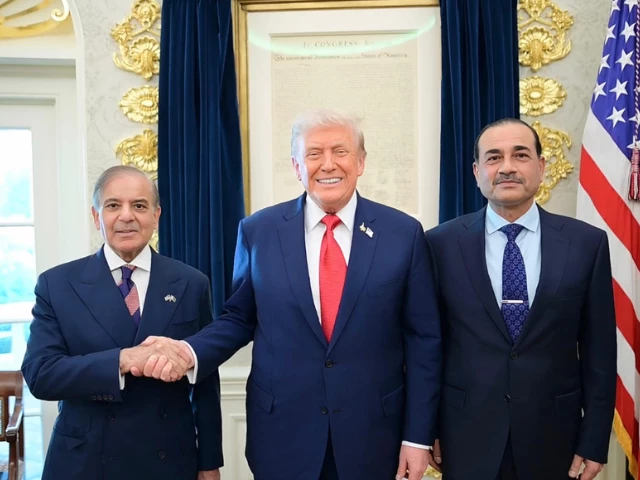
Prime Minister Shehbaz, Field Marshal Munir and US President Donald Trump at the White House Photo: PMO X account
When the Indian foreign minister, Subrahmanyam Jaishankar, recently called Pakistan a fixer to act as a messenger between the US and Iran, the insult betrayed a deep sense of marginalization – and was, in a way, an involuntary acknowledgment of reality.
An analysis published in Foreign policy magazine claimed that in the eyes of US President Donald Trump, being a fixer is not a sign of shame, but a badge of utility.
Trump has found the chief of defense forces and chief of staff Asim Munir “exactly the kind of interlocutor that he likes – a hard-nosed operator with direct access to the White House and a willingness to sell himself as useful.”
This, according to the article, has “left Indian Prime Minister Narendra Modi in an awkward position, relegated to receiving a single phone call from Trump about the crisis in the Middle East” – with Elon Musk listening on the line.
Read: Pakistan emerges where India could not
Pakistan, meanwhile, has been anything but idle. Positioning itself as a neutral mediator between Washington and Tehran, Islamabad hosted talks on March 29 with Egypt, Turkiye and Saudi Arabia, where the four countries formed a committee to support a ceasefire and secured an agreement with Iran to allow Pakistani ships to pass through the Strait of Hormuz.
Foreign Minister Ishaq Dar then rushed to Beijing for a meeting with his Chinese counterpart, after which the two countries released a five-part peace plan. Given the lack of concrete results so far, Foreign policy notes that Pakistan “frames this nascent process as a practical step to widen the channel of communication between the two sides.”
Prime Minister Shehbaz Sharif and Army Chief Munir “maintained direct and separate back channels to pass sensitive messages between Trump and Iranian President Masoud Pezeshkian while communicating with other global leaders.”
The article draws a parallel to a pivotal moment in history: “Pakistan’s role as a bridge between the United States and Iran reflects its relief at the opening of the United States to China in 1971,” when Islamabad leveraged its geography, military channels and status as an intermediary to help secure Henry Kissinger’s secret trip to Beijing—a move that changed Cold War geopolitics.
This “multidirectional diplomacy,” the piece says, suggests Islamabad is trying to reprise that role, where the destination today is not China but a US-Iran rapprochement.
It adds that the recent flurry of activity has “elevated Pakistan from a so-called basket case country to a state recognized for its efforts to ensure regional peace” – a shift after years of Islamabad being sidelined by previous US presidents.
Pakistan has not only deepened its ties with China, but also formalized a new strategic partnership with Saudi Arabia, while finding common ground with Iran on efforts against Baloch separatists.
The catalyst for this shift, Foreign policy claims was the brief military conflict between Pakistan and India in May 2025, saying: “Islamabad managed to turn the crisis into leverage by allowing Trump to claim credit for a ceasefire and nominate him for the Nobel Peace Prize,” while an irate Modi insisted the ceasefire decision was strictly his own.
That exchange, it said, “marked the beginning of a broader strategic turn in which Pakistan ceased to look isolated and India began to look exposed.”
Read more: Iran’s war chaos slows down negotiations, Pakistan warns
The consequences for India have worsened since. At the start of the Iran war, Modi chose to back Israel – and by extension the United States – by placing New Delhi out of a role as a credible arbiter. India has since been reduced to making requests by phone to Tehran to allow ships carrying cooking gas to pass through the Strait of Hormuz, while Pakistan is treated as a credible conduit in the very region where India once hoped to expand its stake.
“Pakistan has done better than India in projecting diplomatic relevance despite its own internal problems and risks of failure as an interlocutor, starting with over-promising and under-delivering,” it said. This moment, it adds, “underscores New Delhi’s poor standing in its extended neighbourhood,” as “India remains wedded to the domestic political narrative of aspiring to global leadership, it is bypassed in the real corridors of power.”
The emergence of a middle power bloc – Pakistan, Egypt, Turkiye and Saudi Arabia – packing “three of the Middle East’s largest armies, nuclear weapons and economic heft” represents a further challenge to Indian interests. For India, which has always preferred bilateral engagements, Foreign policy warns, “the emergence of such a group worryingly suggests a future in which actors not aligned with New Delhi’s vision shape the regional order.”
These challenges also reveal a harsher truth about the US-India relationship, which it claims has “always been more about shared concerns about China than shared values or deep-seated trust.” If Army Chief Munir can deliver a deal with Iran or provide a stable platform for US interests in South Asia, Trump will not hesitate to reward him at Modi’s expense, it is claimed.
Yet the article is equally frank about the risks Pakistan bears. Its mediation is “built on a brittle foundation” and its “diplomatic rise is disproportionately tied to one man and to a White House that rewards theater and tactical utility.”
“Pakistan is not embraced because its institutions are strong or its economy resilient; it is simply accessible,” it adds. Its economy remains fragile, “its military establishment still dominates foreign policy in ways that limit the capacity of civilian officials to negotiate quickly, and its political system is hardly stable enough to support a long-term strategic pivot.”
Any mediating role between hostile powers, Foreign policy warns, exposes Pakistan to “retaliation, suspicion and the possibility of being accused by one side of failing talks or by the other of deducting too many kilometers from access.” Talks are to be indirect, with Pakistani officials shuttling between delegations.
Read also: US VP Vance spoke to Pakistani mediators on Iran conflict as recently as Tuesday: source
“The very position that creates visibility will also make Pakistan the bearer of bad news when talks collapse – and that remains a distinct possibility,” the analysis reads. In court for a transaction leader like Trump, it warns, “the distance between a favored intermediary and a discarded asset is remarkably short.”
Internal vulnerabilities “do not diminish the fact that Pakistan has successfully broken the diplomatic quarantine that Modi worked so hard to impose.”
For more than a decade, Modi’s strategy was straightforward: globalize India’s economy, deepen partnerships with the West and dominate the narrative of a responsible rising power so that “Pakistan would be pushed to the margins.” The current situation, the play argues, shows how foreign policy prioritized domestic narratives over the harsh realities of international power dynamics.
“The real embarrassment for India is not that Pakistan has become more active. It is [Army Chief] Munir is being welcomed in capitals where Modi once expected to be consulted if not postponed.” Foreign police states. Modi, it adds, “must sit with an uncomfortable realization: Pakistan is still there, still irritating, still unstable, and yet also suddenly more useful to the powers that matter at this moment.”
“India cannot afford to ignore this shock at a time of great geopolitical change,” it concludes – and for Modi it should be a wake-up call to rethink the fundamentals of his foreign policy, not an excuse for his minister to resort to derogatory actions against Pakistan.


