
Report explains documented impact on human health using clear, available scientific evidence
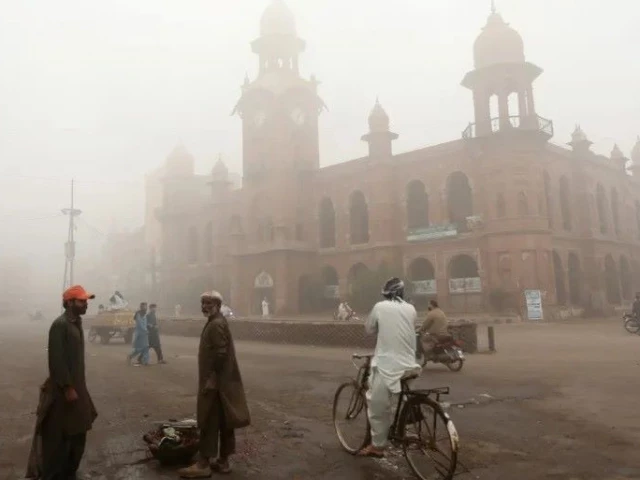
A view of smog in Punjab province. PHOTO: AFP
Pakistan has released its first comprehensive national assessment of air pollution, presenting a scientific analysis of emission sources, public health impacts and policy gaps across four major urban airspaces.
The report, prepared by the Pakistan Air Quality Initiative (PAQI), was launched at the Clean Air Summit held at a private university in Lahore, where environmental experts and policy makers described it as a critical milestone for evidence-based decision-making.
According to the assessment, air pollution has emerged as the nation’s most serious environmental and public health challenge, reducing average life expectancy by nearly four years and contributing to more than 100,000 premature deaths annually. Fine particles, especially PM2.5, are linked to increasing cases of respiratory and cardiovascular diseases, while persistent pollution levels in major cities pose long-term risks to people in the affected zones.
Drawing on satellite data, chemical transport modeling and PAQI’s real-time monitoring network, the report offers disaggregated analyzes for airsheds in Lahore, Karachi, Rawalpindi-Islamabad and Peshawar. It outlines major urban pollution sources and explains their documented impact on human health using clear, available scientific evidence.
In Lahore, emissions from transport, industrial activity and brick kilns remain the dominant contributors, with winter temperature inversions exacerbating pollution. Karachi’s pollution is mainly driven by industrial clusters operating with low-quality fuels and weak regulation, which account for nearly half of the city’s emissions.
In Rawalpindi-Islamabad, rapid growth in vehicular traffic has become the primary source of particulate pollution, while Peshawar’s valley-like geography and transit trade corridors lead to higher average exposure levels compared to other cities.
PAQI founder Abid Omar noted that the report is the result of nearly a decade of data collection and scientific analysis aimed at moving Pakistan’s policy debate from conjecture to evidence.
The document also includes thematic chapters on fundamental rights, environmental justice and institutional reforms, with contributions from former judge Syed Mansoor Ali Shah, Senator Sherry Rehman, Rafay Alam, Sarah Hayat, Dr. Saima Saeed, Dr. Sanval Nasim, Dr. Kulsoom Ahmed and other experts. Omar said policymakers now have an unmistakable scientific picture that identifies where the problem lies and how it can be solved.
The report emphasizes that upgrading transport systems, modernizing industrial units, switching brick kilns to cleaner technologies and enforcing continuous emission monitoring can reduce pollution by up to 50 percent. Such improvements, it notes, would significantly reduce health risks currently borne by urban populations across the country.


