
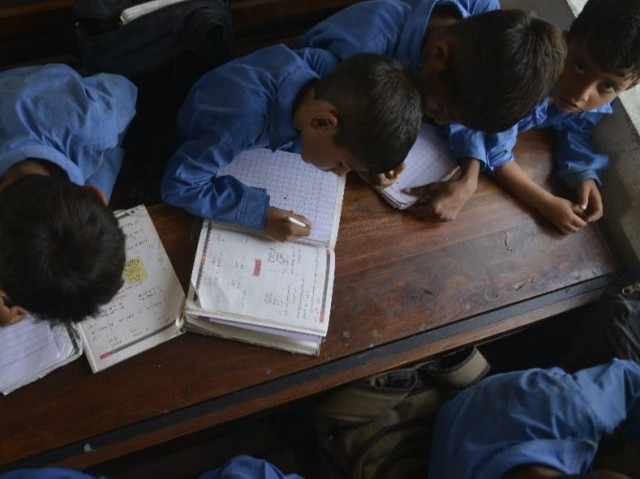
Students attend a class at a school on International Literacy Day in Lahore. PHOTO: AFP
Pakistan remains the lowest-ranked country in South Asia for literacy, with 63% of people aged 10 and above able to read and write, according to a new report by the Free and Fair Election Network (FAFEN).
The review draws on official survey data from the Pakistan Social and Living Standard Measurement-Household Integrated Economic Survey (PSLM-HEIS) 2024-2025 and compares Pakistan’s performance with World Bank literacy figures for the region.
It shows literacy has risen from 60% in 2018-2019 to 63% in 2024-2025, an increase of three percentage points in about six years. Analysts described the pace of improvement as “alarmingly slow” for a country of more than 240 million people.
Regionally, the review places the Maldives at over 98% adult literacy, followed by Sri Lanka at 93%, India at 87% and Bangladesh at 79%. Nepal stands at 68% and Bhutan at 65%, while the South Asian average is 78% – 15 percentage points higher than Pakistan.
Read: WB warns against Pakistan’s failing growth model
The data also highlights stark differences within Pakistan. Male literacy is at 73%, compared to 54% for females. Punjab has the highest provincial literacy rate at 68%, while Sindh and Khyber-Pakhtunkhwa are both at 58%. Balochistan records the lowest rate at 49%.
Youth literacy, covering ages 15 to 24, is reported at 77%, but overall adult literacy for those aged 15 and over lags at 60%, pointing to persistent gaps in education and skills among older age groups.
FAFEN noted that the survey defines a “literate” person as someone aged 10 or over who can read and understand a simple statement and write a simple sentence.
The organization also pointed to Article 25A of Pakistan’s constitution, which guarantees free and compulsory education for children aged five to 16. It said education became a provincial subject after the 18th amendment, while Pakistan is also committed to the United Nations’ education goals under the Sustainable Development Goals.


