
FO accuses India of shifting blame, reiterates stance on Kashmir and water sharing
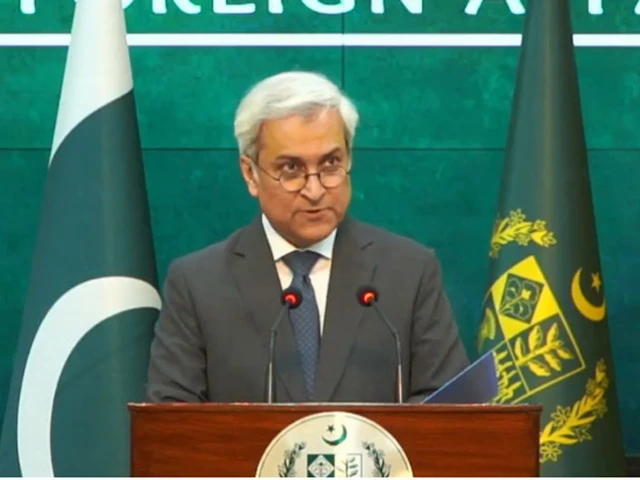
Spokesman for the Ministry of Foreign Affairs, Tahir Hussain Andrabi. PHOTO: Radio Pakistan
Pakistan’s Foreign Ministry on Saturday rejected remarks attributed to Indian Foreign Minister S. Jaishankar and reiterated its position on the Indus Waters Treaty and the disputed region of Jammu and Kashmir.
In a statement issued by the spokesman’s office, Tahir Hussain Andrabi said India “seeks to divert attention from its own troubling history as a neighbor that promotes terrorism and contributes to regional instability.”
The statement referred to what Pakistan described as documented cases of sabotage through proxies, covert support to militant networks and extraterritorial activities. It cited the case of Commander Kulbhushan Jadhav as an example of “organized, state-sponsored terrorism targeting Pakistan.”
Jadhav was captured in Balochistan in March 2016 and later confessed to his affiliation with India’s Research and Analysis Wing and his involvement in espionage and terrorism in Pakistan, according to Pakistani authorities. He remains imprisoned in Pakistan.
Regarding Jammu and Kashmir, the State Department said India “continues its illegal and violent military occupation” of the region. It said Pakistan would continue to extend political, moral and diplomatic support to the Kashmiri people in their “struggle to realize their right to self-determination”, in line with UN Security Council resolutions.
The rebuttal followed public remarks by Jaishankar in which he said India had the right to defend itself against “bad neighbours” and questioned why a country that he says continues terrorism should expect the benefits of neighborly cooperation.
“Many years ago we agreed on a water-sharing arrangement … but if you have decades of terrorism, there is no good neighbourliness,” Jaishankar was quoted as saying. “You can’t say … Please share water with me, but I will continue with terrorism – it is not compatible.”
The State Department statement also addressed the recent discussion surrounding the Indus Waters Treaty, calling it an international agreement “entered into in good faith and at considerable cost.” It warned that any unilateral departure from the treaty framework would “undermine regional stability” and “call into question” the credibility of commitments under international legal obligations.
The ministry said Pakistan would take “all necessary measures” to protect its rights under the treaty.
The exchange comes as both sides continue to signal their positions on the Indus Waters Treaty and regional security issues while relying on existing mechanisms for routine exchanges.
The development follows a brief interaction earlier this week when National Assembly Speaker Ayaz Sadiq and Jaishankar shook hands in Dhaka during the funeral of former Bangladeshi Prime Minister Khaleda Zia. It marked the first high-level contact between Pakistani and Indian officials since the May 2025 military conflict.


