
Islamabad rolls out red carpet for al-Nahyan; Two countries discuss economic cooperation
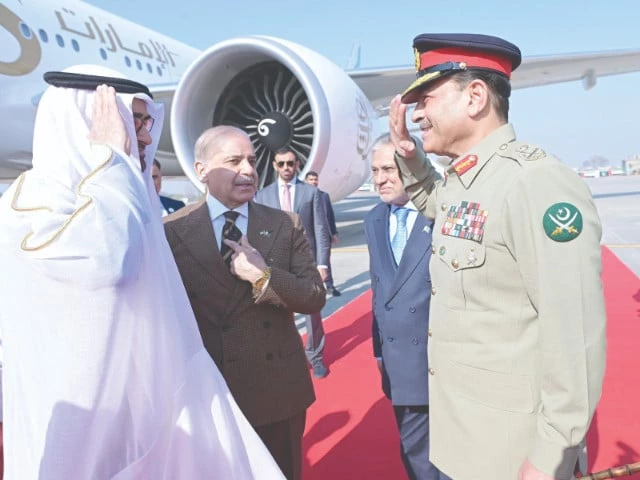
COAS & CDF Field Marshal Syed Asim Munir salutes UAE President Sheikh Mohamed bin Zayed al-Nahyan on his arrival at Nur Khan Airbase in Rawalpindi as Prime Minister Shehbaz Sharif and DPM/FM Ishaq Dar look on. Photo: Express
ISLAMABAD:
President of the United Arab Emirates (UAE) and Ruler of Abu Dhabi Sheikh Mohamed bin Zayed al-Nahyan paid an official visit to Pakistan on Friday, marking his first visit to the country in his capacity as UAE president, as Islamabad continues to consolidate its strategic, economic and diplomatic engagement with key Gulf partners.
The visit, which was conducted at the invitation of Prime Minister Shehbaz Sharif, comes at a time when Pakistan’s relations with the Gulf states have witnessed a renewed upswing, driven by expanded cooperation in defense, investment, energy and regional diplomacy.
Sheikh Mohamed bin Zayed was accorded a warm and ceremonial welcome on his arrival in Islamabad. In a rare display of honour, a formation of JF-17 fighter jets escorted the royal aircraft as it entered Pakistani airspace, underscoring the close defense and security ties between the two countries.
At Nur Khan Airbase, the UAE President was received by Prime Minister Shehbaz Sharif, Deputy Prime Minister and Foreign Minister Senator Mohammad Ishaq Dar, Chief of Army Staff and Chief of Defense Forces Field Marshal Syed Asim Munir along with senior cabinet members and government officials.
According to a statement issued by the Prime Minister’s Office, Sheikh Mohamed bin Zayed held significant talks with Prime Minister Shehbaz Sharif during the visit.
The discussions focused on exchange of views on further strengthening the long standing brotherly relations between Pakistan and the UAE.
The two leaders reviewed the progress made in ongoing areas of cooperation and explored opportunities to deepen engagement across a wide range of sectors.
Both sides stressed the importance of expanding cooperation in economic cooperation, investment, energy, infrastructure development, information technology, technology and people-to-people exchange.
They also agreed on the need to strengthen bilateral trade, noting that it holds significant potential for mutually beneficial growth.
In addition to bilateral affairs, the leaders exchanged views on key regional and international developments and reaffirmed their shared commitment to continue close coordination on issues of common interest.
While expressing satisfaction with the positive trajectory of bilateral relations, Prime Minister Shehbaz Sharif and President Sheikh Mohamed bin Zayed reiterated their determination to continue working closely together to advance the common goals of peace, stability and sustainable development.
The Prime Minister’s Office said the visit will further consolidate the deep fraternal ties between Pakistan and the UAE and help strengthen their strategic partnership.
The high-profile visit reflects a wider pattern of intensified engagement between Pakistan and the countries of the Gulf Cooperation Council (GCC), particularly over the past year. I
Islamabad has increasingly looked to the Gulf as a traditional source of economic support and employment for Pakistani expatriates, but also as a strategic partner in defense cooperation, investment-led growth and regional stability.
Pakistan and the UAE share deep-rooted historical, cultural and people-to-people ties.
Millions of Pakistanis live and work in the Emirates, contributing significantly to the UAE’s economy, while remittances remain an important pillar of Pakistan’s foreign exchange inflows. Over the years, the UAE has also emerged as one of Pakistan’s most important trading partners and investors.
The visit by Sheikh Mohamed bin Zayed comes amid renewed diplomatic momentum between Pakistan and major Gulf states.
In recent months, Pakistan has expanded its defense and security dialogue with regional partners, while also actively seeking Gulf investment in infrastructure, energy and technology sectors as part of the country’s broader economic stabilization and reform agenda.
Saudi Arabia, Pakistan’s longtime strategic ally, has also increased engagement, with both sides reaffirming defense and security cooperation and exploring new economic initiatives.
Analysts see this development as part of Pakistan’s efforts to recalibrate its regional diplomacy, diversify economic partnerships and strengthen ties with countries that play an influential role in regional and global affairs.
Officials familiar with the discussions say the emphasis on investment, energy and infrastructure reflects Pakistan’s priority to attract long-term, sustainable capital over short-term financial aid.
The UAE has shown interest in sectors such as renewable energy, ports, logistics, information technology and agriculture, areas where Pakistan sees significant growth potential.
At the same time, defense and security cooperation remains a key pillar of Pakistan-UAE relations. Joint exercises, training exchanges and defense-related cooperation have continued over the years, supported by mutual trust and strategic coordination.
The exchange of views on regional and international developments during the meeting also highlights Pakistan and the UAE’s shared interest in stability across South Asia, the Middle East and the wider Muslim world. Both countries have traditionally coordinated closely on regional crises and diplomatic initiatives in international forums.
For Islamabad, Sheikh Mohamed bin Zayed’s visit has both symbolic and significant significance. It signals continuity of the UAE’s engagement with Pakistan at the highest level and reinforces the message that bilateral ties remain insulated from regional volatility and global economic uncertainty.
The visit also reinforces Pakistan’s narrative of being a reliable strategic partner for the Gulf states, especially at a time when the region is undergoing rapid economic transformation and geopolitical realignment.
As Pakistan seeks to stabilize its economy and reposition itself as a hub for trade, transit and investment, closer ties with the UAE and other Gulf partners are increasingly seen by policymakers as a cornerstone of its external engagement strategy.
The Prime Minister’s Office described the visit as a milestone that would further strengthen the fraternal relationship and strategic partnership between Pakistan and the UAE, a relationship that both sides appear keen to deepen in the coming months.


