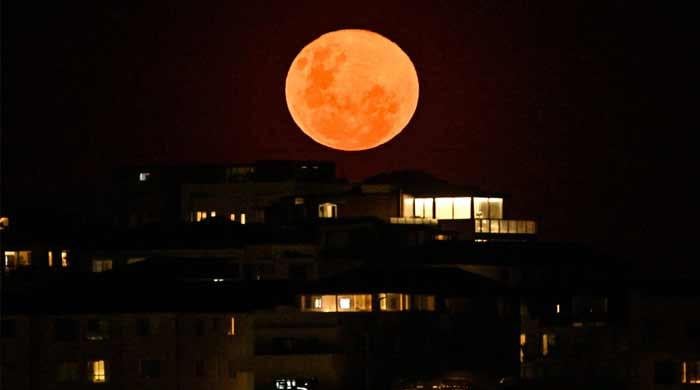
Pakistan will observe the first supermoon of the year 2026 on Saturday, January 3, when the full moon is expected to appear unusually large and bright in the sky, according to astronomical experts.
According to the Space and Upper Atmosphere Research Commission (Suparco), the Supermoon will occur on January 3 and is traditionally known as the “Wolf Moon”. The phenomenon will mark the end of a series of supermoons that began in October 2025.
Experts explained that a supermoon occurs when the moon comes closer to Earth than its average distance, making it appear larger and brighter than a regular full moon.
Because of this close proximity, the moon can appear up to 14% larger and about 30% brighter compared to a regular full moon, scientists added.
Suparco said that the Super Moon will rise in Pakistan at 17:51 on January 3, with the moon’s illumination reaching 99.8% at that time. The supermoon will remain prominently visible throughout the nights of January 3rd and 4th, giving observers a longer viewing period.
During the event, the distance between the Earth and the Moon will be approximately 362,312 kilometers, scientists said, adding that the Supermoon is expected to appear about 6 to 7% larger compared to an average full moon.
Astronomers noted that supermoons generally occur in sequences of three to four consecutive events, and the current series will end with the Jan. 3 Supermoon.
Suparco said the next supermoon will begin in November and will be classified as the second supermoon of 2026, adding that there will be no third supermoon during the year.