
The situation lasted for 18 to 20 hours before it began to stabilize, the effects never reached the ground, spokesman says
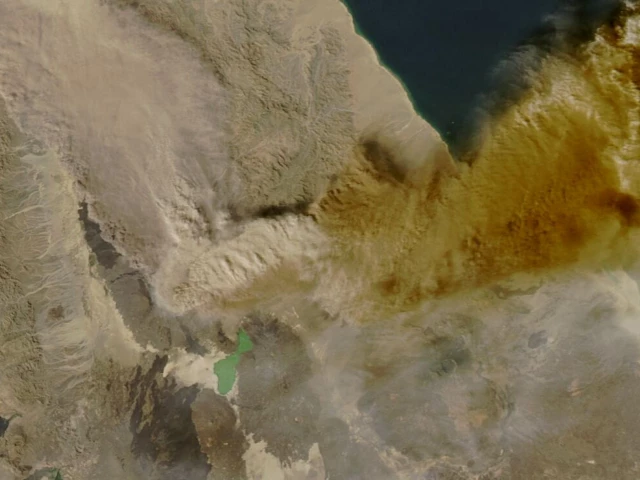
A satellite image shows ash rising from the eruption of the Hayli Gubbi volcano in Ethiopia as it drifts over the Red Sea. PHOTO: NASA/Handout via REUTERS
Pakistan does not face any threat of atmospheric pollution from the volcanic eruption in Ethiopia, the Pakistan Meteorological Department said on Tuesday, assuring that the ash cloud remains confined to high altitudes and poses no risk to public health in the country.
Deputy director and PMD spokesperson Anjum Nazir Zaigham said the eruption at the Hayli Gubbi volcano – reported by the Toulouse Volcanic Ash Advisory Center (VAAC) – had sent massive plumes into the upper atmosphere after it erupted on Sunday for the first time in nearly 12,000 years.
In response, the PMD issued an air traffic alert warning that domestic flights crossing around 35,000 feet and international flights operating between 40,000 and 45,000 feet may face engine hazards due to the ash cloud. Authorities, he added, were actively monitoring its trajectory.
Zaigham issued a detailed statement on Tuesday, saying the volcanic plume initially moved eastwards, spreading across Oman, Yemen and the Arabian Sea before extending towards southern Pakistan and India.
BREAKING: Significant outbreak reported in Afar, Ethiopia 🌋
Urgent reports this morning indicate a significant volcanic explosion in the Afar region, either at Ali Bagu (Amaytole) or possibly Erta Ale itself. Early information suggests that the outbreak may be located between… pic.twitter.com/ChwmyT9vDZ
— Volcaholic 🌋 (@volcaholic1) 23 November 2025
The PMD issued three consecutive Volcanic Ash Advisories (VAA) – the first time in Pakistan’s history that multiple warnings were released in succession – after receiving a mid-air report from an aircraft south of Gwadar, about 60 nautical miles away.
He said the situation lasted for almost 18 to 20 hours before conditions started to stabilize. However, the volcanic remains were only detected in the upper atmosphere at about 45,000 feet or higher, he added.
“These effects never reached the ground,” Zaigham said, adding: “With wind speeds of around 20 kilometers per hour, the plume has now disappeared. It is completely wrong to suggest that Pakistan’s airspace could be contaminated.”
He reiterated that the skies over Pakistan are now ‘absolutely clear’ and noted that any air quality concerns would only arise if an outbreak occurred in a country closer to Pakistan. Zaigham reaffirmed that there is no possibility of atmospheric contamination from the Ethiopian eruption.


