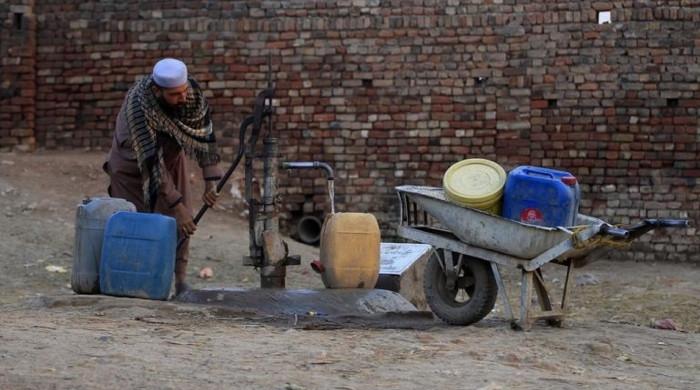
- KP water availability drops to 679 cubic meters.
- Punjab records 760 cubic meters annually.
- Balochistan falls to 928 cubic meters.
Pakistan’s per capita water availability has fallen sharply amid a growing population, the Ministry of Water Resources revealed in a report presented to the National Assembly on Monday.
“From 2017 to 2023, the population increased by 40 million, resulting in a reduction of 154 cubic meters per person in annual water availability,” the ministry stated in its findings.
According to the report, Pakistan’s population is expected to reach 288 million by 2030, where the availability of water per per capita is expected to fall further to 795 cubic metres.
With respect to the province, the annual water availability per per capita in Khyber Pakhtunkhwa decreased to 679 cubic meters, while Punjab recorded 760 cubic meters and Sindh 1,169 cubic meters.
In Balochistan, available water resources stand at 928 cubic meters per person, the report added.
The statistics of declining water resources emerge as the downstream coastal country is in a dispute with India over the Indus Water Treaty (IWT).
India unilaterally put the IWT with Pakistan on hold in April this year following the killing of 26 people in Indian illegally occupied Jammu and Kashmir (IIOK).
The use of the water between the two nations is governed by the IWT, which was brokered by the World Bank and signed by the neighbors in September 1960.
There is no provision in the treaty that any of the countries can unilaterally suspend or terminate the pact, which has clear dispute settlement systems.
Meanwhile, Federal Minister for Food Security and Research Rana Tanveer Hussain said the country is suffering from an annual decline of 10% to 15% in crop production.
In a written response during the NA session, he warned that losses could reach up to 30% due to poor harvesting, handling, storage and transportation.
Hussain added that eliminating these losses could save Pakistan as much as $1.8 billion every year, underscoring the magnitude of the economic impact on the agricultural sector.
According to the minister, climate change effects and inadequate transport systems were among the biggest contributors to crop losses nationwide.