
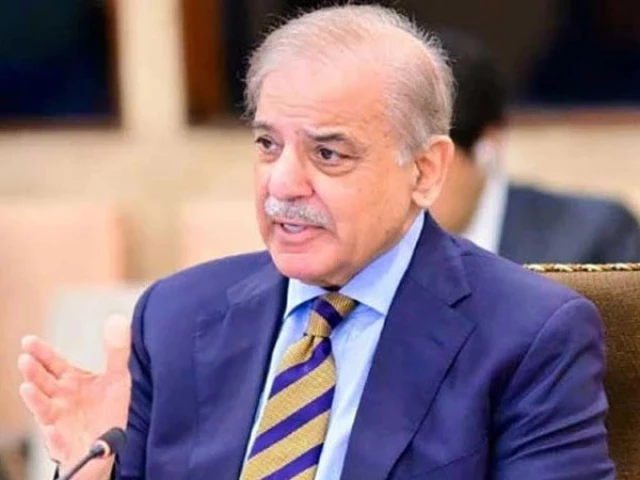
Rejects summary of POL cost hike, says govt to absorb Rs56b burden, Rs95/litre for petrol, Rs203 for diesel
ISLAMABAD:
Prime Minister Shehbaz Sharif said on Friday that the government rejected a summary of a fuel price hike once again and would absorb the burden of Rs56 billion itself.
He addressed the nation about the ongoing Middle East conflict that has triggered a global fuel crisis.
The announcement comes a week after he said he rejected a Rs76 per liter hike in the price of petrol Rs177 per liter in the price of HSD. In the same case, the prime minister had also said that he had also earlier rejected a similar recommendation following a rise in oil prices in the international market on March 13.
The prime minister said he had rejected a summary seeking a rise in oil prices and decided to keep them at current levels for another week.
“I was advised to increase the price of petrol by Rs95 per liter and diesel by Rs203 per litre, but I again refused in view of the difficulties people were facing and decided that the government would bear the cost amounting to Rs56b,” he said.
“This week, the federal government will absorb an additional burden of Rs56b and the public will not have to bear this cost,” he added.
The premier said that based on the prevailing prices in the international market, petrol should have been priced at Rs544 per liter in Pakistan but was supplied to consumers at Rs322 per litre. Similarly, he said the price of diesel should have been Rs 790 per liter but the government supplied it at Rs 335 per liter to protect the public from additional burden.
Recalling the measures taken by the government so far to stabilize oil prices, the Prime Minister said that during the last three weeks, the government had borne a historic burden of Rs125b alone so that the public would not have to bear the cost.
“This amount could have been used to fund several major development projects for your welfare, but at the moment nothing is more important to me than protecting your financial welfare,” he added.
Considering the current situation, he urged people to bring transformative changes in their lives and advised them to think carefully before using cars or motorcycles. “Practicing austerity is no longer optional; it has become our shared responsibility,” he added.
The prime minister said prices around the world had doubled, with long queues at petrol pumps as fuel costs became unaffordable for the public and governments struggled to cope.
“However, despite extremely limited resources, your government has so far managed, through timely and effective measures, to prevent this inflationary storm from reaching you,” he said.
The Prime Minister called on the nation to join the government in implementing austerity measures, noting that it could not do it alone.
“Today I make a heartfelt and sincere appeal to you as citizens to fully cooperate with the plans we are formulating to address this difficult time. Detailed measures will be announced soon,” he added, hinting at measures the government will unveil in the coming days.
The Prime Minister said that even while speaking, Pakistan was playing a highly responsible and important role on two fronts. “On the one hand, we strive to protect our national interests and protect the public from the unprecedented increase in fuel prices in international markets; on the other hand, at the diplomatic level, we are active day and night to bring peace.”
He said that Pakistan was making sincere and energetic efforts at the diplomatic level to mediate an end to the conflict so that the region and the Islamic brotherly countries could be spared its devastating consequences.
The Prime Minister added that efforts were being made to pave the way for lasting peace through collective consultation and wisdom.
He said Pakistan’s diplomatic efforts were not mere official responsibility but were carried out solely for the best interests of the Muslim community. “Therefore, regardless of the school of thought or sect one belongs to, as Muslims, the desire for peace is shared by all,” the premier added.
The Prime Minister began his speech by talking about Pakistan’s efforts to restore peace in the Middle East through diplomacy.
“Pakistan is making sincere and full-fledged mediation efforts on the diplomatic front to end this war so that the region and brotherly Muslim countries no longer face the destructive and negative consequences of this war,” he said. The prime minister further said that the aim of these efforts was to pave the way for lasting peace through “collective wisdom and consultation”.
“Pakistan’s diplomatic efforts are not only an international diplomatic responsibility, but they are also purely for the will of gold and for the benefit of the ummah,” he said.
Prime Minister Shehbaz said regardless of “what school of thought we belong to, as Muslims, we all want peace”.
In this context, he continued, he had several times detailed discussions with the leaders of Iran and the Gulf countries. Besides, Deputy Prime Minister and Foreign Minister Ishaq Dar had also worked for the restoration of peace, while the Chief of Defense and Chief of Army Staff Field Marshal Asim Munir played an “active and key role” for the success of this rapprochement process, he added.
“I appeal to you to pray for the fruits of these efforts,” the prime minister said.
Earlier this month, the government sharply increased diesel and petrol prices by Rs55 per litre, or 20 percent, citing the ongoing conflict between the US and Israel and Iran, which has disrupted global supply chains and pushed crude oil prices to a two-year high.
In response to the crisis, both federal and provincial governments have introduced a series of austerity measures. These include an extra weekly holiday, a reduction in free petrol allocations for ministers, restrictions on protocol vehicles and proposals to provide subsidized fuel for students.
Last week, the government also approved a significant hike of Rs200 per liter in the fuel tax on high-octane fuel used in luxury cars, raising the total tax to Rs300 per liter and the price to Rs600 per litre.
Addressing the nation on Friday, the prime minister warned of a further rise in oil prices due to the war in the region, which has rocked the global economy.
“If the situation continues to deteriorate, the possibility of a further increase cannot be ruled out,” he said.
The Prime Minister said that prices had risen significantly again at the beginning of this week and that he had been advised to raise fuel prices once again. However, he added that he had decided to do so out of a sense of responsibility and in view of the impending Eidul Fitr.
He said the government had so far spent Rs69 billion to prevent a rise of Rs127 per liter in petrol prices and Rs252 per liter in high-speed diesel.
However, he added that this was not a sustainable solution, saying the government would absorb the burden as much as possible to protect the public and provide relief to the poor.


