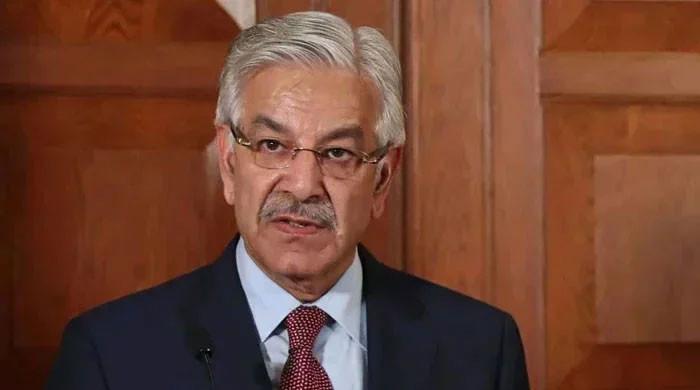
- The Minister of Defense calls the 18th Amendment a “hollow slogan”.
- Asif says politicians failed to execute 18th amendment.
- Minister says decentralization of power strengthens the state.
Defense Minister Khawaja Asif said on Wednesday that the lawmakers behind the 18th Amendment are responsible for its non-implementation.
Talking further Pakinomist news program ‘Capital Talk’, the defense minister said the ultimate responsibility for turning the constitutional amendment into a “hollow slogan” lies with the politicians who had adopted it but failed to implement it in letter and spirit.
The key slogan of the 18th Amendment was the devolution of powers to the grassroots level, Asif said and asked if this goal had been achieved anywhere in the country.
“Have powers actually been devolved to the lower echelons, in or out of parliament?” asked the minister.
Separately, Asif – in a post on X – stressed that empowerment of local governments was essential to bring governance closer to the common citizen, saying that decentralization of power strengthens the state and reduces public frustration.
He said effective and empowered local governments would enable Pakistan’s population of over 250 million to access governance through city administrations in Karachi, Lahore, Quetta and Peshawar via a functional local government system.
He acknowledged that despite the 18th constitutional amendment, successive governments had failed to fully activate the local government framework, attributing it to a lack of political sincerity.
Asif said empowered local governments would allow citizens to elect their own representatives and institutions through polls instead of remaining dependent on bureaucracy whose officials hold temporary positions.
He added that if elected local representatives do not deliver, the public will be able to directly hold them accountable.
The minister said key civil services – including water supply, fire, sanitation, primary education, health care, drainage, encroachment management and local roads – should come under the jurisdiction of local authorities, along with an independent local taxation system.
Referring to global examples, the defense minister noted that in many countries even parts of the justice and police systems operate under elected local authorities.
He warned that weak and powerless local bodies fail to deliver services and cause political harm rather than good, whereas strong municipal institutions strengthen public authority, reduce unrest and create a lasting bond between government and citizens.
Asif concluded that dispersion of power multiplies its effectiveness while concentration of power diminishes it, adding that a satisfied society ultimately leads to a stronger country.
Earlier, the minister said while addressing the National Assembly on Tuesday: “The 18th amendment has been proved to be a sham as all powers have been transferred to the provincial government.”
The defense minister had said that “dictators” had introduced empowered local bodies in the country, but civilian governments tried to avoid handing over power to the grassroots level.
“They (civilian governments) often make poor excuses to postpone elections to local bodies,” he had added.