
The KP government claims its share to increase by 6% to nearly 20% after the merger with tribal districts
ISLAMABAD:
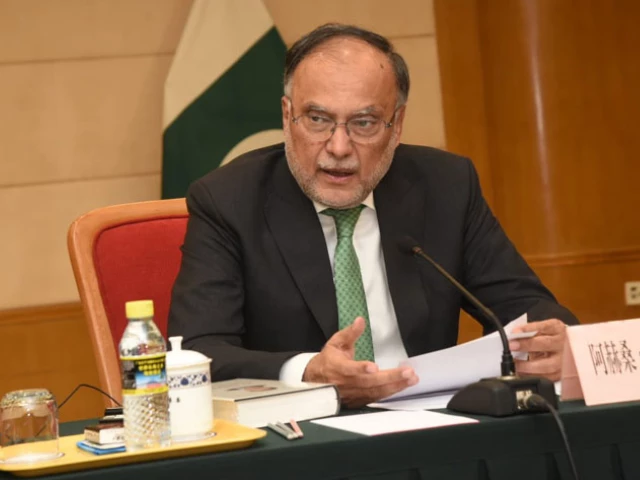
As the maiden meeting of the National Finance Commission is set to focus on the performance of the provinces, especially Khyber-Pakhtunkhwa, Planning Minister Ahsan Iqbal has proposed several options for redistributing resources that would benefit the Center and smaller federating units.
Despite giving more weight to the variables that strengthen the fiscal position of the smaller provinces, the share of KP will increase from 1% to 3% in the range of 15.7% to 17.1%, the details of the proposals submitted to Prime Minister Shehbaz Sharif showed.
The KP government claims its share will increase by 6% to nearly 20% after the merger of erstwhile tribal districts.
According to these options, the federal government should cut 4.7% to 6% of the undistributed divisible pool in advance due to various expenses and then distribute the 57.5% of the remaining taxes among the provinces.
To increase the flow of resources to smaller provinces, the minister has proposed to reduce the share of the population from 82% up to 60% and increase the share of revenue collection to 20% to force them to generate their own resources.
The federal government has called the maiden meeting of the NFC today (Thursday), which will be chaired by Finance Minister Muhammad Aurangzeb. This meeting will form the basis for devising a new formula for the distribution of fiscal resources between the Center and the federating units.
But the focus will be on Chief Minister Khyber Pakhtunkhwa Sohail Afridi, who is also the province’s finance minister. The federal government wants to hold the KP government accountable for its failure to effectively utilize fiscal resources.
Besides its 14.62% share in NFC, the KP government also receives 1% of the divisible pool as compensation for the losses due to war on terror. According to some estimates, the total additional resources transferred to the province was Rs 700 billion since 2010.
But despite the extra support, promised improvements in public safety, policing and post-conflict recovery remain largely unrealized, according to federal authorities. There have been calls for a comprehensive public audit to show exactly how those funds were spent, as the provincial government claims it has not been adequately compensated for the price it pays as a frontline state.
According to the federal authorities, the KP government also enjoyed benefits of direct transfers, oil and gas royalties, hydel profit allocations and rehabilitation grants for merged areas.
Poor contribution from the provinces
The federal government sources said that during the background discussions, the provinces showed some willingness to share the federal expenses, but they were not ready to take a direct hit on their revenue shares.
“While the NFC Award envisioned shared responsibility for revenue generation, provincial revenues have also not expanded in line with the NFC Award’s goals,” according to the Planning Ministry’s report.
There is a massive and guaranteed inflow of financial resources from the federal pool to provincial governments, but they have shown little effort in mobilizing their own revenue.
Provincial tax and non-tax revenues as measured by the size of the economy remained at only 1.1%, which is insignificant compared to their potential. This has created a culture of dependency, leaving provincial finances vulnerable to federal revenue shocks and highlighting the need to modernize their tax generation mechanism.
Federal Purse
Against this background, the Ministry of Planning has proposed changes in the vertical distribution of resources between the center and the provinces and the horizontal distribution between the four provinces.
Under the first vertical option, the Ministry of Planning has proposed that the federal government must deduct 4.7% in advance from the undistributed pool due to war on terror, water security, civilian armed forces expenditure and shares of special areas and federal territory.
It has proposed the second vertical option with upfront deduction of 6% on account of expenditure under the Benazir Income Support Program and the Higher Education Commission, according to the proposals submitted to the Prime Minister.
If the federal government keeps 4.7% of the undistributed pool, it will ease the federal fiscal space a bit. However, in the case of a 6% deduction, federal resources in 2030 would be 12% higher than under the baseline scenario under the 7th NFC award.
Division between provinces
Under the current NFC Award, population dominates with 82% weight percentage, but poverty, income generation and inverse population density have only marginal importance. The Ministry of Planning has proposed some major changes in the formula which would reduce Punjab’s share by around 10% and Sindh’s share would also reduce by half a percentage.
However, KP’s share will increase in the range of 1% to 2.6% and Balochistan’s share may go up to 3%. Islamabad Capital Territory can get up to 5% share for the first time.
According to the first option, the weight for population can be reduced to 78% with modest increases for other factors such as inverse population density, fertility and forest cover. Under the second option, the distribution becomes more balanced as the population weight drops to 68%, while 10% weight is assigned to income generation, 2% to reverse fertility and 2% to forest cover.
According to the third option, the distribution will even change as the population weight drops to 60%, while 20% weight is assigned to income generation, 5% reverse fertility and 5% forest cover. This move to a further broader approach reflects the intention to recognize fiscal efforts, social outcomes and ecological contributions together with the population.
The Ministry of Planning stated that a strategic recalibration of the NFC price was a political necessity rather than a choice. The added defense, debt service, subsidies, and strategic national investments such as water security, energy transition, and climate resilience are inherently federal responsibilities that require sustained and predictable fiscal capacity at the center.
The ministry has also proposed that the federation must maintain the ability to respond to major national shocks, be they natural disasters, global commodity cycles or external security challenges.
Without sufficient fiscal space, the state’s capacity to maintain stability and unity is at risk, with consequences affecting all federating units equally, it added.


