
A flurry of engagements suggests Pakistan may be trying to ease tensions between the two key Gulf allies
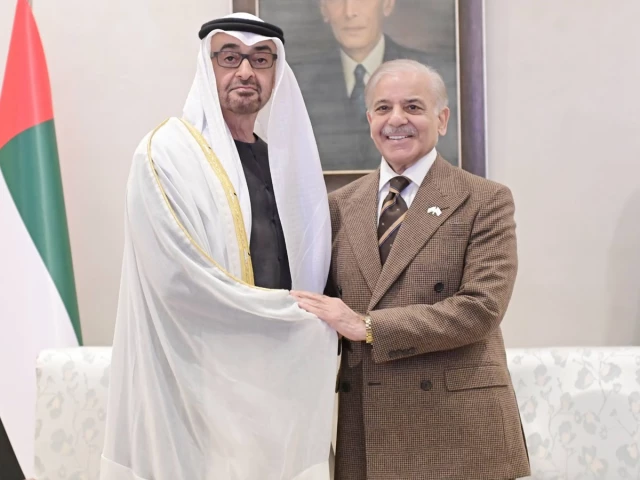
Prime Minister Shehbaz Sharif meets UAE President Sheikh Mohamed bin Zayed Al Nahyan during the latter’s visit to Pakistan last week Photo: X/ File
Prime Minister Shehbaz Sharif traveled to Rahim Yar Khan on Tuesday and held a meeting with the UAE president at Sheikh Zayed Palace, in a development that appears to be linked to ongoing tensions between Riyadh and Abu Dhabi over Yemen.
Sheikh Mohamed bin Zayed Al Nahyan already last Friday had a bilateral meeting with the Prime Minister in Islamabad on his first official visit to Pakistan as President. A statement issued by the prime minister’s office did not explain the reason for a second meeting within days, but observers believe it could possibly be prompted by the ongoing tensions between Saudi and the UAE.
Significantly, the meeting took place hours after the Saudi foreign minister spoke with Deputy Prime Minister and Foreign Minister Ishaq Dar. The flurry of engagements suggests Pakistan may be trying to ease tensions between the two key Gulf allies.
Also read: Dar discusses ‘regional situation’ with Saudi FM amid rising Gulf tensions
In Yemen, the long-standing Gulf cooperation has broken into an acute diplomatic crisis that risks derailing the unity of the Arab Coalition.
Saudi Arabia launched airstrikes on Yemen’s port city of Mukalla, targeting what it said were ships and military hardware from the UAE bound for the UAE-backed Southern Transitional Council (STC), a powerful separatist faction in southern Yemen. Riyadh labeled the shipments a “dangerous” threat to the country’s national security and warned Abu Dhabi of further measures.
The strikes, which Saudi state media said caused no confirmed casualties, were ordered after two vessels unloaded weapons and combat vehicles at Mukalla without coalition permission. Riyadh said its tracking systems were disabled, a claim the United Arab Emirates strongly denied, saying the shipment did not contain weapons and was intended for its own forces – and that the targeting came as a surprise despite prior coordination.
Yemeni authorities backed by Riyadh reacted strongly. Yemen’s Presidential Leadership Council declared a state of emergency, canceled a defense pact with the United Arab Emirates and gave Emirati forces 24 hours to withdraw. A 72-hour blockade was imposed on ports and border crossings in territory under their control.
Against this background, the meeting between the Prime Minister and the President of the United Arab Emirates and the telephone conversation between the Foreign Ministers of Pakistan and Saudi Arabia were significant.
Read more: Saudi Arabia calls national security a red line, calls on UAE to leave Yemen
Pakistan has close strategic and economic ties with Saudi Arabia and the UAE and therefore does not want any further escalation between the two Gulf countries. According to the official handout, Shehbaz, accompanied by DPM Dar, Information Minister Ata Tarar and senior officials, reiterated Islamabad’s commitment to deepen strategic and economic cooperation between Pakistan and the UAE.
It said the talks built on discussions in Islamabad last week during the UAE president’s first official visit to Pakistan. Prime Minister Shehbaz emphasized increasing bilateral trade and expanding cooperation across the IT, energy, mining and defense sectors, while praising the UAE’s role in hosting over 2.1 million Pakistani expatriates, cementing people-to-people ties.
Meanwhile, a separate statement from the Foreign Ministry said Dar called Saudi Foreign Minister Prince Faisal bin Farhan.
“Both leaders exchanged views on the current regional situation and recent developments. DPM/FM conveyed Season’s greetings and best wishes for the New Year, which were warmly reciprocated by Prince Faisal. DPM/FM expressed satisfaction with the positive trajectory of bilateral relations. Prince Faisal reaffirmed his commitment to further strengthen and strengthen bilateral relations.”


